Punti salienti
- 1100 è una lega di alluminio commercialmente puro con eccellente formabilità, resistenza alla corrosione ed elevata conducibilità termica.
- Offre una saldabilità eccezionale, ma non è trattabile termicamente per ottenere maggiore resistenza.
- Il suo basso tasso di incrudimento è adatto ad applicazioni che richiedono formatura profonda e complessa.
- Gli usi comuni includono la lavorazione chimica e alimentare, l'imballaggio e le finiture decorative.
- La sua resistenza alla corrosione lo rende una scelta ideale per scambiatori di calore e superfici riflettenti.

Introduzione
Lega di alluminio 1100 È un grado di alluminio commercialmente puro ampiamente utilizzato, apprezzato per la sua formabilità e resistenza alla corrosione. Questa guida ne copre la composizione, le proprietà meccaniche e fisiche e le applicazioni tipiche, con specifiche pratiche a supporto della selezione dei materiali. Dagli scambiatori di calore ai componenti imbutiti, le sezioni seguenti spiegano cosa rende il 1100 una scelta versatile in diversi settori industriali.
Che cos'è l'alluminio 1100?
L'alluminio 1100 è una lega di alluminio commercialmente puro con eccellente formabilità e resistenza alla corrosione. È comunemente utilizzato nella lavorazione chimica e alimentare e in applicazioni dove la duttilità è più importante della resistenza. Essendo duttile e saldabile, è presente in scambiatori di calore, utensili da cucina e riflettori.

Composizione elementare della lega 1100
La lega 1100 è composta da almeno il 99,0% di alluminio, il che le conferisce il carattere leggero e resistente alla corrosione tipico dell'alluminio puro. Ferro e silicio in tracce sono presenti dalla produzione, mentre un piccolo contenuto di rame aggiunge un modesto beneficio in termini di resistenza.
Questa composizione produce una lega che si lavora in modo accettabile, salda bene e resiste alla corrosione, rendendola una scelta comune in vari settori industriali.
Proprietà fisiche e meccaniche chiave della lega di alluminio 1100
| Proprietà | Valore | Cosa significa |
|---|---|---|
| Densità | 2,71 g/cm³ | Peso ridotto; facile da maneggiare e trasportare. |
| Punto di fusione | ~643–657°C (1.190–1.215°F) | Rimane solido attraverso le normali temperature di lavorazione. |
| Resistenza alla trazione | ~90–120 MPa (ricotto) | Bassa resistenza; non adatto a carichi strutturali. |
| Conduttività termica | 218–225 W/m·K | Dissipazione efficiente del calore per scambiatori e alette. |
| Conducibilità elettrica | 59–62% IACS | Buon conduttore per barre collettrici e cablaggi. |
| Resistenza alla corrosione | Eccellente | Adatto per ambienti esterni e umidi. |
| Duttilità | Molto elevata | Si forma e si imbutisce facilmente senza cricche. |
Il 1100 combina proprietà fisiche e meccaniche utili per lavori non strutturali. La sua conducibilità elettrica raggiunge il 59–62% IACS, circa il 60% della conducibilità del rame, il che lo rende una scelta pratica per applicazioni elettriche dove peso e costo sono rilevanti.
Meccanicamente, il 1100 non è una lega ad alta resistenza, ma la sua duttilità e malleabilità lo distinguono. Si forma facilmente sia a freddo che a caldo e supporta formatura complessa senza perdere integrità.
La sua resistenza intrinseca alla corrosione ne rafforza l'attrattiva dove i componenti sono esposti a condizioni difficili o umide. Questa combinazione di proprietà rende il 1100 adatto a un'ampia gamma di usi industriali e commerciali.
Applicazioni della lega 1100 in vari settori industriali
Il 1100 è leggero e morbido, con buona formabilità, resistenza alla corrosione e conducibilità termica ed elettrica. Serve i seguenti settori:

- Industria elettrica
- Utilizzato per fili e conduttori grazie alla sua buona conducibilità (59–62% IACS). È più leggero ed economico del rame, quindi è comune nelle linee e nei cavi elettrici.
- Imballaggio
- Adatto a fioretto come pellicole alimentari e coperchi per contenitori. Si forma facilmente, resiste alla corrosione e sigilla ermeticamente senza aggiungere peso.
- Costruzione
- Utilizzato in finiture decorative, lampeggiante, e pannelli luminosi. Resistente agli agenti atmosferici e si adatta facilmente alle esigenze edilizie.
- Trasferimento di calore
- Presente in scambiatori di calore e alette del radiatore perché trasferisce il calore rapidamente (218–225 W/m·K). È una scelta standard per i sistemi di raffreddamento in veicoli e condizionatori d'aria.
Confronto tra la lega 1100 e altre leghe di alluminio
Comprendere come il 1100 si confronta con altri gradi aiuta a selezionare il materiale giusto. I confronti seguenti evidenziano dove il 1100 eccelle e dove un'altra lega potrebbe essere più adatta.
1100 vs. 1050 Lega di alluminio

| Caratteristica | Lega di alluminio 1100 | Lega di alluminio 1050 |
|---|---|---|
| Trucco principale | 99% Alluminio + piccolo contenuto di rame | 99,5% Alluminio (più puro) |
| La forza | ~90–120 MPa | ~75–110 MPa |
| Resistenza alla corrosione | Eccellente | Eccellente |
| Conducibilità elettrica | 59–62% IACS | 61–63% IACS |
| Lavorabilità | Facile da piegare e modellare | Facile da piegare e modellare |
| Uso tipico | Filo, lamina, componenti leggeri | Padelle di cottura, riflettori |
1100 e Alluminio 1050 sono entrambi gradi di alluminio quasi puro con eccellente formabilità. Il 1100 contiene un piccolo contenuto di rame che conferisce una resistenza leggermente superiore (90–120 MPa vs 75–110 MPa), mentre il 1050 è più puro (99,5%) e leggermente più conduttivo (61–63% IACS vs 59–62% IACS). Entrambi resistono bene alla corrosione. Scegliere il 1100 per filo o lamina dove un po' più di resistenza è utile; scegliere il 1050 per pentole e riflettori dove purezza e conducibilità contano.
1100 vs. 3003 Lega di alluminio

| Caratteristica | Lega di alluminio 1100 | Lega di alluminio 3003 |
|---|---|---|
| Trucco principale | 99% Alluminio + piccolo contenuto di rame | Al + 1% Manganese |
| La forza | ~90–120 MPa | ~110–145 MPa |
| Resistenza alla corrosione | Eccellente | Molto buono |
| Conducibilità elettrica | 59–62% IACS | 40–50% IACS |
| Lavorabilità | Facile da piegare, molto formabile | Facile da piegare, un po' più rigido |
| Uso tipico | Filo, lamina, componenti leggeri | Pentole, serbatoi, rivestimenti |
1100 e Alluminio 3003 sono entrambi leggeri e resistenti alla corrosione. Il 1100 è più puro (99%) e più morbido, con resistenza inferiore (90–120 MPa vs 110–145 MPa) rispetto al 3003 contenente manganese. Il 1100 conduce meglio (59–62% vs 40–50% IACS) e si forma più facilmente. Utilizzare il 1100 per parti conduttive e flessibili come filo e lamina; utilizzare il 3003 per pentole, serbatoi e rivestimenti dove è necessaria maggiore resistenza.
1100 vs. 5052 Lega di alluminio

| Caratteristica | Lega di alluminio 1100 | Lega di alluminio 5052 |
|---|---|---|
| Trucco principale | 99% Alluminio + piccolo contenuto di rame | Al + 2,5% Magnesio |
| La forza | ~90–120 MPa | ~190–260 MPa |
| Resistenza alla corrosione | Eccellente | Eccellente (buona in acqua salata) |
| Conducibilità elettrica | 59–62% IACS | 30–35% IACS |
| Lavorabilità | Molto facile da piegare e modellare | Buono, ma più rigido del 1100 |
| Uso tipico | Filo, lamina, componenti leggeri | Scafi di barche, pannelli, parti più robuste |
1100 e Alluminio 5052 servono esigenze diverse. Il 1100 è morbido e leggero (90–120 MPa) e altamente formabile, con buona conducibilità (59–62% IACS). Il 5052, con magnesio, è molto più resistente (190–260 MPa) e performa bene in acqua salata, quindi è comune in applicazioni marine e per pannelli. Il 1100 si piega più facilmente; il 5052 è più rigido ma più tenace. Scegliere il 1100 per componenti elettrici leggeri e flessibili; scegliere il 5052 per componenti più resistenti e per impieghi gravosi.
Quando scegliere una lega di alluminio 1100: Lista di controllo rapida
| Fattore | Perché è importante | Scegliere il 1100 Se… |
|---|---|---|
| Esigenze di forza | La bassa resistenza limita l'uso portante. | È necessaria solo una resistenza leggera (~90–120 MPa). |
| Lavorabilità | Eccellente formabilità a freddo. | Si desidera formare forme complesse. |
| Resistenza alla corrosione | Performa bene in ambienti umidi o esterni. | Il componente è esposto a condizioni atmosferiche o umidità. |
| Conducibilità elettrica | Buona capacità di conduzione di corrente. | È necessario filo o conduttori (59–62% IACS). |
| Trasferimento di calore | Conduzione termica efficiente. | Sono necessari dissipatori di calore o radiatori. |
| Costo | Costo inferiore rispetto alle leghe più resistenti. | Si desidera controllare il costo del materiale. |
| Peso | Bassa densità, 2,71 g/cm³. | Il peso ridotto è una priorità. |
Testa a testa: Se il progetto richiede elevata resistenza o tenacità, come componenti strutturali o per impieghi gravosi, evitare il 1100 e considerare leghe come 5052 o 6061.
Conclusione
La lega 1100 è una scelta eccellente per formabilità, resistenza alla corrosione e conducibilità, ma la sua bassa resistenza (circa 90–120 MPa) significa che non può sostituire leghe strutturali come 5052 o 6061 dove la prestazione portante è importante. Per gli acquirenti che necessitano di 1100 in forme, tempere e volumi specifici, Linsy Aluminum è un fornitore pratico.
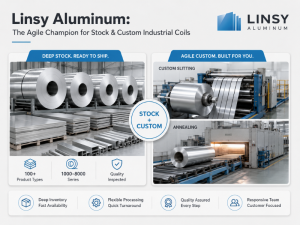
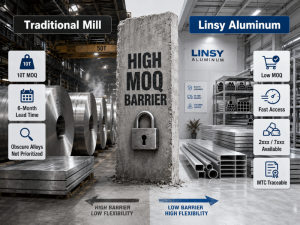
Linsy Aluminum è una fabbrica di alluminio con sede a Shenzhen con oltre 20 anni di esperienza nel settore, che fornisce piastre, lamiere, barre, tubi, fili, bobine, profili e blocchi nelle serie 1000–8000. Il suo modello combina fornitura diretta dalla fabbrica, inventario pronto e produzione personalizzata con MOQ basso, con tempi di consegna di 10–60 giorni. Ogni ordine viene spedito con MTC, i rapporti di test SGS sono disponibili su richiesta e le operazioni sono certificate ISO 9001, ISO 14001 e ISO 45001. Lavorazioni CNC interne, saldatura TIG e MIG, taglio laser e finiture superficiali (anodizzazione, lucidatura, finitura da laminazione, verniciatura a polvere RAL 9016, film in PVC) supportano componenti finiti.
Contattare oggi Linsy Aluminum per discutere i requisiti dell'alluminio 1100 e richiedere un preventivo.
Domande frequenti
Perché la lega 1100 è preferita per le applicazioni dell'industria alimentare?
La resistenza alla corrosione del 1100 aiuta a prevenire la contaminazione e la lega è atossica, il che la rende adatta ad articoli a contatto con alimenti come pentole e imballaggi. La sua formabilità supporta inoltre superfici sottili e facili da pulire.
La lega 1100 può essere utilizzata in ambienti esterni?
Sì. La sua resistenza alla corrosione e durabilità lo rendono adatto all'uso esterno e resiste alle normali condizioni atmosferiche, rendendolo affidabile per componenti esterni e finiture.
Qual è la conducibilità della Lega 1100 rispetto ad altre leghe?
La lega 1100 presenta un'elevata conducibilità elettrica e termica. La sua conducibilità elettrica è pari al 59–62% IACS (circa il 60% di quella del rame), mentre la sua conducibilità termica di 218–225 W/m·K supera quella di molte altre leghe di alluminio, rendendola una scelta economicamente vantaggiosa per un trasferimento energetico efficiente.
Quali sono le tecniche di saldatura adatte alla Lega 1100?
La lega 1100 offre un'eccellente saldabilità e si unisce facilmente con metodi convenzionali quali TIG (GTAW) e MIG (GMAW). La sua buona lavorabilità e la bassa resistenza meccanica rendono la saldatura semplice, senza necessità di pretrattamenti speciali.
Ci sono limitazioni nell'uso della lega 1100 per le applicazioni marine?
Sebbene la lega 1100 resista bene alla corrosione, la sua minore resistenza a trazione può limitarne l'uso in componenti strutturali marini soggetti a elevate sollecitazioni. Per componenti marini di grandi dimensioni o portanti, è generalmente preferibile una lega più resistente come la 5052.