Aspectos más destacados
- 1100 es una aleación de aluminio comercialmente puro con excelente formabilidad, resistencia a la corrosión y alta conductividad térmica.
- Ofrece una soldabilidad excepcional, pero no es tratable térmicamente para obtener mayor resistencia.
- Su baja tasa de endurecimiento por deformación la hace adecuada para aplicaciones que requieren conformado profundo e intrincado.
- Los usos comunes incluyen procesamiento químico y de alimentos, empaques y molduras decorativas.
- Su resistencia a la corrosión la convierte en una opción sólida para intercambiadores de calor y superficies reflectantes.

Introducción
Aleación de aluminio 1100 Es un grado de aluminio comercialmente puro ampliamente utilizado, valorado por su formabilidad y resistencia a la corrosión. Esta guía cubre su composición, propiedades mecánicas y físicas, y aplicaciones típicas, con especificaciones prácticas para respaldar la selección de materiales. Desde intercambiadores de calor hasta piezas embutidas profundamente, las secciones siguientes explican qué hace de la 1100 una opción versátil en diversas industrias.
¿Qué es el aluminio 1100?
El aluminio 1100 es una aleación de aluminio comercialmente puro con excelente formabilidad y resistencia a la corrosión. Se utiliza comúnmente en procesamiento químico y de alimentos, y en aplicaciones donde la ductilidad importa más que la resistencia. Al ser dúctil y soldable, aparece en intercambiadores de calor, utensilios de cocina y reflectores.

Composición elemental de la aleación 1100
La aleación 1100 es al menos 99.0% aluminio, lo que le confiere el carácter ligero y resistente a la corrosión típico del aluminio puro. Trazas de hierro y silicio están presentes por el proceso de producción, mientras que un pequeño contenido de cobre añade un beneficio moderado de resistencia.
Esta composición produce una aleación que se maquina aceptablemente, suelda bien y resiste la corrosión, lo que la convierte en una opción común en sectores industriales.
Propiedades físicas y mecánicas clave de la aleación de aluminio 1100
| Propiedad | Valor | Qué significa |
|---|---|---|
| Densidad | 2.71 g/cm³ | Bajo peso; fácil de manejar y transportar. |
| Punto de fusión | ~643–657°C (1,190–1,215°F) | Permanece sólida a través de temperaturas de procesamiento normales. |
| Resistencia a la tracción | ~90–120 MPa (recocida) | Baja resistencia; no apta para cargas estructurales. |
| Conductividad térmica | 218–225 W/m·K | Disipación eficiente del calor para intercambiadores y aletas. |
| Conductividad eléctrica | 59–62% IACS | Buen conductor para barras colectoras y cableado. |
| Resistencia a la corrosión | Excelente | Adecuada para entornos exteriores y húmedos. |
| Ductilidad | Muy alta | Se forma y embute fácilmente sin agrietarse. |
La 1100 combina propiedades físicas y mecánicas útiles para trabajos no estructurales. Su conductividad eléctrica alcanza 59–62% IACS, aproximadamente 60% de la conductividad del cobre, lo que la convierte en una opción práctica para aplicaciones eléctricas donde el peso y el costo importan.
Mecánicamente, la 1100 no es una aleación de alta resistencia, pero su ductilidad y maleabilidad la distinguen. Se forma fácilmente tanto en condiciones de frío como de calor y soporta conformado intrincado sin perder integridad.
Su resistencia inherente a la corrosión refuerza su atractivo donde las piezas enfrentan condiciones adversas o húmedas. Esta combinación de propiedades hace que la 1100 sea adecuada para una amplia gama de usos industriales y comerciales.
Aplicaciones de la aleación 1100 en diversas industrias
La 1100 es ligera y blanda, con buena formabilidad, resistencia a la corrosión y conductividad térmica y eléctrica. Sirve a los siguientes sectores:

- Industria eléctrica
- Utilizado para cables y conductores debido a su buena conductividad (59–62% IACS). Es más ligera y económica que el cobre, por lo que es común en líneas eléctricas y cables.
- Embalaje
- Adecuada para lámina como envolturas de alimentos y tapas de contenedores. Se forma fácilmente, resiste la corrosión y sella herméticamente sin añadir peso.
- Construcción
- Utilizado en molduras decorativas, intermitentey paneles luminosos. Resiste bien la intemperie y se adapta a las necesidades de construcción con poco esfuerzo.
- Transferencia de calor
- Se encuentra en intercambiadores de calor y aletas del radiador porque transfiere calor rápidamente (218–225 W/m·K). Es una opción estándar para sistemas de refrigeración en vehículos y aires acondicionados.
Comparación de la aleación 1100 con otras aleaciones de aluminio
Comprender cómo se compara la 1100 con otros grados ayuda a seleccionar el material adecuado. Las comparaciones siguientes destacan dónde sobresale la 1100 y dónde otra aleación puede ser más adecuada.
Aleación de aluminio 1100 frente a 1050

| Característica | Aleación de aluminio 1100 | Aleación de aluminio 1050 |
|---|---|---|
| Maquillaje principal | 99% Aluminio + pequeño contenido de cobre | 99,5% Aluminio (más puro) |
| Fuerza | ~90–120 MPa | ~75–110 MPa |
| Resistencia a la corrosión | Excelente | Excelente |
| Conductividad eléctrica | 59–62% IACS | 61–63% IACS |
| Trabajabilidad | Fácil de doblar y conformar | Fácil de doblar y conformar |
| Uso típico | Alambre, lámina, piezas ligeras | Sartenes, reflectores |
1100 y 1050 Aluminio son ambos grados de aluminio casi puro con excelente formabilidad. La 1100 contiene un pequeño contenido de cobre que le otorga una resistencia ligeramente mayor (90–120 MPa vs 75–110 MPa), mientras que la 1050 es más pura (99.5%) y marginalmente más conductiva (61–63% IACS vs 59–62%). Ambas resisten bien la corrosión. Elija 1100 para alambre o lámina donde un poco más de resistencia ayuda; elija 1050 para sartenes y reflectores donde la pureza y la conductividad importan.
Aleación de aluminio 1100 frente a 3003

| Característica | Aleación de aluminio 1100 | Aleación de aluminio 3003 |
|---|---|---|
| Maquillaje principal | 99% Aluminio + pequeño contenido de cobre | Al + 1% Manganeso |
| Fuerza | ~90–120 MPa | ~110–145 MPa |
| Resistencia a la corrosión | Excelente | Muy buena |
| Conductividad eléctrica | 59–62% IACS | 40–50% IACS |
| Trabajabilidad | Fácil de doblar, muy formable | Fácil de doblar, un poco más rígido |
| Uso típico | Alambre, lámina, piezas ligeras | Utensilios de cocina, tanques, revestimientos |
1100 y Aluminio 3003 son ambas ligeras y resistentes a la corrosión. La 1100 es más pura (99%) y más blanda, con menor resistencia (90–120 MPa vs 110–145 MPa) que la 3003 con manganeso. La 1100 conduce mejor (59–62% vs 40–50% IACS) y se forma más fácilmente. Use 1100 para piezas conductivas y flexibles como alambre y lámina; use 3003 para utensilios de cocina, tanques y revestimientos donde se necesita más resistencia.
Aleación de aluminio 1100 vs. 5052

| Característica | Aleación de aluminio 1100 | Aleación de aluminio 5052 |
|---|---|---|
| Maquillaje principal | 99% Aluminio + pequeño contenido de cobre | Al + 2,5% Magnesio |
| Fuerza | ~90–120 MPa | ~190–260 MPa |
| Resistencia a la corrosión | Excelente | Excelente (buena en agua salada) |
| Conductividad eléctrica | 59–62% IACS | 30–35% IACS |
| Trabajabilidad | Muy fácil de doblar y conformar | Bueno, pero más rígido que el 1100 |
| Uso típico | Alambre, lámina, piezas ligeras | Cascos de embarcaciones, paneles, piezas más resistentes |
1100 y Aluminio 5052 satisfacen diferentes necesidades. La 1100 es blanda y ligera (90–120 MPa) y altamente formable, con buena conductividad (59–62% IACS). La 5052, con magnesio, es mucho más resistente (190–260 MPa) y se desempeña bien en agua salada, por lo que es común en trabajos marinos y de paneles. La 1100 se dobla más fácilmente; la 5052 es más rígida pero más resistente. Elija 1100 para piezas ligeras, flexibles y eléctricas; elija 5052 para componentes más resistentes y de servicio pesado.
Cuándo elegir una aleación de aluminio 1100: Lista de comprobación rápida
| Factor | Por qué es importante | Elija 1100 Si… |
|---|---|---|
| Necesidades de fuerza | La baja resistencia limita el uso bajo carga. | Solo necesita resistencia ligera (~90–120 MPa). |
| Trabajabilidad | Excelente formabilidad en frío. | Desea formar formas complejas. |
| Resistencia a la corrosión | Se desempeña bien en uso húmedo o exterior. | La pieza está expuesta a la intemperie o la humedad. |
| Conductividad eléctrica | Buena capacidad de conducción de corriente. | Necesita alambre o conductores (59–62% IACS). |
| Transferencia de calor | Conducción térmica eficiente. | Necesita disipadores de calor o radiadores. |
| Coste | Menor costo que aleaciones más resistentes. | Desea controlar el costo del material. |
| Peso | Baja densidad, 2.71 g/cm³. | El bajo peso es una prioridad. |
De cabeza: Si su proyecto requiere alta resistencia o tenacidad, como piezas estructurales o de servicio pesado, omita la 1100 y considere aleaciones como 5052 o 6061.
Conclusión
La aleación 1100 es una excelente opción para conformado, resistencia a la corrosión y conductividad, pero su baja resistencia (aproximadamente 90–120 MPa) significa que no puede reemplazar aleaciones estructurales como 5052 o 6061 donde el rendimiento bajo carga importa. Para compradores que necesitan 1100 en formas, temple y volúmenes específicos, Linsy Aluminum es un proveedor práctico.
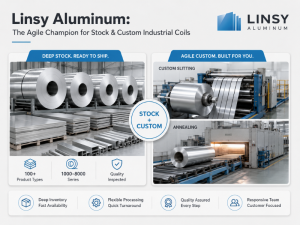
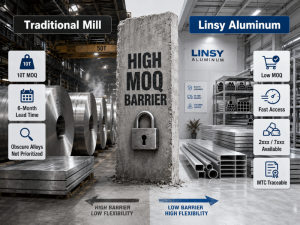
Linsy Aluminum es una fábrica de aluminio con sede en Shenzhen con más de 20 años de experiencia en la industria, que suministra placa, lámina, barra, tubo, alambre, bobina, perfil y bloque en las series 1000–8000. Su modelo combina suministro directo de fábrica, inventario listo y producción personalizada con MOQ bajo, con plazos de entrega de 10–60 días. Cada pedido se envía con un MTC, los informes de prueba SGS están disponibles bajo solicitud, y las operaciones cuentan con ISO 9001, ISO 14001 e ISO 45001. Mecanizado CNC interno, soldadura TIG y MIG, corte láser y acabado de superficies (anodizado, pulido, acabado de molino, recubrimiento en polvo RAL 9016, película PVC) respaldan piezas terminadas.
Contacte a Linsy Aluminum hoy para discutir sus requisitos de aluminio 1100 y solicitar una cotización.
Preguntas frecuentes
¿Por qué se prefiere la aleación 1100 para aplicaciones de la industria alimentaria?
La resistencia a la corrosión de la 1100 ayuda a prevenir la contaminación, y la aleación es no tóxica, lo que la hace adecuada para artículos en contacto con alimentos como utensilios de cocina y empaques. Su formabilidad también soporta superficies delgadas y fáciles de limpiar.
¿Puede utilizarse la aleación 1100 en exteriores?
Sí. Su resistencia a la corrosión y durabilidad la hacen adecuada para uso exterior, y soporta condiciones climáticas normales, lo que la hace confiable para componentes externos y molduras.
¿Cómo es la conductividad de la aleación 1100 en comparación con otras aleaciones?
El 1100 tiene alta conductividad eléctrica y térmica. Su conductividad eléctrica es de 59–62% IACS (aproximadamente el 60% de la del cobre), mientras que su conductividad térmica de 218–225 W/m·K supera a la de muchas otras aleaciones de aluminio, lo que lo convierte en una opción rentable para la transferencia eficiente de energía.
¿Cuáles son las técnicas de soldadura adecuadas para la aleación 1100?
El 1100 presenta excelente soldabilidad y se une fácilmente con métodos convencionales como TIG (GTAW) y MIG (GMAW). Su buena trabajabilidad y baja resistencia facilitan la soldadura sin necesidad de un pretratamiento especial.
¿Existen limitaciones en el uso de la aleación 1100 para aplicaciones marinas?
Aunque el 1100 resiste bien la corrosión, su menor resistencia a la tracción puede limitar su uso en piezas marinas estructurales sometidas a altas tensiones. Para componentes marinos de mayor tamaño o que soporten cargas, suele ser mejor un grado más resistente como el 5052.