Principais destaques
- 1100 é uma liga de alumínio comercialmente puro com excelente conformabilidade, resistência à corrosão e alta condutividade térmica.
- Oferece excelente soldabilidade, mas não é tratável termicamente para obter maior resistência.
- Sua baixa taxa de encruamento é adequada para aplicações que exigem conformação profunda e intrincada.
- Usos comuns incluem processamento químico e de alimentos, embalagens e acabamentos decorativos.
- Sua resistência à corrosão a torna uma escolha forte para trocadores de calor e superfícies refletivas.

Introdução
Liga de alumínio 1100 É um grau de alumínio comercialmente puro amplamente utilizado, valorizado por sua conformabilidade e resistência à corrosão. Este guia aborda sua composição, propriedades mecânicas e físicas e aplicações típicas, com especificações práticas para apoiar a seleção de materiais. De trocadores de calor a peças estampadas profundamente, as seções abaixo explicam o que torna a liga 1100 uma escolha versátil em diversos setores.
O que é o alumínio 1100?
O alumínio 1100 é uma liga de alumínio comercialmente puro com excelente conformabilidade e resistência à corrosão. É comumente utilizado em processamento químico e de alimentos e em aplicações onde a ductilidade importa mais do que a resistência. Sendo dúctil e soldável, aparece em trocadores de calor, utensílios de cozinha e refletores.

A composição elementar da liga 1100
A liga 1100 é composta por pelo menos 99,0% de alumínio, o que lhe confere o caráter leve e resistente à corrosão típico do alumínio puro. Traços de ferro e silício estão presentes na produção, enquanto um pequeno teor de cobre adiciona um benefício moderado de resistência.
Essa composição resulta em uma liga que usina de forma aceitável, solda bem e resiste à corrosão, tornando-a uma escolha comum em setores industriais.
Principais propriedades físicas e mecânicas da liga de alumínio 1100
| Propriedade | Valor | O que isso significa |
|---|---|---|
| Densidade | 2,71 g/cm³ | Baixo peso; fácil de manusear e transportar. |
| Ponto de fusão | ~643–657°C (1.190–1.215°F) | Permanece sólida em temperaturas normais de processamento. |
| Resistência à tração | ~90–120 MPa (recozida) | Baixa resistência; não indicada para cargas estruturais. |
| Condutividade térmica | 218–225 W/m·K | Dissipação eficiente de calor para trocadores e aletas. |
| Condutividade elétrica | 59–62% IACS | Boa condutora para barramentos e fiação. |
| Resistência à corrosão | Excelente | Adequada para ambientes externos e úmidos. |
| Ductilidade | Muito alta | Conforma-se e estampa-se facilmente sem trincar. |
A liga 1100 combina propriedades físicas e mecânicas úteis para trabalhos não estruturais. Sua condutividade elétrica atinge 59–62% IACS, aproximadamente 60% da condutividade do cobre, o que a torna uma escolha prática para aplicações elétricas onde peso e custo importam.
Mecanicamente, a liga 1100 não é uma liga de alta resistência, mas sua ductilidade e maleabilidade a diferenciam. Ela se conforma facilmente em condições a frio e a quente e suporta modelagem intrincada sem perder integridade.
Sua resistência inerente à corrosão fortalece seu apelo onde as peças enfrentam condições adversas ou úmidas. Essa combinação de propriedades torna a liga 1100 adequada para uma ampla gama de usos industriais e comerciais.
Aplicações da liga 1100 em vários setores
A liga 1100 é leve e macia, com boa conformabilidade, resistência à corrosão e condutividade térmica e elétrica. Ela atende aos seguintes setores:

- Setor elétrico
- Usado para fios e condutores devido à sua boa condutividade (59–62% IACS). É mais leve e mais barata que o cobre, por isso é comum em linhas de transmissão e cabos.
- Embalagem
- Adequada para folha como embalagens de alimentos e tampas de recipientes. Conforma-se facilmente, resiste à corrosão e sela firmemente sem adicionar peso.
- Construção
- Usado em acabamento decorativo, intermitentee painéis de luz. Resiste bem às intempéries e se molda às necessidades da construção com pouco esforço.
- Transferência de calor
- Encontrada em trocadores de calor e aletas do radiador porque transfere calor rapidamente (218–225 W/m·K). É uma escolha padrão para sistemas de refrigeração em veículos e condicionadores de ar.
Comparação da Alloy 1100 com outras ligas de alumínio
Compreender como a liga 1100 se compara a outros graus ajuda a selecionar o material certo. As comparações abaixo destacam onde a 1100 se destaca e onde outra liga pode ser mais adequada.
Liga de alumínio 1100 vs. 1050

| Recurso | Liga de alumínio 1100 | Liga de alumínio 1050 |
|---|---|---|
| Maquiagem principal | 99% Alumínio + pequeno teor de cobre | 99,5% Alumínio (mais puro) |
| Força | ~90–120 MPa | ~75–110 MPa |
| Resistência à corrosão | Excelente | Excelente |
| Condutividade elétrica | 59–62% IACS | 61–63% IACS |
| Capacidade de trabalho | Fácil de dobrar e moldar | Fácil de dobrar e moldar |
| Uso típico | Fio, folha, peças leves | Panelas de cozimento, refletores |
1100 e Alumínio 1050 são ambos graus de alumínio quase puro com excelente conformabilidade. A 1100 contém um pequeno teor de cobre que confere resistência ligeiramente maior (90–120 MPa vs 75–110 MPa), enquanto a 1050 é mais pura (99,5%) e marginalmente mais condutora (61–63% IACS vs 59–62% IACS). Ambas resistem bem à corrosão. Escolha a 1100 para fios ou folhas onde um pouco mais de resistência ajuda; escolha a 1050 para panelas e refletores onde pureza e condutividade importam.
Liga de alumínio 1100 vs. 3003

| Recurso | Liga de alumínio 1100 | Liga de alumínio 3003 |
|---|---|---|
| Maquiagem principal | 99% Alumínio + pequeno teor de cobre | Al + 1% Manganês |
| Força | ~90–120 MPa | ~110–145 MPa |
| Resistência à corrosão | Excelente | Muito bom |
| Condutividade elétrica | 59–62% IACS | 40–50% IACS |
| Capacidade de trabalho | Fácil de dobrar, muito conformável | Fácil de dobrar, um pouco mais rígido |
| Uso típico | Fio, folha, peças leves | Utensílios de cozinha, tanques, revestimento |
1100 e Alumínio 3003 são ambas leves e resistentes à corrosão. A 1100 é mais pura (99%) e mais macia, com menor resistência (90–120 MPa vs 110–145 MPa) do que a 3003, que contém manganês. A 1100 conduz melhor (59–62% vs 40–50% IACS) e se conforma mais facilmente. Use a 1100 para peças condutoras e flexíveis, como fios e folhas; use a 3003 para utensílios de cozinha, tanques e revestimentos onde é necessária maior resistência.
Liga de alumínio 1100 vs. 5052

| Recurso | Liga de alumínio 1100 | Liga de alumínio 5052 |
|---|---|---|
| Maquiagem principal | 99% Alumínio + pequeno teor de cobre | Al + 2,5% Magnésio |
| Força | ~90–120 MPa | ~190–260 MPa |
| Resistência à corrosão | Excelente | Excelente (boa em água salgada) |
| Condutividade elétrica | 59–62% IACS | 30–35% IACS |
| Capacidade de trabalho | Muito fácil de dobrar e moldar | Boa, mas mais rígida do que a 1100 |
| Uso típico | Fio, folha, peças leves | Cascos de barcos, painéis, peças mais resistentes |
1100 e Alumínio 5052 atendem a necessidades diferentes. A 1100 é macia e leve (90–120 MPa) e altamente conformável, com boa condutividade (59–62% IACS). A 5052, com magnésio, é muito mais resistente (190–260 MPa) e apresenta bom desempenho em água salgada, sendo comum em trabalhos marítimos e de painéis. A 1100 dobra mais facilmente; a 5052 é mais rígida, porém mais resistente. Escolha a 1100 para peças elétricas leves e flexíveis; escolha a 5052 para componentes mais fortes e de serviço pesado.
Quando escolher a liga de alumínio 1100: Lista de verificação rápida
| Fator | Por que é importante | Escolha a 1100 Se… |
|---|---|---|
| Necessidades de força | A baixa resistência limita o uso em cargas estruturais. | Você precisa apenas de resistência leve (~90–120 MPa). |
| Capacidade de trabalho | Excelente conformabilidade a frio. | Você deseja formar formas complexas. |
| Resistência à corrosão | Apresenta bom desempenho em uso úmido ou externo. | A peça está exposta ao clima ou à umidade. |
| Condutividade elétrica | Boa capacidade de condução de corrente. | Você precisa de fios ou condutores (59–62% IACS). |
| Transferência de calor | Condução térmica eficiente. | Você precisa de dissipadores de calor ou radiadores. |
| Custo | Custo menor do que ligas mais resistentes. | Você deseja controlar o custo do material. |
| Peso | Baixa densidade, 2,71 g/cm³. | Baixo peso é uma prioridade. |
Heads-Up: Se o seu projeto exige alta resistência ou tenacidade, como peças estruturais ou de serviço pesado, evite a 1100 e considere ligas como 5052 ou 6061.
Conclusão
A liga 1100 é uma excelente escolha para conformação, resistência à corrosão e condutividade, mas sua baixa resistência (cerca de 90–120 MPa) significa que ela não pode substituir ligas estruturais como 5052 ou 6061 onde o desempenho sob carga é relevante. Para compradores que precisam da 1100 em formas, têmperas e volumes específicos, a Linsy Aluminum é um fornecedor prático.
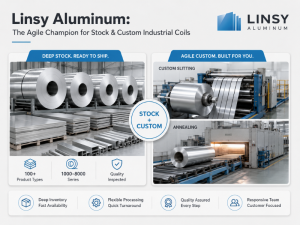
A Linsy Aluminum é uma fábrica de alumínio sediada em Shenzhen com mais de 20 anos de experiência no setor, fornecendo chapas, folhas, barras, tubos, fios, bobinas, perfis e blocos nas séries 1000–8000. Seu modelo combina fornecimento direto de fábrica, estoque pronto e produção personalizada com pedido mínimo baixo, com prazos de entrega de 10 a 60 dias. Cada pedido é enviado com MTC, relatórios de teste SGS disponíveis mediante solicitação, e as operações possuem certificações ISO 9001, ISO 14001 e ISO 45001. Usinagem CNC interna, soldagem TIG e MIG, corte a laser e acabamento de superfície (anodização, polimento, acabamento de fábrica, pintura eletrostática RAL 9016, filme de PVC) suportam peças acabadas.
Entre em contato com a Linsy Aluminum hoje para discutir seus requisitos de alumínio 1100 e solicitar um orçamento.
Perguntas frequentes
Por que a liga 1100 é preferida para aplicações no setor alimentício?
A resistência à corrosão da liga 1100 ajuda a prevenir contaminação, e a liga é atóxica, o que a torna adequada para itens em contato com alimentos, como utensílios de cozinha e embalagens. Sua conformabilidade também suporta superfícies finas e fáceis de limpar.
O Alloy 1100 pode ser usado em ambientes externos?
Sim. Sua resistência à corrosão e durabilidade são adequadas para uso externo, e ela suporta condições climáticas normais, o que a torna confiável para componentes externos e acabamentos.
Como a condutividade da Alloy 1100 se compara à de outras ligas?
A liga 1100 possui alta condutividade elétrica e térmica. Sua condutividade elétrica é de 59–62% IACS (cerca de 60% da do cobre), enquanto sua condutividade térmica de 218–225 W/m·K supera muitas outras ligas de alumínio, tornando-a uma opção econômica para transferência eficiente de energia.
Quais são as técnicas de soldagem adequadas para a Alloy 1100?
A liga 1100 apresenta excelente soldabilidade e une-se facilmente por métodos convencionais, como TIG (GTAW) e MIG (GMAW). Sua boa usinabilidade e baixa resistência mecânica tornam a soldagem simples, sem necessidade de pré-tratamento especial.
Há alguma limitação no uso da Alloy 1100 para aplicações marítimas?
Embora a liga 1100 resista bem à corrosão, sua menor resistência à tração pode limitar seu uso em peças estruturais marinhas sujeitas a altas tensões. Para componentes marítimos maiores ou de suporte de carga, uma liga mais resistente, como a 5052, geralmente é mais adequada.