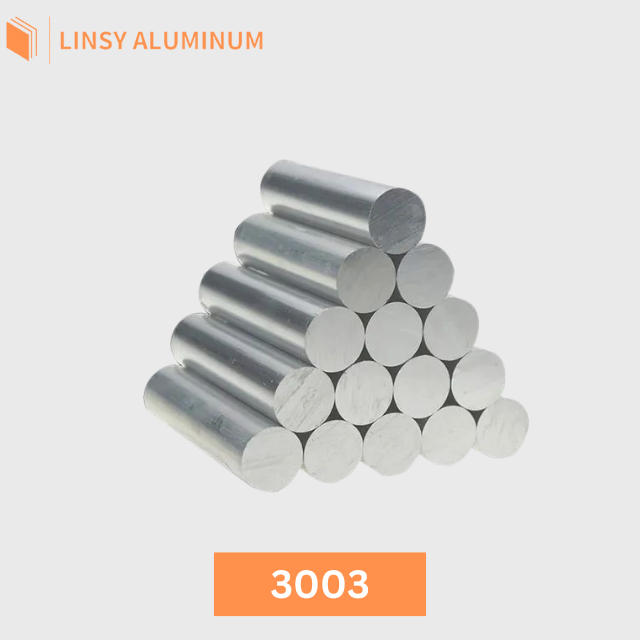


3003 aluminum round bar is a non-heat-treatable Al-Mn bar, the workhorse of the 3xxx family. Manganese raises strength roughly 20% over 1100 while keeping the same excellent workability, which is why it appears in chemical equipment, tanks, heat exchangers and cookware rather than in anything that has to be strong. Strength comes entirely from strain hardening — it softens permanently wherever it is welded.
Diameter: 3–300 mm (by temper)
Length: 1,000–6,000 mm, cut to length
Tempers: O / H14 / H16 / H18 / H22
Standard: ASTM B221
Quality documents: MTC report with every order
3003 aluminum round bar is a non-heat-treatable Al-Mn bar, the workhorse of the 3xxx family and one of the most versatile alloys in general engineering. Manganese raises its strength by roughly 20% over 1100 while keeping the same excellent workability and corrosion resistance, which is why it appears in chemical equipment, tanks, heat exchangers and cookware rather than in anything that has to be strong. It cannot be heat treated, so strength comes entirely from strain hardening — and it softens permanently wherever it is welded. Alloy data: 3003 aluminum alloy.
| Temper | Diameter (mm) | Length (mm) | Standard |
|---|---|---|---|
| O | 3 – 300 | 1,000 – 6,000 | ASTM B221 |
| H14 | 3 – 300 | 1,000 – 6,000 | ASTM B221 |
| H16 | 5 – 200 | 1,000 – 6,000 | ASTM B221 |
| H18 | 5 – 150 | 1,000 – 6,000 | ASTM B221 |
| H22 | 5 – 250 | 1,000 – 6,000 | ASTM B221 |
Supplied to ASTM B221 as standard; EN 755 and GB/T 3190 equivalents are available on request. Commercial tolerances apply to diameter and straightness, with tighter classes quoted where the bar feeds a bar feeder.
The available diameter narrows as the temper hardens: O and H14 run to 300 mm, H18 only to 150 mm. That reflects production, not preference — a fully hard bar in a large diameter is difficult to draw and straighten. Designation: UNS A93003 / EN AW-3003 / AlMn1Cu.
| Temper | Tensile (MPa) | Yield (MPa) | Elongation | Hardness (HB) |
|---|---|---|---|---|
| O | 95 – 130 | ≥ 35 | ≥ 25% | 28 |
| H14 (quarter hard) | 140 – 180 | ≥ 115 | ≥ 5% | 40 |
| H22 | ≥ 185 | ≥ 165 | ≥ 3% | 55 |
Typical values; confirm against the MTC. Density 2.73 g/cm³, elastic modulus 69 GPa. Note the elongation: O is ductile enough for deep drawing, H22 is not formable at all in any meaningful sense — it is a finished-strength condition.
H14 is the general-purpose condition and covers most machined and fabricated parts — about 140–180 MPa with enough ductility to take a bend or a flange. H22 is partially annealed after hardening, so it sits at higher strength than H14 with better ductility than H18, and is often the best compromise where a part is formed lightly and then used.
One structural point that decides a lot of 3003 jobs: it brazes better than it welds. Brazing happens below the melting point of the parent metal, so the bar keeps most of its temper and the joint is made with a 4xxx filler at around 580–600 °C rather than a fusion weld at 660 °C. That is why 3003 is the standard core alloy in brazing sheet for radiators and heat exchangers: the whole assembly can be brazed in one furnace pass.
O is for serious forming: deep drawing, spinning, complex presswork. H16 and H18 are for parts that need maximum strength from this alloy and will not be formed afterwards — and note the diameter limit falls to 200 and 150 mm respectively. Because 3003 cannot be heat treated, there is no route back up after forming or welding; choose the temper after the process route is fixed, not before.
| Alloy / temper | Tensile (MPa) | Yield (MPa) | Corrosion | Where it fits |
|---|---|---|---|---|
| 3003-H14 | 140 – 180 | ≥ 115 | Good | Chemical equipment, tanks, heat exchangers, general fabrication |
| 5052-H32 | 214 – 262 | ≥ 159 | Better in salt water | Marine, fuel lines, higher strength formed parts |
| 1100-O / H14 | 90 – 165 | ≥ 35 – 145 | Excellent | Deep drawing, chemical handling, electrical, lowest strength |
3003 sits between 1100 and 5052: about 20% stronger than 1100 with the same workability, and clearly weaker than 5052 but cheaper and easier to form. Choose 3003 when the part is formed or welded and the load is modest — tanks, ducting, heat-transfer parts. Move to 5052 when salt water or higher stress enters, and to 1100 only when maximum formability or conductivity matters more than strength.
Machining: soft and gummy, similar to 5052. Sharp polished carbide, high rake, firm feed and generous coolant; light cuts smear. Threads form well but strip at lower torque than on a 6xxx, so specify thread engagement accordingly.
Forming and joining: this is where 3003 is at its best. It bends, rolls, spins and draws readily in O, and brazes well — 3003 is one of the standard brazing-sheet alloys, which is why it appears in heat exchangers and radiators. Anodizing works and gives a slightly warmer tone than 6xxx because of the manganese — acceptable for industrial parts, less so where a colour must match a 6xxx assembly. Where 3003 is formed in O and then needs strength, the only route is to form, then strain harden by further cold work if the geometry allows; there is no ageing step to recover hardness after annealing.
Welding: good with 4043 or 1100 filler. The weld and heat-affected zone come back near O condition and cannot be restored by heat treatment — if the welded zone must carry load, either design for the annealed strength or use a heat-treatable alloy instead.
Chemical processing equipment and tanks, heat exchangers and radiators, brazing-sheet assemblies, pressure vessels in non-aggressive service, ducting and ventilation, cooking utensils and food-processing equipment, roofing and siding, fuel tanks, general sheet-metal and light structural fabrication, decorative anodized trim, brazed radiator cores, air-conditioning evaporators, storage tanks for non-aggressive liquids, signage and nameplates, truck and trailer panelling.
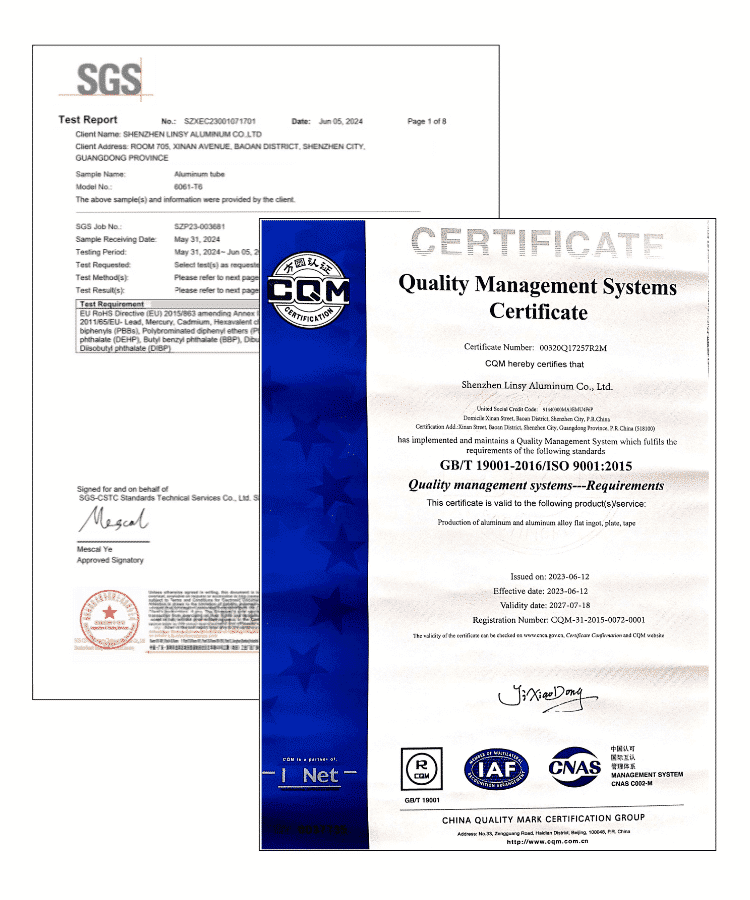
Every order ships with an MTC reporting alloy, temper, chemical composition and mechanical results against ASTM B221. For pressure or chemical service, state the temper and standard on the enquiry so the certificate matches the design calculation. Third-party testing is available on request at additional cost; production runs under ISO 9001, ISO 14001 and ISO 45001 certified systems.
Sales confirm stock or custom lead time for that exact combination.
Shenzhen-based aluminum factory, more than 20 years in the industry, supplying 1000–8000 series alloys in standard specifications and custom sizes.
Q: Can 3003 be heat treated?
A: No. It is non-heat-treatable; strength comes from strain hardening only. Welding or forming softens it permanently, and there is no ageing step to recover the strength.
Q: H14 or O for a part that gets formed?
A: O if the forming is significant — deep drawing, spinning, tight bends. H14 handles light forming but will crack on a tight radius. Decide the forming route before the temper.
Q: Is 3003 good for brazing?
A: Yes — it is one of the standard brazing-sheet alloys and appears widely in heat exchangers and radiators. Its combination of formability, brazeability and modest strength is exactly what that application needs.
Q: Why 3003 instead of 5052?
A: Cost and formability. 3003 is cheaper and easier to form; 5052 is 30–50% stronger and better in salt water. If the part sees seawater or real load, use 5052.
Q: What sizes do you hold?
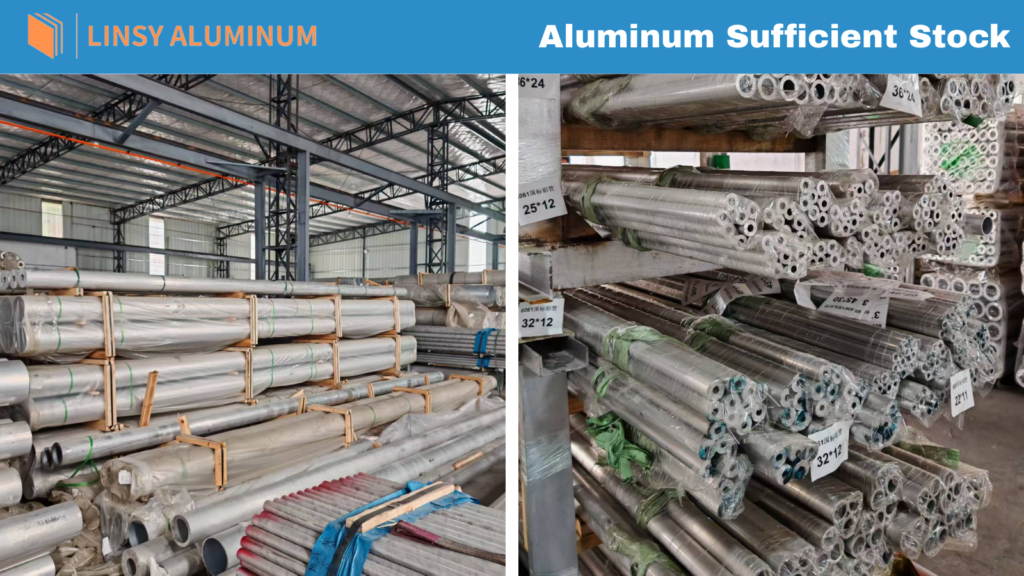
A: 3–300 mm in O and H14, 5–200 mm in H16, 5–150 mm in H18 and 5–250 mm in H22, cut to length from 1,000 to 6,000 mm.
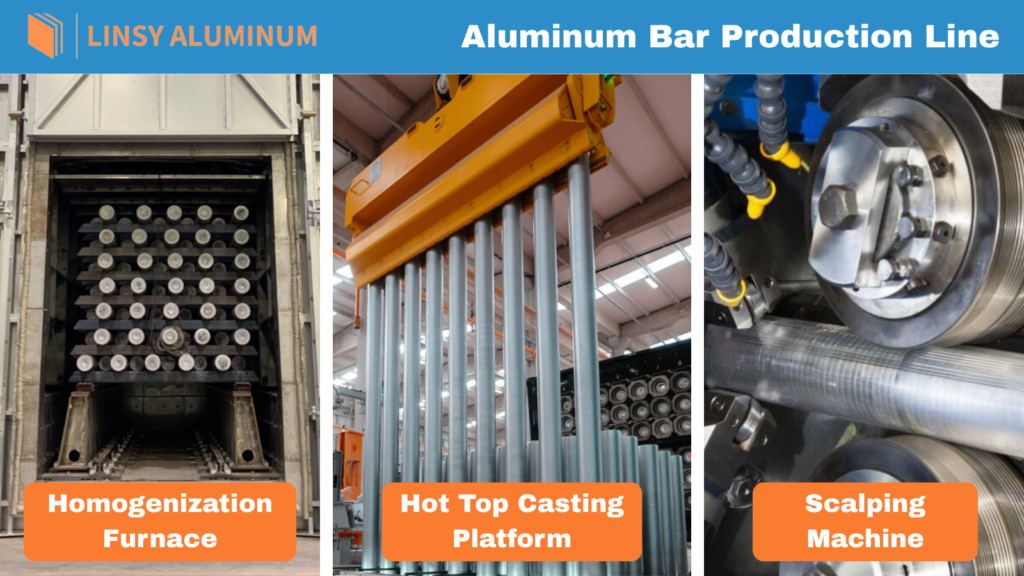
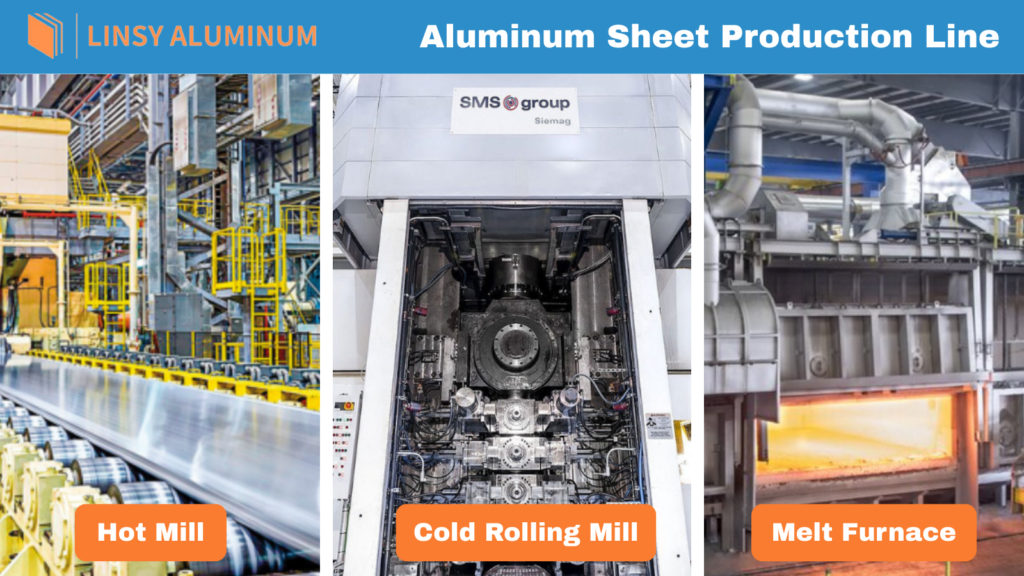
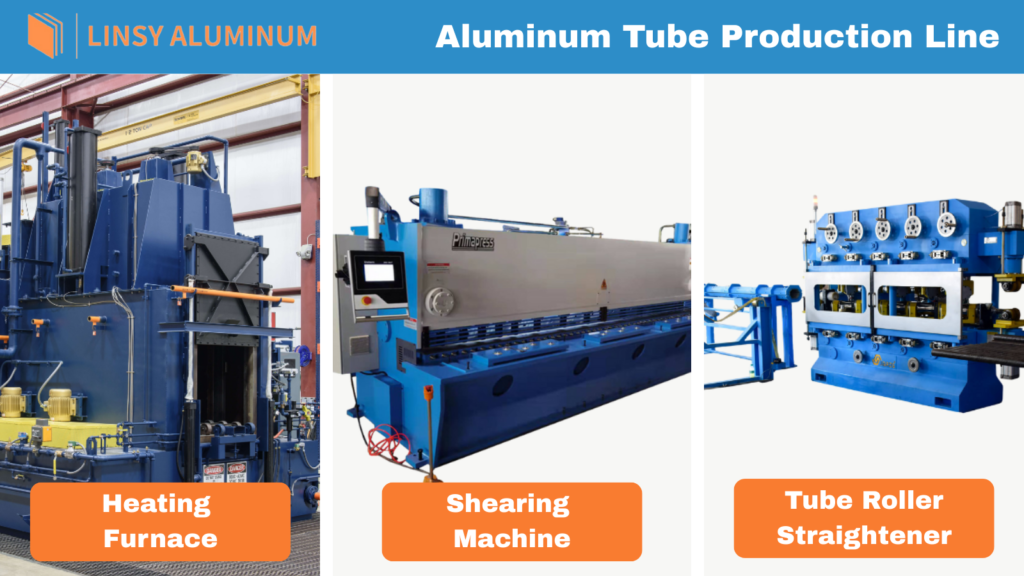
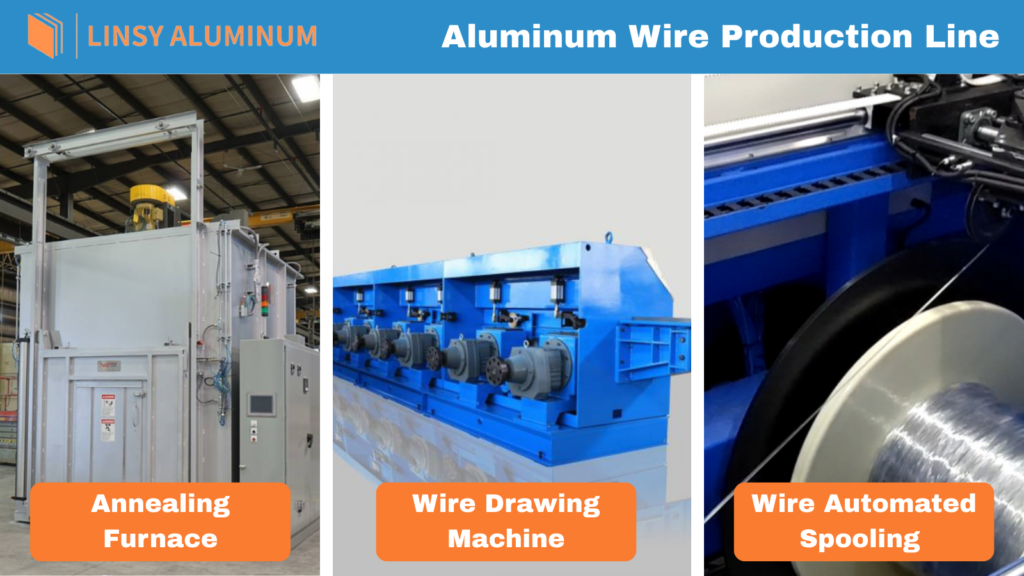
Linsy Advantages
Linsy Aluminum is a leading supplier of aluminum processing products, serving diverse industries including aerospace, general engineering, automotive, marine, shipbuilding and other specialized industrial applications.
We are committed to maintaining the highest standards of quality and environmental responsibility, as demonstrated by our certifications: ISO 9001:2008, ISO 14001:2004 and SGS.