6106是一种中等强度、可热处理的6xxx系挤压合金。其决定性特性是挤压性:它能够流入更薄、更复杂的截面,而强度更高的6xxx合金牌号则无法填充这些截面。它的镁和硅含量低于6061,而这种更精简的化学成分正是关键所在——与6061或6082相比,它可以被挤压成更薄的壁厚和更复杂的横截面,同时强度仍高于 6063 。典型用途为结构件:梯子和检修塔、铁路机车车辆、汽车结构件,以及甲板上方的船舶制造件。.
有两件事会让首次选材者栽跟头。第一是产品形式:6106不是轧制牌号,因此图纸若规定按ASTM B209供应6106厚板或薄板,并没有对应的标准产品。第二是焊接。由于6106的强度来自热处理而非冷加工,电弧焊会在局部去除很大一部分强度,而这种强度损失决定了接头的尺寸设计。.
什么是6106铝合金?
6106是6000系中的一种铝–镁–硅合金(含锰),于1979年首次注册。你会在图纸和工厂文件中看到的牌号表示如下:
| 牌号体系 | 价值 |
| 铝业协会(AA) | 6106 |
| UNS | A96106 |
| EN数字牌号 / 化学牌号 | EN AW-6106 / AlMgSiMn |
| 中国标准 | 范围 |
| 分析控制用成分限值 | EN 573-3 |
| 挤压产品力学性能值 | EN 755-2 |
| 挤压棒、杆、线、型材、管 | ASTM B221 |
| 挤压杆、棒、管、型材(ISO) | ISO 6362-2 |
大多数欧洲库存商使用的合金描述比数据表更能概括其设计意图:这是一种挤压合金,旨在在保持6000系合金所具备的耐腐蚀性、可焊性和成形性的同时,提供力学性能、形状复杂性、最小截面厚度和表面质量的最佳可用组合。无法用6082等更高强度合金生产的截面,通常可以用6106生产。.
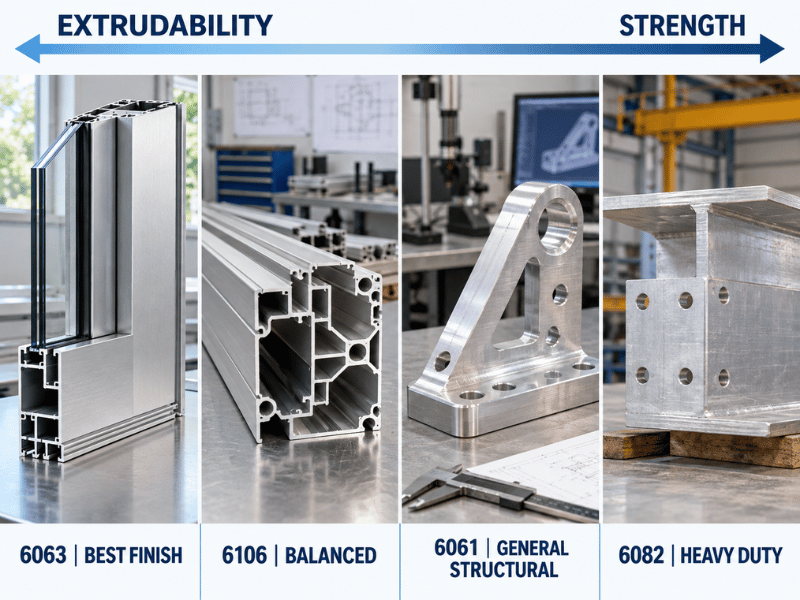
这一定位比任何单一性能数值都更重要。如果你把6xxx系合金想象在一条轴上,从6063经过6106延伸到6061和6082,那么向右移动时挤压性下降、强度上升。6106被有意放在中间位置,当这条线的两端都不适用时,它就有其价值。.
化学成分
以下限值遵循EN 573-3和铝业协会注册。所有数值均为重量百分比,余量为铝。.
| 要素 | 构成(%) |
| 硅 (Si) | 0.30 – 0.60 |
| 镁(Mg) | 0.40 – 0.80 |
| 锰 (Mn) | 0.05 - 0.20 |
| 铁(Fe) | 0.35 最大值 |
| 铜 (Cu) | 最大 0.25 |
| 铬 (Cr) | 0.20(最大值) |
| 锌 (Zn) | 最大 0.10 |
| 钛 (Ti) | 最大 0.10 |
| 其他,各 | 0.05 最大值 |
| 其他,合计 | 0.15 最大值 |
请将其与6061对照阅读,后者大约含0.8–1.2%镁、0.4–0.8%硅,并添加0.15–0.4%铜。这一差异几乎解释了两种合金之间所有的性能差距:
- 更低的Mg + Si总量 意味着可用于强化的Mg₂Si析出相更少,因此峰值强度更低——但铝中残留的固溶合金元素也更少,这就是为什么电导率更高、挤压过程中的流变应力更低。.
- 极低的铜 保持腐蚀行为纯净,并有助于阳极氧化的一致性。这也意味着6106无法像含铜6xxx合金那样追求更高强度。.
- 有意添加锰 (0.05–0.20%),不同于大多数6xxx牌号中锰仅作为杂质存在。Mn通过再结晶控制晶粒结构,并改善挤压截面的韧性和表面光洁度。.
- 严格控制铁含量 对阳极氧化很重要。含铁金属间化合物正是透明阳极氧化表面中出现条纹和灰色斑点的主要原因。.
不同回火状态下的力学性能
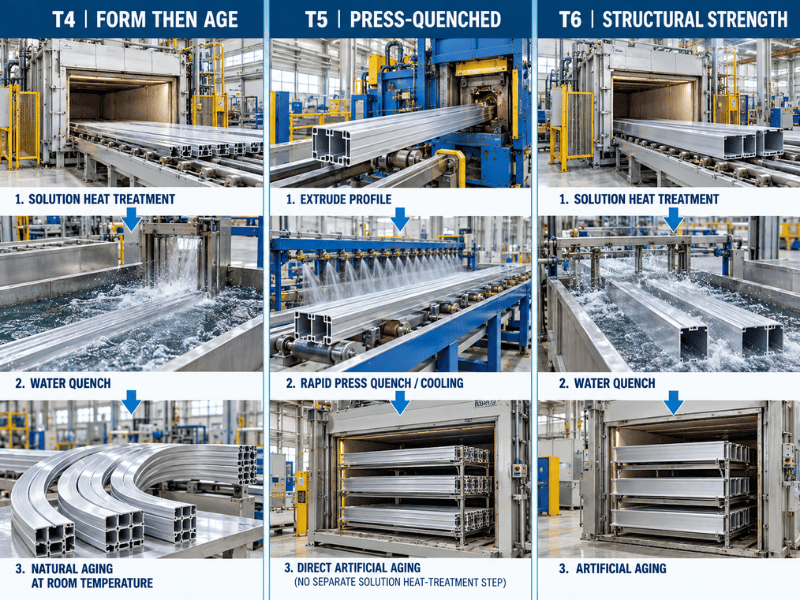
6106的强度来自固溶热处理后时效,因此订单项上的状态几乎决定了零件行为的一切。以下数值为 典型值; ;真正决定验收的是产品标准中的最小值,并且应针对所订购的具体型材和壁厚,用工厂材质证明书进行确认。.
| 脾气 | 典型抗拉强度(MPa) | 典型屈服强度(MPa) | 典型伸长率(%) | 典型用途 |
| O(退火) | ~110 | ~60 | ~22 | 后续处理前的成形坯料 |
| T4(固溶处理,自然时效) | ~200 | ~120 | ~16 | 弯曲或成形,然后时效至T6 |
| T5(在线淬火,人工时效) | ~220 | ~165 | ~12 | 成本敏感的结构挤压件 |
| T6(固溶处理,人工时效) | ~290 | ~220 | 9 – 14 | 标准结构规范 |
对于壁厚不超过10 mm的型材,EN 755-2规定T6状态下的最小值为 抗拉强度250 MPa、规定非比例延伸强度200 MPa、伸长率6%. 。请注意这些最小值比典型值低多少:这种差距是正常的,并且会随壁厚增加而扩大,这就是为什么设计应采用标准最小值或MTC值——绝不要采用数据表中引用的典型值。.
由上表可得出三个实际结论:
T5值得在T6之前先询价。. T5的淬火来自挤压机而非单独的炉次循环,这省去了一道工序,通常也降低了成本。对于许多结构型材而言,强度差异并不会改变设计,因此当出于习惯指定T6时,实际上是把真金白银留在了桌上。.
成形应在最终时效之前进行。. 在T6状态下进行冷加工是可能的,但受限。会在T6状态下开裂的弯曲,在O或T4状态下则很容易实现,之后零件可以时效至T6性能。如果你目前的工序是“挤压成T6,然后弯曲”,请问问“成形为T4,然后时效”是否可行。.
厚度会改变答案。. 已公布的最小值之所以与壁厚挂钩是有原因的:较厚截面淬火更慢,因此留在固溶体中的合金元素更少,随后形成的强化析出相也更少。厚壁6106型材达不到薄壁型材的数值,而实际截面的MTC是唯一可靠的记录。.
物理特性
| 财产 | 价值 |
| 密度 | 2.70 克/立方厘米 |
| 熔化范围(固相线–液相线) | ~610 – 660 °C |
| 弹性模量 | ~69.5 GPa |
| 热膨胀系数 | ~23.4 × 10⁻⁶ /K |
| 导热性 | ~190 W/m·K |
| 电导率(等体积) | ~49 % IACS |
| 最高连续使用温度 | ~160 °C |
| 疲劳强度(T6) | ~88 MPa |
其中两项值得特别说明,因为它们经常被误读。.
热膨胀并不能将6106与6061区分开来。. 6106的测量值约为23.4 × 10⁻⁶/K,6061约为23.6 × 10⁻⁶/K。你看到的任何将“更低的热膨胀”列为6106优势的对比表,都是把一个舍入差异当作材料特性来报告。如果热位移控制着你的接头设计,请将这两种合金视为相同,并在详细设计中解决该问题。.
电导率确实更高, ,而这正是精益化学成分在数据中的体现。在约49% IACS下,6106高于6061(约40–43%),这就是为什么它出现在母线、接触轨和散热器工作中——这些场合对机械性能要求不高,但对电气性能要求很高。结合约190 W/m·K的导热率,这使其成为必须同时承载电流和热量的零件的合理单一规格选择。.
~160 °C的上限是真实限制,而非形式上的规定。强度来自Mg₂Si析出物,持续暴露在约高于该温度的环境中会使其永久粗化。零件一旦经过高温时效,就无法通过重新时效恢复。.
为什么6106被归类为挤压合金
这是大多数合金介绍文章会跳过的部分,而它恰恰决定了6106是否应该出现在你的图纸上。.
可挤压性不是单一性能。它是一组行为的集合,共同决定挤压机能够生产什么:合金在流经模具时抵抗多大压力、在表面撕裂前能以多快速度被推送、是否能填充薄壁和远端角落、模具变形量有多大,以及成品表面是否足够洁净,无需在油漆下掩盖缺陷即可交付。合金含量会使上述每一项都朝不利方向发展,因此精益化学成分天然胜出——而6106正是精益成分。.
这在实践中带来的好处:
- 更薄的的最小壁厚。. 一个腹板必须减薄以达到重量目标的截面,在6061中以生产速度可能根本无法填充,而在6106中则可以轻松运行。.
- 更高的复杂度。. 多孔腔中空、深凹槽和精细细节都更容易实现。库存商经常指出,在6082中不可能实现的形状在6106中是常规操作。.
- 更好的表面。. 更低的流动应力意味着更少的模具粘铝和更少的表面缺陷,当表面处理是阳极氧化而非喷涂时,这一点直接重要。.
- 更高的线速度。. 根据截面不同,6106可以比6061运行得更快,即使坯料价格相同,这也会体现在单位成本上。.
代价是强度,接下来讨论。.
如果你想了解工艺本身的力学原理,包括挤压厂在报价型材之前需要从图纸中获取什么信息,我们的 定制铝挤压指南 有单独介绍。.
6106 vs 6063 vs 6061 vs 6082
这个比较才是6106真正赢得或失去规格的地方,选择正确的对比对象很重要——只与6061比较会让6106看起来像是某物的弱化版本,而不是它本来的样子。.
典型T6值:
| 财产 | 6106-T6 | 6063-T6 | 6061-T6 | 6082-T6 |
| 抗拉强度 (MPa) | ~290 | ~240 | ~310 | ~310 |
| 屈服强度 (MPa) | ~220 | ~215 | ~275 | ~260 |
| 伸长率 (%) | ~9 | ~12 | ~12 | ~10 |
| 复杂薄壁挤压 | 非常好 | 优秀 | 良好 | 公平 |
| 阳极氧化表面质量 | 非常好 | 最佳 | 良好 | 公平 |
| 机械加工性能 | 良好 | 中度 | 良好 | 中度 |
| 电弧可焊性 | 非常好 | 非常好 | 非常好 | 良好 |
| 典型用途 | 梯子、塔架、轨道车辆型材、汽车结构 | 建筑装饰、窗框 | 一般结构件、机加工零件 | 桥梁、起重机、重型框架 |
关键解读: 6106-T6的抗拉强度比6063-T6高出约20%,同时在可挤压性轴上与6063的距离远小于与6061的距离。. 这就是指定它的具体理由——一个仍然需要阳极氧化后外观良好的结构截面,并且需要比6061能可靠生产的更复杂的形状。.
各替代方案分别在哪些方面胜出:
- 6063 当零件是建筑装饰或窗框时,截面简单,表面质量是优先考虑,载荷较低。它挤压更容易,表面处理效果更好。.
- 6061 当强度主导时,当零件需要大量机加工时,或者当你想要最广泛的库存覆盖且工程师已经熟悉它时。参见我们的 6061铝材指南.
- 6082 用于重型结构工程——桥梁、起重机、车辆底盘——其强度与韧性平衡正是选用它的原因,但需接受复杂薄壁截面无法实现。比较 6082-T6 在确定截面之前。.
- 6005 是另一种值得与6106一起询价的薄壁结构挤压型材,适用于结构管材和桁架工程;其 性能和局限 差异足够大,值得关注。.
应用
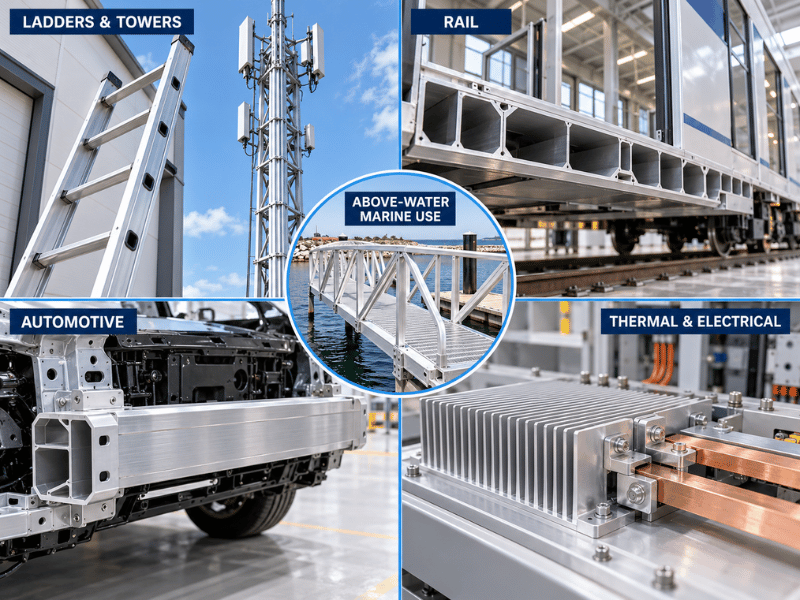
6106适用于任何需要轻量化、以挤压而非机加工方式生产、且要求严格尺寸重复性的焊接结构组件。.
梯子、塔架和桅杆。. 这是最经典的应用,几乎所有库存商都会首先提到。伸缩梯和脚手架横杆受益于高刚度重量比的薄壁空心截面、用户接触部件的光洁表面以及可焊接性。横档与横杆的接头采用焊接,因此下述热影响区余量决定了接头设计。.
铁路车辆。. 用于车身框架、地板支撑和内饰框架的挤压结构型材。复杂多腔截面、可焊接性以及防火和烟雾性能的组合使6xxx系合金在此领域占据主导地位,而6106的填充能力支持将多个制造零件整合为一体化截面。.
汽车结构。. 碰撞盒、保险杠横梁、副车架部件、车顶纵梁和电池包框架。薄壁能力直接推动减重,而更高的导热率在电池包作为热管理路径一部分时尤为重要。.
船舶与海洋工程。. 甲板结构、舷梯、桅杆和上层建筑框架。但需要明确指出:良好的通用耐腐蚀性不等同于船用级别。持续海水浸泡或飞溅区服役应选用 5xxx系合金 如5083-H116或5086-H116,它们抗敏化的方式与高镁但不同的6xxx系截面不同。6106用于水线以上,而非水线以下。.
建筑与建造。. 结构幕墙构件、结构玻璃装配型材以及承受实际载荷而非装饰性的框架,其中同一挤压型材必须同时满足挠度限制和外观要求。.
热管理与电气。. 散热器、母线排、接触轨和电气外壳,利用约190 W/m·K的导热率和约49% IACS的导电率。在此领域,力学规格通常次要,截面也较简单。.
6106的焊接
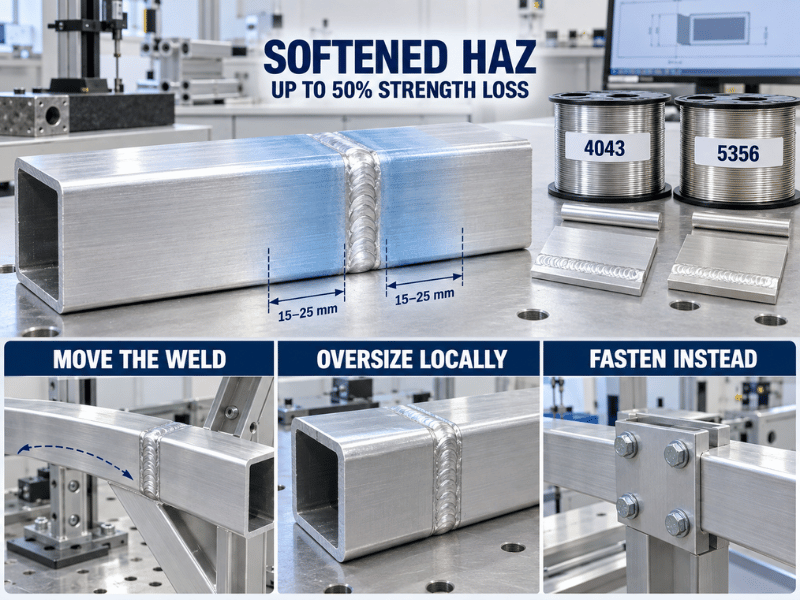
6106的弧焊评级为非常好。难点不在于连接本身——而在于电弧对焊缝旁时效状态的影响。.
热影响区强度损失。. 6106的强度来自热处理锁定的Mg₂Si析出相。熔焊会不受控制地将邻近金属重新加热经过同一析出温度区间,使炉内循环建立的析出相过时效或溶解,因此焊缝旁的区域可能损失高达一半的母材强度。降低热输入可减少这种损失,但无法消除。AWS D1.2对此的反映是指导设计者对热影响区采用T4或O态性能而非T6值,因此6106的操作规则与所有可热处理6xxx系挤压型材相同:按降低后的值设计接头,并在载荷工况重要时通过评定试验确认数据。.
有帮助的措施:
- 移开焊缝。. 软化区大约从焊缝中心线延伸15–25 mm,因此使焊缝远离峰值弯曲应力是最经济的解决方案。.
- 局部加大尺寸。. 管材壁厚加大一档通常能以极小的重量代价恢复全部焊接损失。.
- 改用紧固连接。. 螺栓连接可保持母材完整的T6强度。.
- 在T4态焊接,然后时效。. 在人工时效前焊接比焊接后时效能恢复明显更多的强度,而对已经是T6态的焊接件进行低温时效几乎无额外效果。我们不自行进行时效处理,因此需将其纳入进度计划。.
填充焊丝。. ER4043适用于一般制造;ER5356适用于需要更高焊态强度或阳极氧化后颜色更匹配的场合。我们的 铝焊丝指南 涵盖了选择,而 6061焊接指南 涵盖了工艺控制和接头强度评定。.
机加工、成形与表面处理
机加工。. 6106在T6态下使用锋利刀具和足够间隙时加工性能良好;较软的O态和T4态更容易产生积屑瘤和涂抹,因此“粘刀”的名声属于这些状态,而非人们实际加工的T6态。在总体机加工排名中,6061仍然表现更好,因此如果零件主要是切削加工而非以挤压为主,6061仍是更好的选择。.
成形。. 在最终时效前完成。T4是弯曲和成形的实用成形状态;T6仅能承受有限的冷加工,在此状态下尝试紧密弯曲容易在外侧纤维处产生裂纹。回弹适中,通过模具设计比通过更换合金能更好地控制。请记住,矫直过程中任何重度局部加热都会像焊接一样软化该区域。.
阳极氧化. 这是6106的真正优势之一。低铁和低铜含量可获得一致的无色和着色阳极氧化膜,良好的挤压态表面意味着入槽前所需的机械预处理更少。实际注意事项是:由6106焊接而成的截面在阳极氧化后会显示焊缝及其热影响区为可见条带,除非针对外观选择填充焊丝和工艺;我们的 阳极氧化指南 解释了为什么大多数可见缺陷始于合金选择和表面预处理,而非阳极氧化本身。.
耐腐蚀性。. 良好的通用大气耐腐蚀性,为6000系的典型特征,在工业大气环境中优于许多用户的预期。它在苛刻条件下并非不受晶间腐蚀影响,也不适用于持续浸泡或飞溅区。粉末涂装或阳极氧化可大幅延长使用寿命;对于海水浸泡,应改用5xxx系而非升级表面处理。.
标准与采购文件
文件准备与合金选择同样重要,因为它决定了你收到的型材是否是你指定的那种。.
同时规定标准和状态。. “仅写”6106-T6”留下太多空白。完整的行项目应注明合金、状态、产品形式、适用规范、适用尺寸公差和壁厚等级。对于挤压产品,这意味着 ASTM B221 或 EN 755-2 (含 EN 573-3 用于成分分析和 范围 用于中国工厂供应)。如果图纸要求6106对应轧制板或板材规格,报价前请先确认供货可能性——中标后才发现不匹配,代价远高于提前问一句。.
值得索取的文件:
| 文件 | 其提供的性能 |
| 工厂测试证书(MTC) | 所供批次的热号专属成分和实际力学值 |
| EN 10204 3.1证书 | 独立于工厂的声明,确认数值已按订单核实 |
| SGS化学或力学报告 | 项目要求时的第三方验证 |
| SGS尺寸检验 | 关键型材尺寸与图纸的核对 |
需要把握的区别:本文中的数字是 典型值 用于参考定位的数值。具有约束力的是标准最低值和特定批次的MTC值。当两者不一致时,以MTC为准。.
下单前还值得确认的事项:壁厚等级,因为它决定最低力学值;回火路线,T5还是T6,因为它同时改变成本和性能;以及图纸是否打算在成形或焊接后进行任何挤压后时效,因为该步骤应纳入排程,而不是在制造中途才发现。.
何时选择6106——以及何时不选
在以下情况选择6106:
- 截面是约束条件, ,而不是合金牌号——薄壁、多孔腔、严格公差,或6061无法在生产速度下可靠填充的细节。.
- 你需要比6063更高的强度,同时比6061更好的表面质量, ,尤其是在同一挤压件既承力又外露的情况下。.
- 零件将进行焊接且承受中等载荷, ,并有空间将接头布置在远离峰值应力处或在局部加大尺寸。所有6xxx系合金都是这种表现;要提前规划。.
- 每米重量正在被降低 ,通过减小壁厚而非更换合金来实现。.
- 零件还需要导电 ——母线、散热器、导电轨——此时约49% IACS是一个6061无法匹敌的优势。.
在以下情况下另寻他选:
- 峰值强度主导设计。. 升级到 6061-T6 或6082-T6。.
- 焊接接头必须保持完整的T6强度。. 没有任何6xxx系合金能做到这一点。要么重新设计,使焊缝不成为控制部位,要么考虑非热处理强化的5xxx系牌号是否更适合该载荷工况。.
- 使用工况为持续海水浸泡或飞溅区。. 改用5083-H116或5086-H116。.
- 零件是低载荷的装饰性建筑型材。. 6063更易挤压、阳极氧化效果更好,而且成本更低。请参阅我们的 6063挤压指南.
- 使用工况持续高于约160 °C。. 析出相粗化是不可逆的。.
结论
6106是一种6xxx系挤压合金,它以峰值强度换取通过模具的可挤压程度——比6063-T6约高20%,同时仍能填充6061无法可靠生产的薄壁和多孔腔截面。两个规格陷阱导致了它的大多数失效:按轧制板或板材标准而非ASTM B221或EN 755-2订购,以及在熔焊会去除高达一半局部强度时,仍按T6母材值设计焊接接头。.
我们供应 6106 可供应型材、棒材、管材和线材,状态包括O、T4、T5和T6,按ASTM B221或EN 755-2报价并注明壁厚等级,我们在内部完成CNC加工、焊接、激光切割和阳极氧化。焊后时效是我们不自行运行的独立工厂工序,因此要将其纳入排程,且每笔订单都附带MTC。.
将图纸、标准和回火路线发给我们,我们会在您承诺下单前确认可用壁厚、公差和文件。.
常见问题
6106的价格与6063和6061相比如何?
牌号的重要性不如零件的采购方式。6106是较窄的牌号,工厂库存少于6063,因此形态、回火和订单数量对价格的影响大于合金选择。发送截面、回火和年用量,我们将按实际批次报价,而不是按目录价。.
6106的最小起订量是多少?
常备型材按标准包装数量发货。常备范围之外的任何产品都是低MOQ定制生产,因此实际最小量取决于形态、回火以及是否有现成炉号。告诉我们规格和数量,我们将确认哪些可从库存发货,哪些必须生产。.
6106挤压件的交期预计是多久?
预计大约10–60天,取决于型材是否有库存。常备截面数天内发货;新模具在首支挤压长度之前会增加设计、制造和试模时间。请尽早将截面与您的建造排程核对,因为模具在关键路径上。.