6106은 중간 강도의 열처리 가능한 6xxx 압출 합금입니다. 이 합금의 정의적 특성은 압출성입니다. 즉, 더 강한 6xxx 계열이 채우지 못하는 얇고 복잡한 단면으로 유동합니다. 6061보다 마그네슘과 규소 함량이 적으며, 이 더 낮은 화학 조성이 핵심입니다 — 6061이나 6082보다 더 얇은 벽과 더 복잡한 단면으로 압출할 수 있으면서도 6063 강도 면에서 더 우수합니다. 전형적인 용도는 구조용입니다: 사다리 및 접근 타워, 철도 차량, 자동차 구조물, 갑판 위 해양 구조물 등입니다.
처음 사양을 지정하는 사람들이 두 가지에서 걸려 넘어집니다. 첫째는 형태입니다: 6106은 압연 지정이 아니므로, ASTM B209에 따라 6106 플레이트나 시트를 명시한 도면에는 이를 뒷받침하는 표준 제품이 없습니다. 둘째는 용접입니다. 6106은 냉간 가공이 아닌 열처리에서 강도를 얻기 때문에, 아크 용접은 국부적으로 강도의 상당 부분을 제거하며, 그 손실이 접합부의 크기를 결정합니다.
6106 알루미늄이란 무엇인가?
6106은 6000 계열의 알루미늄–마그네슘–규소 합금(망간 포함)으로, 1979년에 최초 등록되었습니다. 도면과 제조사 문서에서 볼 수 있는 명칭:
| 명칭 체계 | 가치 |
| 알루미늄 협회(AA) | 6106 |
| UNS | A96106 |
| EN 숫자 / 화학 | EN AW-6106 / AlMgSiMn |
| 중국 표준 | GB/T 3190 |
| 분석 관리를 위한 조성 한도 | EN 573-3 |
| 압출 제품 기계적 값 | EN 755-2 |
| 압출 봉재, 환봉, 선재, 프로파일, 튜브 | ASTM B221 |
| 압출 봉, 바, 튜브, 프로파일 (ISO) | ISO 6362-2 |
대부분의 유럽 재고업자가 사용하는 합금 설명은 데이터시트보다 설계 의도를 더 잘 요약합니다: 기계적 특성, 형상 복잡성, 최소 단면 두께, 표면 품질의 최상의 조합을 제공하면서 6000 계열 특유의 내식성, 용접성, 성형성을 유지하도록 의도된 압출 합금입니다. 6082와 같은 더 강한 합금으로는 생산할 수 없는 단면이 6106으로 일상적으로 생산됩니다.
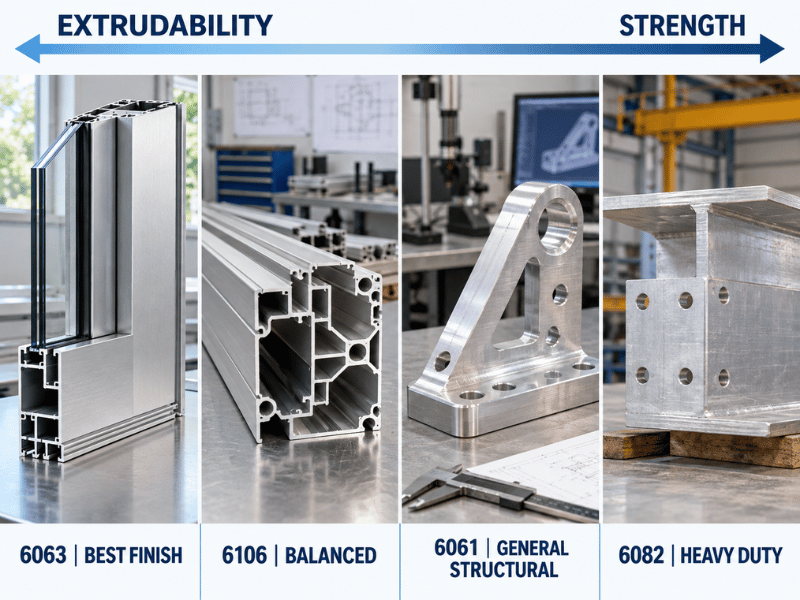
이 위치는 어떤 단일 특성 수치보다 더 중요합니다. 6xxx 합금을 6063에서 6106을 거쳐 6061과 6082로 이어지는 하나의 축에 놓으면, 오른쪽으로 갈수록 압출성은 떨어지고 강도는 올라갑니다. 6106은 의도적으로 중간에 위치하며, 그 선의 양쪽 끝 어느 쪽도 적합하지 않을 때 그 자리를 얻습니다.
화학 성분
아래 한도는 EN 573-3 및 Aluminum Association 등록을 따릅니다. 모두 중량 백분율이며, 잔량은 알루미늄입니다.
| 요소 | 구성 (%) |
| 실리콘(Si) | 0.30 – 0.60 |
| 마그네슘(Mg) | 0.40 – 0.80 |
| 망간(Mn) | 0.05 - 0.20 |
| 철(Fe) | 0.35 최대 |
| 구리(Cu) | 최대 0.25 |
| 크롬(Cr) | 0.20 최대 |
| 아연(Zn) | 최대 0.10 |
| 티타늄(Ti) | 최대 0.10 |
| 그 외, 각각 | 최대 0.05 |
| 기타, 합계 | 최대 0.15 |
이를 6061과 비교해 보십시오. 6061은 대략 0.8–1.2% 마그네슘, 0.4–0.8% 규소이며 0.15–0.4% 구리를 추가합니다. 이 차이가 두 합금 간의 거의 모든 거동 차이를 설명합니다:
- 더 낮은 Mg + Si 총량 은 강화에 사용할 수 있는 Mg₂Si 석출물이 더 적다는 것을 의미하므로 최대 강도는 더 낮습니다 — 그러나 알루미늄에 용해된 합금 원소도 더 적게 남아 있어, 전기 전도도가 더 높고 압출 시 유동 응력이 더 낮습니다.
- 매우 낮은 구리 는 부식 거동을 깨끗하게 유지하고 아노다이징 일관성에 도움을 줍니다. 또한 6106이 구리 함유 6xxx 합금처럼 강도를 추구할 수 없다는 것을 의미합니다.
- 망간이 의도적으로 포함되어 있습니다 (0.05–0.20%), 대부분의 6xxx 계열에서는 불순물에 불과한 것과 다릅니다. Mn은 재결정을 통해 결정립 구조를 제어하고 압출 단면의 인성과 표면 마감을 향상시킵니다.
- 엄격한 철 관리 는 아노다이징에 중요합니다. 철 함유 금속간 화합물이 투명 아노다이징 마감에서 줄무늬와 회색 반점으로 나타나는 것입니다.
열처리 상태에 따른 기계적 특성
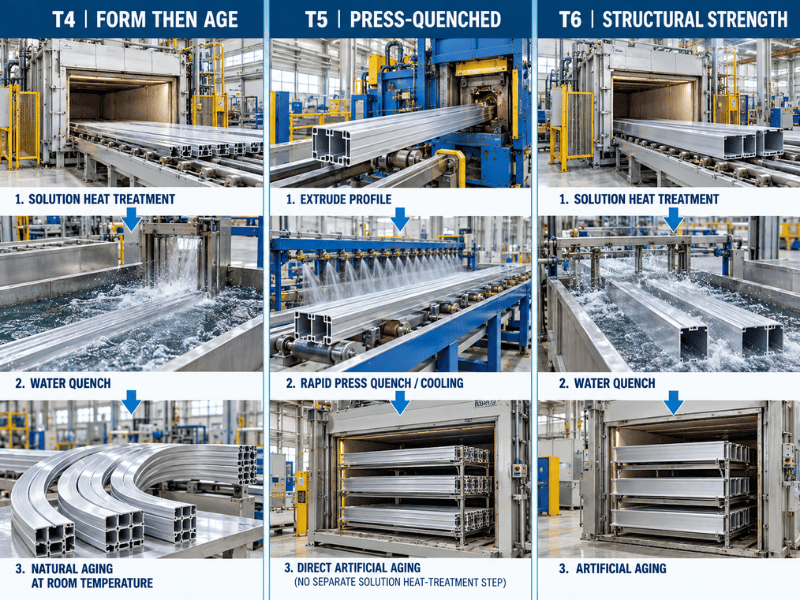
6106은 용체화 열처리 후 시효 처리로 강도를 얻으므로, 라인 항목의 조질 상태가 부품 거동의 거의 모든 것을 결정합니다. 아래 값은 전형적인; 값입니다; 실제로 합격 여부를 결정하는 수치는 제품 표준의 최소값이며, 이는 주문한 특정 프로파일과 벽 두께에 대한 제조사 시험 성적서와 대조하여 확인해야 합니다.
| 성질 | 전형적 인장 강도 (MPa) | 전형적 항복 강도 (MPa) | 전형적 연신율 (%) | 일반 용도 |
| O(어닐링) | ~110 | ~60 | ~22 | 추가 처리 전 성형 소재 |
| T4 (용체화 처리, 자연 시효) | ~200 | ~120 | ~16 | 굽힘 또는 성형 후 T6으로 시효 |
| T5 (프레스 급냉, 인공 시효) | ~220 | ~165 | ~12 | 비용 민감 구조용 압출재 |
| T6 (용체화 처리, 인공 시효) | ~290 | ~220 | 9 – 14 | 표준 구조 사양 |
벽 두께 10 mm 이하의 프로파일의 경우, EN 755-2는 T6 조건에서 최소값을 다음과 같이 규정합니다: 인장 250 MPa, 내력 200 MPa, 연신율 6%. 이 최소값이 전형적 수치보다 얼마나 낮은지 주목하십시오: 이 차이는 정상이며, 벽 두께가 증가할수록 커지며, 이것이 설계 시 표준 최소값이나 MTC 값을 사용해야 하는 이유입니다 — 데이터시트에서 인용된 전형적 수치를 절대 사용해서는 안 됩니다.
이 표에서 세 가지 실질적 결과가 따릅니다:
T5는 T6보다 먼저 가격을 책정할 가치가 있습니다. T5는 별도의 로 사이클이 아닌 압출 프레스에서 급냉을 하므로 공정 단계가 하나 줄고 일반적으로 비용이 낮아집니다. 많은 구조용 단면에서 강도 차이가 설계를 바꾸지 않으므로, 습관적으로 T6을 지정할 때 실질적인 비용이 낭비됩니다.
성형은 최종 시효 전에 해야 합니다. T6에서의 냉간 가공은 가능하지만 제한적입니다. T6에서 균열이 발생할 굽힘은 O 또는 T4에서는 간단하며, 이후 부품을 시효 처리하여 T6 특성에 도달할 수 있습니다. 현재 공정이 “T6 압출 후 굽힘”이라면, “T4 성형 후 시효”가 대안이 될 수 있는지 검토하십시오.
두께가 답을 바꿉니다. 공표된 최소값이 벽 두께에 연동되는 데는 이유가 있습니다: 두꺼운 단면은 더 느리게 급냉되므로 더 적은 합금 원소가 고용 상태로 남고 나중에 더 적은 강화 석출물이 형성됩니다. 두꺼운 벽의 6106 프로파일은 얇은 벽의 프로파일이 달성하는 값에 도달하지 못하며, 실제 단면에 대한 MTC만이 유일하게 신뢰할 수 있는 기록입니다.
물리적 속성
| 속성 | 가치 |
| 밀도 | 2.70g/cm³ |
| 용융 범위 (고상선–액상선) | ~610 – 660 °C |
| 탄성 계수 | ~69.5 GPa |
| 열팽창 계수 | ~23.4 × 10⁻⁶ /K |
| 열 전도성 | ~190 W/m·K |
| Electrical conductivity (equal volume) | ~49 % IACS |
| Maximum continuous service temperature | ~160 °C |
| Fatigue strength (T6) | ~88 MPa |
Two of these deserve a note because they are routinely misread.
Thermal expansion does not separate 6106 from 6061. 6106 measures about 23.4 × 10⁻⁶/K and 6061 about 23.6 × 10⁻⁶/K. Any comparison table you see listing “lower thermal expansion” as a 6106 advantage is reporting a rounding difference as if it were a property. If thermal movement governs your joint design, treat these alloys as identical and solve the problem in detail design.
Electrical conductivity is genuinely higher, and it is the lean chemistry showing up in the numbers. At roughly 49% IACS, 6106 runs above 6061 (about 40–43%), which is why it turns up in bus bar, conductor rail, and heat sink work where the mechanical requirement is modest but the electrical one is not. Combined with ~190 W/m·K thermal conductivity, that makes it a reasonable single-spec choice for parts that must carry both current and heat.
The ~160 °C ceiling is a real limit, not a formality. Strength comes from Mg₂Si precipitates, and sustained exposure above roughly that temperature coarsens them permanently. There is no re-aging your way back once a part has been cooked.
Why 6106 Is Classified as an Extrusion Alloy
This is the section most alloy write-ups skip, and it is the one that decides whether 6106 belongs on your drawing at all.
Extrudability is not a single property. It is a bundle of behaviors that together determine what a press can produce: how much pressure the alloy resists as it flows through the die, how fast it can be pushed before the surface tears, whether it fills thin and remote corners, how much the die deflects, and whether the finished surface looks clean enough to ship without masking the defects under paint. Alloy content pushes every one of those in the wrong direction, so a lean chemistry wins by default — and 6106 is lean.
What that buys in practice:
- Thinner minimum walls. A section whose web has to come down to meet a weight target may simply not be fillable in 6061 at production speed, while running comfortably in 6106.
- Higher complexity. Multi-void hollows, deep recesses, and fine detail are all easier. Stockists routinely note that shapes impossible in 6082 are routine in 6106.
- Better surface. Lower flow stress means less die pickup and fewer surface defects, which matters directly when the finish is anodized rather than painted.
- Higher line speed. Depending on the section, 6106 can run faster than 6061, which shows up in unit cost even when the billet price is the same.
The trade is strength, discussed next.
If you want the mechanics of the process itself, including what a mill needs from a drawing before quoting a profile, our custom aluminum extrusion guide covers it separately.
6106 vs 6063 vs 6061 vs 6082
This comparison is where 6106 actually earns or loses a specification, and picking the right comparator matters — comparing only against 6061 makes 6106 look like a weaker version of something, rather than what it is.
Typical T6 values:
| 속성 | 6106-T6 | 6063-T6 | 6061-T6 | 6082-T6 |
| 인장 강도(MPa) | ~290 | ~240 | ~310 | ~310 |
| 항복 강도(MPa) | ~220 | ~215 | ~275 | ~260 |
| 연신율 (%) | ~9 | ~12 | ~12 | ~10 |
| Complex thin-wall extrusion | 매우 우수 | 우수 | Good | 공정 |
| Anodized surface quality | 매우 우수 | Best | Good | 공정 |
| 기계 가공성 | Good | 보통 | Good | 보통 |
| Arc weldability | 매우 우수 | 매우 우수 | 매우 우수 | Good |
| Typical work | Ladders, towers, rail stock, auto structures | 건축 트림, 창틀 | General structural, machined parts | Bridges, cranes, heavy frames |
The reading that matters: 6106-T6 carries roughly 20% more tensile strength than 6063-T6 while staying much closer to it than to 6061 on the extrudability axis. That is the specific reason to specify it — a structural section that still needs to look good anodized, and needs to be more complicated than 6061 will reliably produce.
Where each alternative wins instead:
- 6063 when the part is architectural trim or window framing, the section is simple, the finish is the priority, and loads are low. It extrudes even more easily and finishes better.
- 6061 when strength governs, when the part will be machined heavily, or when you want the widest stock coverage and engineers already know it. See our 전체 프로파일을 다룹니다..
- 6082 for heavy structural work — bridges, cranes, vehicle chassis — where its strength-to-toughness balance is the reason it is specified, accepting that complex thin sections are off the table. Compare 6082-T6 before committing to a section.
- 6005 is another thin-wall structural extrusion worth pricing alongside 6106 for structural tube and truss work; its properties and limits differ enough to be worth a look.
애플리케이션
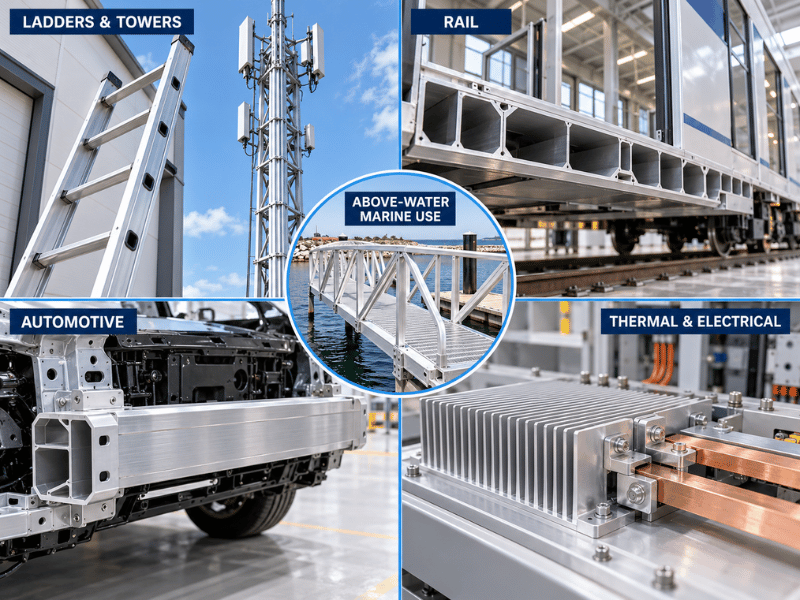
6106 shows up wherever a welded structural assembly needs to be light, extruded rather than machined, and held to tight dimensional repeatability.
Ladders, towers, and masts. The classic application, and named first by nearly every stockist. Extension ladders and scaffold rails benefit from thin-wall hollow sections at high stiffness-per-weight, from clean surface finish on parts users handle, and from weldability. Rung-to-rail joints are welded, so the HAZ allowance below governs the joint design.
Railway rolling stock. Extruded structural sections in body frames, floor supports, and interior framing. The combination of complex multi-void profiles, weldability, and fire and smoke behavior keeps 6xxx alloys dominant here, and 6106’s fill capability supports the integrated sections that replace multiple fabricated parts.
Automotive structures. Crash boxes, bumper beams, subframe components, roof rails, and battery enclosure framing. Thin-wall capability drives mass reduction directly, and the higher conductivity matters where the enclosure is part of a thermal management path.
Marine and offshore. Deck structures, gangways, masts, and superstructure framing. Worth stating plainly, though: good general corrosion resistance is not the same as marine-grade. Continuous seawater immersion or splash-zone service belongs to 5xxx alloys such as 5083-H116 or 5086-H116, which resist sensitization in a way high-magnesium-but-different 6xxx sections do not. Use 6106 above the waterline, not below it.
Architecture and building. Structural curtain wall members, structural glazing profiles, and framing that carries real load rather than trim, where the same extrusion must satisfy both deflection limits and an appearance requirement.
Thermal and electrical. Heat sinks, bus bars, conductor rail, and electrical enclosures, drawing on ~190 W/m·K thermal conductivity and ~49% IACS electrical conductivity. Here the mechanical spec usually arrives second and the section is simple.
Welding 6106
106 is rated very good for arc welding. The difficulty is not joining it — it is what the arc does to the temper alongside the weld.
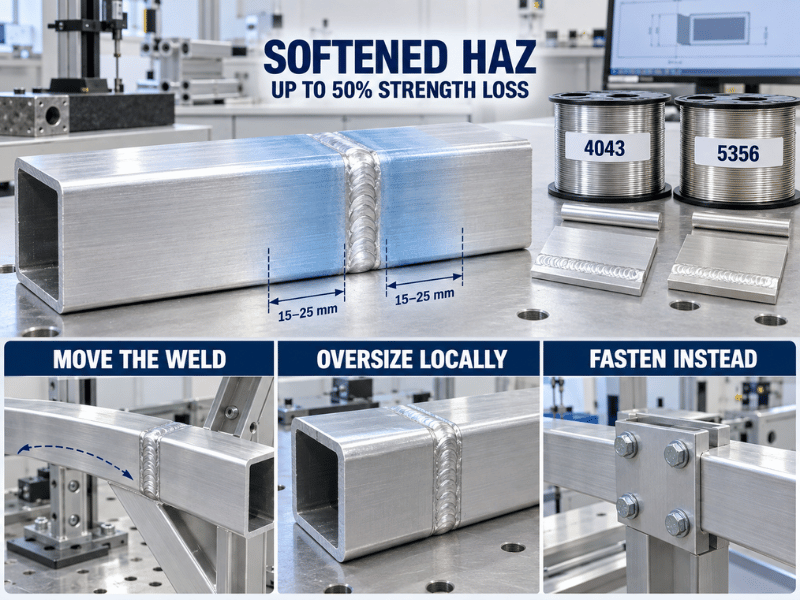
The heat-affected zone loses strength. 6106 takes its strength from Mg₂Si precipitates locked in by heat treatment. A fusion weld reheats the adjacent metal through that same precipitation window without control, over-aging or dissolving what a furnace cycle built, so the zone beside the weld can lose up to half the parent strength. Lower heat input reduces that loss; it does not remove it. AWS D1.2 reflects this by directing designers to T4 or O properties for the heat-affected zone rather than T6 values, so the operating rule for 6106 is the same one used for every heat-treatable 6xxx extrusion: size the joint on reduced values, and confirm the figure with a qualification test where the load case matters.
What helps:
- Move the weld. The soft zone runs roughly 15–25 mm from the weld centerline, so keeping welds clear of peak bending stress is the cheapest fix.
- Oversize locally. One wall size up on a tube usually recovers the whole welded loss for very little weight.
- Fasten instead. A bolted joint keeps full parent T6 strength.
- Weld in T4, then age. Welding before artificial aging recovers appreciably more than welding after it, and a low-temperature cycle on an already-T6 weldment adds almost nothing. We do not run aging in-house, so build it into the schedule.
Filler. ER4043 suits general fabrication; ER5356 where you need more as-welded strength or a closer color match after anodizing. Our 알루미늄 용접 와이어 가이드 covers the selection, and the 6061 welding guide covers procedure control and joint-strength qualification.
Machining, Forming, and Surface Finishing
절삭 가공. 6106 machines well in T6 with sharp tools and adequate clearance; the softer O and T4 conditions are more prone to built-up edge and smearing, so the “gummy” reputation attaches to those rather than to the T6 condition people actually machine. In general machining ranking, 6061 still performs better, so where a part is mostly chips rather than mostly extrusion, 6061 remains the better ask.
성형. Do it before final aging. T4 is the practical forming condition for bending and shaping; T6 tolerates only limited cold work, and attempting tight bends there invites cracking along the outer fiber. Springback is moderate and is better controlled by die design than by alloy substitution. Remember that any heavy local heating during straightening will soften the area in the same way a weld does.
양극 산화. One of 6106’s real advantages. Low iron and copper give consistent clear and colored anodic films, and the good as-extruded surface means less mechanical prep before the tank. The practical caution is that a 6106 section welded together will show the weld and its HAZ as a visible band after anodizing unless the filler and procedure are chosen for appearance; our anodizing guide explains why most visible failures start with alloy selection and surface preparation rather than with the anodizing itself.
Corrosion. Good general atmospheric corrosion resistance, typical of the 6000 series, and better than many users expect in industrial atmospheres. It is not immune to intergranular attack in aggressive conditions, and it does not belong in continuous immersion or the splash zone. Powder coating or anodizing extends service life substantially; for marine immersion, move to 5xxx rather than upgrading the finish.
Standards and Procurement Documentation
Getting the paperwork right matters as much as getting the alloy right, because it is what determines whether the section you receive is the one you specified.
Specify the standard and the temper together. “6106-T6” alone leaves too much open. A complete line item names the alloy, temper, product form, governing specification, applicable dimensional tolerance, and wall-thickness class. For extruded product that means ASTM B221 또는 EN 755-2 (with EN 573-3 for composition analysis and GB/T 3190 for Chinese mill supply). Confirm availability before quoting if a drawing calls for 6106 against a rolled plate or sheet specification — a mismatch discovered after award costs far more than a question asked early.
Documents worth requesting:
| 문서 | 제공하는 것 |
| Mill test certificate (MTC) | Heat-specific composition and actual mechanical values for the supplied lot |
| EN 10204 3.1 certificate | Mill-independent statement that values were verified against the order |
| SGS chemical or mechanical report | Third-party verification where the project requires it |
| SGS dimensional inspection | Verification of critical profile dimensions against the drawing |
The distinction to hold onto: the figures in this article are 전형적인 values for orientation. The numbers that bind are the standard minimums and the MTC values for the specific lot. When those disagree, the MTC wins.
Also worth confirming before placing an order: the wall thickness class, since it drives the minimum mechanical values; the temper route, T5 versus T6, since it changes both cost and properties; and whether the drawing intends any post-extrusion aging after forming or welding, since that step belongs in the schedule rather than discovered mid-fabrication.
When to Choose 6106 — and When Not To
Choose 6106 when:
- The section is the constraint, not the alloy number — thin walls, multiple voids, tight tolerances, or details that 6061 will not fill reliably at production speed.
- You need more strength than 6063 and better finish than 6061, particularly where the same extrusion is structural and visible.
- The part will be welded and moderately loaded, with room to place joints away from peak stress or to oversize locally. Every 6xxx behaves this way; plan for it.
- Weight per metre is being driven down through wall thickness rather than through alloy substitution.
- The part also conducts — bus bar, heat sink, conductor rail — where roughly 49% IACS is an advantage 6061 cannot match.
다음과 같은 경우에는 다른 소재를 찾아라:
- Peak strength governs the design. Step up to 6061-T6 or 6082-T6.
- A welded joint must retain full T6 strength. No 6xxx alloy does this. Either redesign so the weld is not the governing location, or consider whether a non-heat-treatable 5xxx grade suits the load case better.
- The service is continuous seawater immersion or splash zone. Move to 5083-H116 or 5086-H116.
- The part is decorative architectural trim with low load. 6063 extrudes more easily and anodizes better, and it costs less. See our 6063 extrusion guide.
- Service runs continuously above roughly 160 °C. Precipitation coarsening is permanent.
결론
6106 is a 6xxx extrusion alloy that trades peak strength for how far it can be pushed through a die — roughly 20% stronger than 6063-T6 while still filling thin-wall and multi-void sections that 6061 cannot produce reliably. Two specification traps drive most failures with it: ordering it against a rolled plate or sheet standard instead of ASTM B221 or EN 755-2, and sizing welded joints on T6 parent values when fusion welding removes up to half the local strength.
당사는 공급함 6106 as profile, bar, tube, and wire in O, T4, T5, and T6, quoted to ASTM B221 or EN 755-2 with the wall-thickness class stated, and we handle CNC machining, welding, laser cutting, and anodizing in-house. Post-weld aging is a separate mill step we do not run ourselves, so build it into the schedule, and every order carries an MTC.
Send us the drawing, the standard, and the temper route, and we will confirm available wall thicknesses, tolerances, and documentation before you commit.
자주 묻는 질문
How does 6106 pricing compare with 6063 and 6061?
The grade matters less than how the part is bought. 6106 is a narrower designation with less mill stock than 6063, so form, temper and order quantity move the number more than the alloy choice does. Send the section, temper and annual volume, and we will quote the actual lot rather than a list price.
What is the minimum order quantity for 6106?
Stocked profiles ship from standard pack quantities. Anything outside the stocked range is a low-MOQ custom run, so the practical minimum depends on the form, the temper and whether a heat is available. Tell us the specification and quantity and we will confirm what ships from stock and what has to be produced.
What lead time should I expect for 6106 extrusions?
Plan on roughly 10–60 days, depending on whether the profile is stocked. Stocked sections ship in days; a new die adds design, fabrication and trial time before the first extruded length. Confirm the section against your build schedule early, because the die is on the critical path.