Le 6106 est un alliage d'extrusion 6xxx à résistance moyenne, durcissable par traitement thermique. Sa propriété déterminante est son extrudabilité : il s'écoule dans des sections minces et complexes que les nuances 6xxx plus résistantes ne peuvent pas remplir. Il contient moins de magnésium et de silicium que le 6061, et cette chimie plus pauvre est précisément l'objectif — il peut être extrudé en parois plus minces et en sections transversales plus complexes que ne le permettent le 6061 ou le 6082, tout en restant au-dessus 6063 en résistance. Les utilisations typiques sont structurelles : échelles et tours d'accès, matériel roulant ferroviaire, structures automobiles et fabrications marines de pont supérieur.
Deux choses déroutent les prescripteurs débutants. La première est la forme : le 6106 n'est pas une désignation de produit laminé, donc un dessin qui spécifie une plaque ou une tôle 6106 selon l'ASTM B209 n'a aucun produit standard correspondant. La seconde est le soudage. Parce que le 6106 tire sa résistance du traitement thermique plutôt que de l'écrouissage, un soudage à l'arc en supprime localement une grande partie, et cette perte régit le dimensionnement du joint.
Qu'est-ce que l'aluminium 6106 ?
Le 6106 est un alliage aluminium–magnésium–silicium (avec manganèse) de la série 6000, enregistré pour la première fois en 1979. Désignations que vous verrez sur les dessins et les documents d'usine :
| Système de désignation | Valeur |
| Association de l'aluminium (AA) | 6106 |
| UNS | A96106 |
| Numérique EN / chimique | EN AW-6106 / AlMgSiMn |
| Norme chinoise | GB/T 3190 |
| Limites de composition pour le contrôle analytique | EN 573-3 |
| Valeurs mécaniques des produits extrudés | EN 755-2 |
| Barres, tiges, fils, profilés, tubes extrudés | ASTM B221 |
| Tiges, barres, tubes, profilés extrudés (ISO) | ISO 6362-2 |
La description de l'alliage utilisée par la plupart des distributeurs européens résume mieux l'intention de conception qu'une fiche technique : un alliage d'extrusion destiné à offrir la meilleure combinaison disponible de propriétés mécaniques, de complexité de forme, d'épaisseur minimale de paroi et de qualité de surface, tout en conservant la résistance à la corrosion, la soudabilité et la formabilité associées à la série 6000. Les sections qui ne peuvent pas être produites dans des alliages plus résistants tels que le 6082 sont couramment produites en 6106.
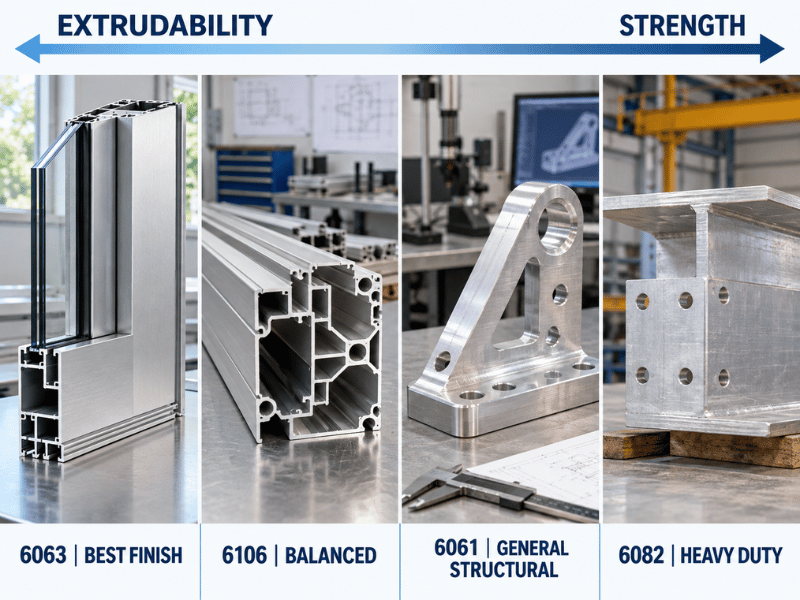
Cette position compte plus que n'importe quel chiffre de propriété individuel. Si vous imaginez les alliages 6xxx sur un axe allant du 6063 au 6106 puis au 6061 et au 6082, l'extrudabilité diminue à mesure que vous vous déplacez vers la droite et la résistance augmente. Le 6106 se situe délibérément au milieu, et il mérite sa place lorsque ni l'une ni l'autre extrémité de cette ligne ne convient.
Composition chimique
Les limites ci-dessous suivent l'EN 573-3 et l'enregistrement de l'Aluminum Association. Tout est en pourcentage massique, le reste étant de l'aluminium.
| Élément | Composition (%) |
| Silicium (Si) | 0.30 – 0.60 |
| Magnésium (Mg) | 0.40 – 0.80 |
| Manganèse (Mn) | 0.05 - 0.20 |
| Fer (Fe) | 0,35 max |
| Cuivre (Cu) | 0,25 max |
| Chrome (Cr) | 0,20 max |
| Zinc (Zn) | 0,10 max |
| Titane (Ti) | 0,10 max |
| D'autres, chacun | 0,05 max |
| Autres, total | 0,15 max |
Lisez ceci en comparaison avec le 6061, qui contient environ 0,8–1,2% de magnésium, 0,4–0,8% de silicium et ajoute 0,15–0,4% de cuivre. Cette différence explique presque tous les écarts de comportement entre les deux alliages :
- Somme Mg + Si plus faible signifie moins de précipité Mg₂Si disponible pour le durcissement, donc une résistance de pointe plus faible — mais il reste aussi moins d'éléments d'alliage dissous dans l'aluminium, ce qui explique une conductivité électrique plus élevée et une contrainte d'écoulement plus faible lors de l'extrusion.
- Cuivre très faible maintient un comportement à la corrosion propre et favorise la régularité de l'anodisation. Cela signifie aussi que le 6106 ne peut pas rechercher la résistance comme le peuvent les alliages 6xxx contenant du cuivre.
- Le manganèse est délibérément présent (0,05–0,20%), contrairement à la plupart des nuances 6xxx où il n'est qu'une impureté. Le Mn contrôle la structure des grains par recristallisation et améliore la ténacité et l'état de surface de la section extrudée.
- Un contrôle strict du fer est important pour l'anodisation. Les intermétalliques contenant du fer sont ce qui apparaît sous forme de stries et de taches grises dans un fini anodisé transparent.
Propriétés mécaniques selon le traitement thermique
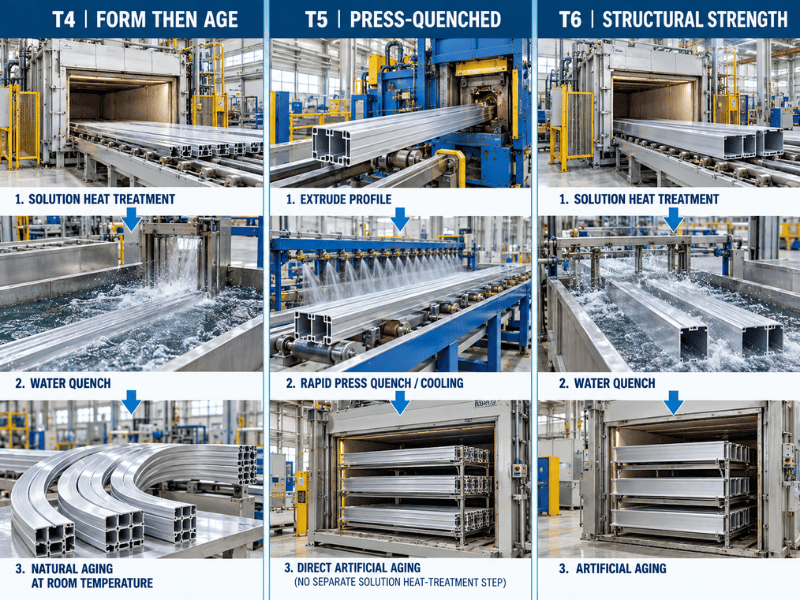
Le 6106 tire sa résistance d'un traitement thermique de mise en solution suivi d'un vieillissement, de sorte que l'état métallurgique indiqué sur la ligne détermine presque tout le comportement de la pièce. Les valeurs ci-dessous sont typiques; les chiffres qui régissent réellement l'acceptation sont les minimums de la norme produit, et ceux-ci doivent être confirmés par le certificat de contrôle en usine pour le profilé et l'épaisseur de paroi spécifiques commandés.
| Tempérer | Résistance à la traction typique (MPa) | Limite d'élasticité typique (MPa) | Allongement typique (%) | Utilisation typique |
| O (recuit) | ~110 | ~60 | ~22 | Matière à former avant tout traitement ultérieur |
| T4 (mis en solution, vieilli naturellement) | ~200 | ~120 | ~16 | Cintrer ou former, puis vieillir à T6 |
| T5 (trempé à la presse, vieilli artificiellement) | ~220 | ~165 | ~12 | Extrusions structurelles sensibles au coût |
| T6 (mis en solution, vieilli artificiellement) | ~290 | ~220 | 9 – 14 | Spécification structurelle standard |
Pour les profilés jusqu'à 10 mm d'épaisseur de paroi, l'EN 755-2 fixe des valeurs minimales à l'état T6 de 250 MPa en traction, 200 MPa en limite d'épreuve et 6% d'allongement. Notez combien ces minimums sont inférieurs aux chiffres typiques : cet écart est normal, il s'accentue avec l'épaisseur de paroi, et c'est pourquoi la conception doit utiliser soit le minimum normalisé, soit la valeur du certificat de contrôle en usine — jamais un chiffre typique cité d'une fiche technique.
Trois conséquences pratiques découlent du tableau :
Le T5 mérite d'être chiffré avant le T6. Le T5 tire sa trempe de la presse d'extrusion plutôt que d'un cycle de four séparé, ce qui supprime une étape de processus et réduit généralement le coût. Pour de nombreuses sections structurelles, la différence de résistance ne change pas la conception, c'est donc de l'argent réel laissé sur la table lorsque le T6 est spécifié par habitude.
Le formage doit précéder le vieillissement final. Le travail à froid en T6 est possible mais limité. Les cintrages qui fissureraient en T6 sont simples en O ou T4, et la pièce peut ensuite être vieillie pour atteindre les propriétés T6. Si votre séquence est actuellement “ extruder T6, puis cintrer ”, demandez si “ former T4, puis vieillir ” fonctionne à la place.
L'épaisseur change la réponse. Les minimums publiés sont liés à l'épaisseur de paroi pour une raison : les sections plus épaisses trempent plus lentement, donc moins d'éléments d'alliage restent en solution et moins de précipité durcissant se forme ensuite. Un profilé 6106 à paroi épaisse n'atteindra pas les valeurs d'un profilé à paroi mince, et le certificat de contrôle en usine de la section réelle est le seul document fiable.
Propriétés physiques
| Propriété | Valeur |
| Densité | 2,70 g/cm³ |
| Plage de fusion (solidus–liquidus) | ~610 – 660 °C |
| Module d'élasticité | ~69,5 GPa |
| Coefficient de dilatation thermique | ~23,4 × 10⁻⁶ /K |
| Conductivité thermique | ~190 W/m·K |
| Conductivité électrique (volume égal) | ~49 % IACS |
| Température maximale de service continu | ~160 °C |
| Résistance à la fatigue (T6) | ~88 MPa |
Deux de ces valeurs méritent une note car elles sont couramment mal interprétées.
La dilatation thermique ne distingue pas le 6106 du 6061. Le 6106 mesure environ 23,4 × 10⁻⁶/K et le 6061 environ 23,6 × 10⁻⁶/K. Tout tableau comparatif que vous voyez mentionner une “ dilatation thermique inférieure ” comme avantage du 6106 rapporte une différence d'arrondi comme s'il s'agissait d'une propriété. Si les mouvements thermiques régissent la conception de votre assemblage, traitez ces alliages comme identiques et résolvez le problème en conception détaillée.
La conductivité électrique est véritablement supérieure, et c'est la chimie allégée qui se manifeste dans les chiffres. À environ 49% IACS, le 6106 se situe au-dessus du 6061 (environ 40–43%), ce qui explique pourquoi on le retrouve dans les travaux de barres omnibus, de rails conducteurs et de dissipateurs thermiques où l'exigence mécanique est modeste mais l'exigence électrique ne l'est pas. Combiné à une conductivité thermique d'environ 190 W/m·K, cela en fait un choix raisonnable à spécification unique pour les pièces devant conduire à la fois le courant et la chaleur.
Le plafond d'environ 160 °C est une limite réelle, non une formalité. La résistance provient des précipités de Mg₂Si, et une exposition prolongée au-dessus de cette température environ les grossit de manière permanente. Il n'existe aucun moyen de revenir en arrière par un nouveau vieillissement une fois qu'une pièce a été surchauffée.
Pourquoi le 6106 est classé comme alliage d'extrusion
C'est la section que la plupart des fiches d'alliages omettent, et c'est celle qui détermine si le 6106 a sa place sur votre plan.
L'extrudabilité n'est pas une propriété unique. C'est un ensemble de comportements qui déterminent ensemble ce qu'une presse peut produire : la pression que l'alliage oppose à son écoulement à travers la filière, la vitesse à laquelle il peut être poussé avant que la surface ne se déchire, sa capacité à remplir les angles fins et éloignés, la déflexion de la filière, et si la surface finie paraît suffisamment propre pour être expédiée sans masquer les défauts sous la peinture. La teneur en éléments d'alliage pousse chacun de ces facteurs dans la mauvaise direction, de sorte qu'une chimie allégée l'emporte par défaut — et le 6106 est allégé.
Ce que cela apporte en pratique :
- Épaisseurs minimales de paroi plus fines. Une section dont l'âme doit être réduite pour atteindre un objectif de poids peut simplement ne pas être remplissable en 6061 à vitesse de production, alors qu'elle se forme aisément en 6106.
- Complexité plus élevée. Les creux multi-vides, les évidements profonds et les détails fins sont tous plus faciles. Les distributeurs notent régulièrement que des formes impossibles en 6082 sont courantes en 6106.
- Meilleure surface. Une contrainte d'écoulement plus faible signifie moins d'adhérence à la filière et moins de défauts de surface, ce qui importe directement lorsque la finition est anodisée plutôt que peinte.
- Vitesse de ligne plus élevée. Selon la section, le 6106 peut être extrudé plus rapidement que le 6061, ce qui se reflète dans le coût unitaire même lorsque le prix du billette est identique.
Le compromis est la résistance, abordée ci-après.
Si vous souhaitez les mécanismes du procédé lui-même, y compris ce qu'une usine attend d'un plan avant de chiffrer un profilé, notre guide d'extrusion d'aluminium sur mesure le couvre séparément.
6106 vs 6063 vs 6061 vs 6082
C'est dans cette comparaison que le 6106 gagne ou perd effectivement une spécification, et le choix du bon comparateur importe — comparer uniquement au 6061 fait apparaître le 6106 comme une version plus faible de quelque chose, plutôt que pour ce qu'il est.
Valeurs typiques à l'état T6 :
| Propriété | 6106-T6 | 6063-T6 | 6061-T6 | 6082-T6 |
| Résistance à la traction (MPa) | ~290 | ~240 | ~310 | ~310 |
| Limite d'élasticité (MPa) | ~220 | ~215 | ~275 | ~260 |
| Élongation (%) | ~9 | ~12 | ~12 | ~10 |
| Extrusion complexe à parois minces | Très bonne | Excellent | Bon | Juste |
| Qualité de surface anodisée | Très bonne | Meilleure | Bon | Juste |
| Usinabilité | Bon | Modéré | Bon | Modéré |
| Soudabilité à l'arc | Très bonne | Très bonne | Très bonne | Bon |
| Applications typiques | Échelles, pylônes, matériel ferroviaire, structures automobiles | Boiseries architecturales, encadrements de fenêtres | Structure générale, pièces usinées | Ponts, grues, châssis lourds |
L'interprétation qui compte : Le 6106-T6 présente environ 20% de résistance à la traction en plus que le 6063-T6 tout en restant bien plus proche de ce dernier que du 6061 sur l'axe de l'extrudabilité. C'est la raison spécifique de le spécifier — une section structurelle qui doit néanmoins présenter un bel aspect anodisé, et qui doit être plus complexe que ce que le 6061 produira de manière fiable.
Là où chaque alternative l'emporte à la place :
- 6063 lorsque la pièce est une moulure architecturale ou un cadre de fenêtre, que la section est simple, que la finition est la priorité et que les charges sont faibles. Il s'extrude encore plus facilement et se finit mieux.
- 6061 lorsque la résistance est déterminante, lorsque la pièce sera fortement usinée, ou lorsque vous souhaitez la couverture de stock la plus large et que les ingénieurs le connaissent déjà. Voir notre 6061 aluminum guide.
- 6082 pour les ouvrages structurels lourds — ponts, grues, châssis de véhicules — où son équilibre résistance/ténacité justifie sa spécification, en acceptant que les sections minces complexes soient exclues. Comparer 6082-T6 avant de s'engager sur une section.
- 6005 est une autre extrusion structurelle à paroi mince qui mérite d'être chiffrée aux côtés du 6106 pour les tubes structurels et les travaux en treillis ; ses propriétés et limites diffèrent suffisamment pour mériter un examen.
Applications
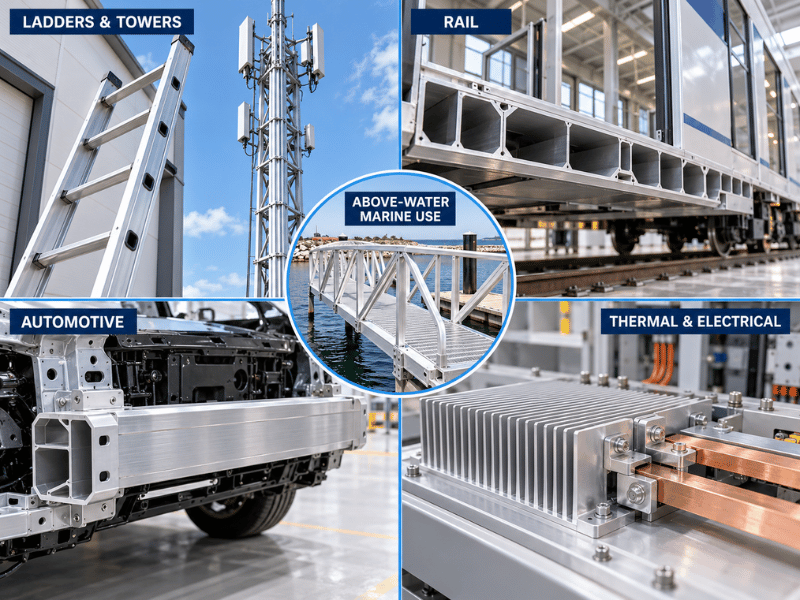
Le 6106 apparaît partout où un assemblage structurel soudé doit être léger, extrudé plutôt qu'usiné, et maintenu à une répétabilité dimensionnelle serrée.
Échelles, tours et mâts. L'application classique, citée en premier par presque tous les distributeurs. Les échelles extensibles et les rails d'échafaudage bénéficient de sections creuses à paroi mince offrant une rigidité élevée par unité de poids, d'un fini de surface propre sur les parties manipulées par les utilisateurs, et d'une soudabilité. Les jonctions échelon-rail sont soudées, de sorte que la tolérance ZAT ci-dessous régit la conception du joint.
Matériel roulant ferroviaire. Sections structurelles extrudées dans les cadres de caisse, les supports de plancher et l'ossature intérieure. La combinaison de profilés multi-vides complexes, de soudabilité et de comportement au feu et à la fumée maintient les alliages 6xxx dominants ici, et la capacité de remplissage du 6106 soutient les sections intégrées qui remplacent plusieurs pièces fabriquées.
Structures automobiles. Caissons de crash, poutres de pare-chocs, composants de sous-châssis, rails de toit et encadrement de boîtiers de batteries. La capacité de paroi mince entraîne directement une réduction de masse, et la conductivité plus élevée importe là où le boîtier fait partie d'un circuit de gestion thermique.
Marine et offshore. Structures de pont, passerelles, mâts et ossature de superstructure. Il convient toutefois de le dire clairement : une bonne résistance générale à la corrosion n'équivaut pas à une qualité marine. L'immersion continue en eau de mer ou le service en zone d'éclaboussures relève des alliages 5xxx tels que le 5083-H116 ou le 5086-H116, qui résistent à la sensibilisation d'une manière que les sections 6xxx à haute teneur en magnésium mais différentes ne permettent pas. Utiliser le 6106 au-dessus de la ligne de flottaison, pas en dessous.
Architecture et bâtiment. Éléments structurels de murs-rideaux, profilés de vitrage structurel et ossatures portant une charge réelle plutôt que décorative, où la même extrusion doit satisfaire à la fois les limites de déflexion et une exigence d'apparence.
Thermique et électrique. Dissipateurs de chaleur, barres omnibus, rails conducteurs et enceintes électriques, tirant parti d'une conductivité thermique d'environ 190 W/m·K et d'une conductivité électrique d'environ 49 % IACS. Ici, la spécification mécanique arrive généralement en second et la section est simple.
Soudage du 6106
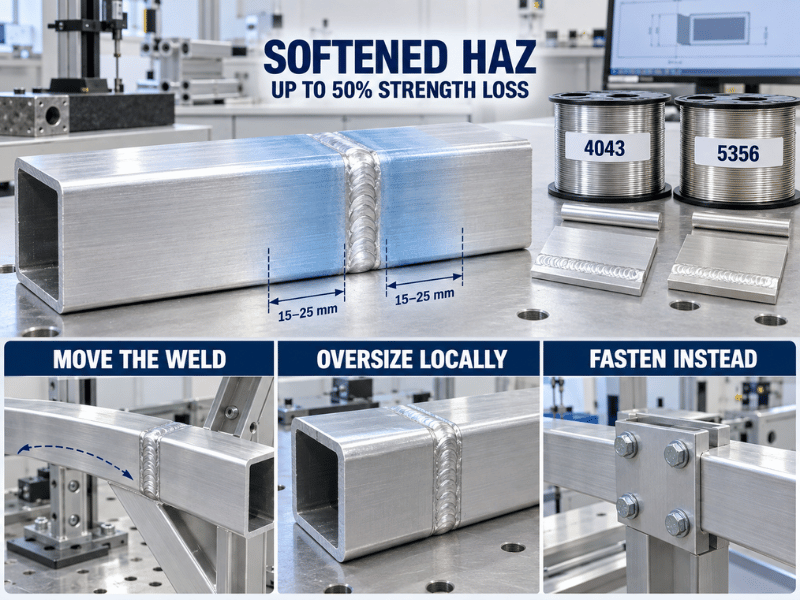
Le 6106 est classé très bon pour le soudage à l'arc. La difficulté ne réside pas dans le fait de le joindre — mais dans ce que l'arc fait au revenu le long de la soudure.
La zone affectée thermiquement perd de la résistance. Le 6106 tire sa résistance des précipités de Mg₂Si verrouillés par le traitement thermique. Une soudure par fusion réchauffe le métal adjacent à travers cette même fenêtre de précipitation sans contrôle, sur-vieillissant ou dissolvant ce qu'un cycle de four a construit, de sorte que la zone adjacente à la soudure peut perdre jusqu'à la moitié de la résistance du métal de base. Un apport thermique plus faible réduit cette perte ; il ne l'élimine pas. L'AWS D1.2 en tient compte en orientant les concepteurs vers les propriétés T4 ou O pour la zone affectée thermiquement plutôt que vers les valeurs T6, de sorte que la règle opérationnelle pour le 6106 est la même que celle utilisée pour toute extrusion 6xxx trempable : dimensionner le joint sur des valeurs réduites, et confirmer le chiffre par un essai de qualification là où le cas de charge importe.
Ce qui aide :
- Déplacer la soudure. La zone molle s'étend sur environ 15 à 25 mm de l'axe de la soudure, de sorte que maintenir les soudures à l'écart de la contrainte de flexion maximale est la solution la moins coûteuse.
- Surdimensionner localement. Une taille de paroi supplémentaire sur un tube récupère généralement toute la perte due au soudage pour très peu de poids.
- Assembler par fixation à la place. Un joint boulonné conserve la pleine résistance T6 du métal de base.
- Souder en T4, puis vieillir. Le soudage avant le vieillissement artificiel récupère sensiblement plus que le soudage après celui-ci, et un cycle à basse température sur un assemblage déjà T6 n'apporte presque rien. Nous ne réalisons pas le vieillissement en interne, donc l'intégrer au planning.
Métal d'apport. L'ER4043 convient à la fabrication générale ; l'ER5356 là où une résistance à l'état brut de soudage plus élevée ou une correspondance de couleur plus proche après anodisation est nécessaire. Notre guide des fils de soudage pour aluminium couvre la sélection, et le guide de soudage du 6061 couvre le contrôle des procédures et la qualification de la résistance des joints.
Usinage, formage et finition de surface
Usinage. Le 6106 s'usine bien en T6 avec des outils affûtés et un dégagement adéquat ; les états O et T4 plus tendres sont plus sujets à l'arête rapportée et à l'étalement, de sorte que la réputation de “ collant ” s'attache à ceux-ci plutôt qu'à l'état T6 que les gens usinent réellement. Dans le classement général d'usinabilité, le 6061 reste plus performant, donc là où une pièce est principalement constituée de copeaux plutôt que principalement d'extrusion, le 6061 demeure le meilleur choix.
Formage. Le faire avant le vieillissement final. Le T4 est l'état de formage pratique pour le pliage et la mise en forme ; le T6 ne tolère qu'un travail à froid limité, et tenter des pliages serrés invite à la fissuration le long de la fibre externe. Le retour élastique est modéré et se contrôle mieux par la conception de la matrice que par la substitution d'alliage. Rappelons que tout chauffage local important lors du redressage ramollira la zone de la même manière qu'une soudure.
Anodisation. L'un des véritables avantages du 6106. La faible teneur en fer et en cuivre donne des films anodiques clairs et colorés réguliers, et la bonne surface brute d'extrusion signifie moins de préparation mécanique avant le bain. La mise en garde pratique est qu'une section 6106 soudée ensemble montrera la soudure et sa ZAT comme une bande visible après anodisation, à moins que le métal d'apport et la procédure ne soient choisis pour l'apparence ; notre guide d'anodisation explique pourquoi la plupart des défaillances visibles commencent par la sélection de l'alliage et la préparation de surface plutôt que par l'anodisation elle-même.
Corrosion. Bonne résistance générale à la corrosion atmosphérique, typique de la série 6000, et meilleure que ce que beaucoup d'utilisateurs attendent en atmosphères industrielles. Elle n'est pas immunisée contre l'attaque intergranulaire dans des conditions agressives, et elle n'a pas sa place en immersion continue ou en zone d'éclaboussures. Le revêtement par poudre ou l'anodisation prolonge considérablement la durée de vie ; pour l'immersion marine, passer aux 5xxx plutôt que d'améliorer la finition.
Normes et documentation d'approvisionnement
Bien établir la documentation importe autant que bien choisir l'alliage, car c'est ce qui détermine si la section que vous recevez est celle que vous avez spécifiée.
Spécifier la norme et le revenu ensemble. “ 6106-T6 ” seul laisse trop de place à l'interprétation. Une ligne complète nomme l'alliage, le revenu, la forme du produit, la spécification applicable, la tolérance dimensionnelle applicable et la classe d'épaisseur de paroi. Pour les produits extrudés, cela signifie ASTM B221 ou EN 755-2 (avec EN 573-3 pour l'analyse de composition et GB/T 3190 pour l'approvisionnement des usines chinoises). Confirmez la disponibilité avant de citer si un dessin exige du 6106 contre une spécification de tôle ou de plaque laminée — une incompatibilité découverte après attribution coûte bien plus qu'une question posée tôt.
Documents à demander :
| Document | Ce que cela vous apporte |
| Certificat d'essai de coulée (MTC) | Composition spécifique au lot et valeurs mécaniques réelles pour le lot fourni |
| Certificat EN 10204 3.1 | Déclaration indépendante de l'usine attestant que les valeurs ont été vérifiées par rapport à la commande |
| Rapport chimique ou mécanique SGS | Vérification par un tiers lorsque le projet l'exige |
| Inspection dimensionnelle SGS | Vérification des dimensions critiques du profil par rapport au dessin |
La distinction à retenir : les chiffres de cet article sont typiques des valeurs d'orientation. Les chiffres qui font foi sont les minimums normatifs et les valeurs MTC pour le lot spécifique. En cas de divergence, le MTC prévaut.
Il convient également de confirmer avant de passer commande : la classe d'épaisseur de paroi, car elle détermine les valeurs mécaniques minimales ; la gamme de traitement thermique, T5 versus T6, car elle modifie à la fois le coût et les propriétés ; et si le dessin prévoit un vieillissement après extrusion après formage ou soudage, car cette étape doit figurer dans le planning plutôt que d'être découverte en cours de fabrication.
Quand choisir le 6106 — et quand ne pas le choisir
Choisissez le 6106 lorsque :
- La section est la contrainte, et non le numéro d'alliage — parois minces, multiples cavités, tolérances serrées, ou détails que le 6061 ne remplira pas de manière fiable à vitesse de production.
- Vous avez besoin de plus de résistance que le 6063 et d'un meilleur fini que le 6061, en particulier lorsque la même extrusion est structurelle et visible.
- La pièce sera soudée et modérément chargée, avec la possibilité de placer les joints à l'écart des contraintes maximales ou de surdimensionner localement. Tous les 6xxx se comportent ainsi ; planifiez en conséquence.
- Le poids au mètre est réduit par l'épaisseur de paroi plutôt que par la substitution d'alliage.
- La pièce conduit également — barre omnibus, dissipateur thermique, rail conducteur — où environ 49% IACS est un avantage que le 6061 ne peut égaler.
Cherchez ailleurs lorsque :
- La résistance de pointe régit la conception. Passez au 6061-T6 ou au 6082-T6.
- Un joint soudé doit conserver pleine résistance T6. Aucun alliage 6xxx ne le permet. Soit reconcevez pour que le cordon de soudure ne soit pas la localisation déterminante, soit examinez si un grade 5xxx non traitable thermiquement convient mieux au cas de charge.
- Le service est une immersion continue en eau de mer ou une zone d'éclaboussures. Passez au 5083-H116 ou 5086-H116.
- La pièce est une garniture architecturale décorative à faible charge. Le 6063 s'extrude plus facilement et s'anodise mieux, et il coûte moins cher. Voir notre guide d'extrusion du 6063.
- Le service fonctionne en continu au-dessus d'environ 160 °C. Le grossissement des précipités est permanent.
Conclusion
Le 6106 est un alliage d'extrusion 6xxx qui échange la résistance de pointe contre la distance qu'il peut parcourir à travers une filière — environ 20% plus résistant que le 6063-T6 tout en remplissant des sections à parois minces et multi-cavités que le 6061 ne peut produire de manière fiable. Deux pièges de spécification causent la plupart des défaillances avec cet alliage : le commander selon une norme de tôle ou de plaque laminée au lieu de l'ASTM B221 ou de l'EN 755-2, et dimensionner les joints soudés sur les valeurs du métal de base T6 alors que le soudage par fusion supprime jusqu'à la moitié de la résistance locale.
Nous fournissons 6106 sous forme de profilés, barres, tubes et fils en O, T4, T5 et T6, cotés selon l'ASTM B221 ou l'EN 755-2 avec la classe d'épaisseur de paroi indiquée, et nous assurons l'usinage CNC, le soudage, la découpe laser et l'anodisation en interne. Le vieillissement après soudage est une étape distincte en usine que nous n'effectuons pas nous-mêmes, donc intégrez-le au planning, et chaque commande est accompagnée d'un MTC.
Envoyez-nous le dessin, la norme et la gamme de traitement thermique, et nous confirmerons les épaisseurs de paroi disponibles, les tolérances et la documentation avant que vous ne vous engagiez.
Questions fréquemment posées
Comment le prix du 6106 se compare-t-il à celui du 6063 et du 6061 ?
Le grade importe moins que la façon dont la pièce est achetée. Le 6106 est une désignation plus étroite avec moins de stock d'usine que le 6063, donc la forme, le traitement thermique et la quantité commandée influent davantage sur le prix que le choix de l'alliage. Envoyez la section, le traitement thermique et le volume annuel, et nous citerons le lot réel plutôt qu'un prix catalogue.
Quelle est la quantité minimale de commande pour le 6106 ?
Les profilés en stock sont expédiés à partir des quantités de pack standard. Tout ce qui sort de la gamme stockée est une production personnalisée à faible MOQ, donc le minimum pratique dépend de la forme, du traitement thermique et de la disponibilité d'une coulée. Indiquez-nous la spécification et la quantité et nous confirmerons ce qui est expédié du stock et ce qui doit être produit.
Quel délai de livraison dois-je prévoir pour les extrusions en 6106 ?
Prévoyez environ 10 à 60 jours, selon que le profilé est en stock. Les sections en stock sont expédiées en quelques jours ; une nouvelle filière ajoute du temps de conception, de fabrication et d'essai avant la première longueur extrudée. Confirmez la section par rapport à votre planning de construction tôt, car la filière est sur le chemin critique.