6065 is specified for one thing: chip control. It is 6061’s chemistry with bismuth added — not a high-strength grade — and it rarely comes up until a drawing names it or a machinist asks for it. Reading it as a high-strength aerospace grade is the mistake that leads to the wrong specification.
The bismuth changes how the alloy machines, not how strong it gets: extruded product in both grades carries the same T6 minimum under EN 755-2.
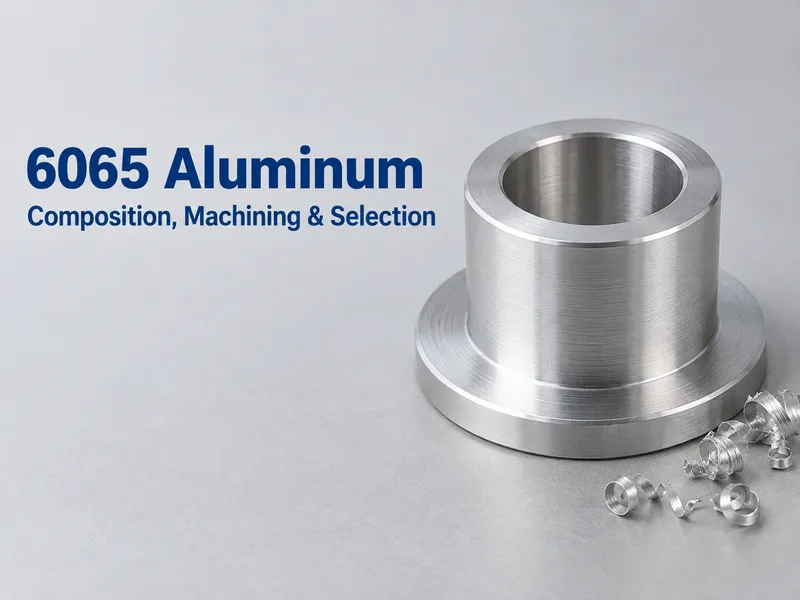
What Is 6065 Aluminum?
6065 is a heat-treatable aluminium-magnesium-silicon alloy of the 6xxx family. It is registered as AA/UNS 6065 (A96065) and as EN AW-6065 (AlMg1Bi1Si), and it strengthens the same way 6061 does — through Mg₂Si precipitation during age hardening.
Bismuth is what makes it a separate grade rather than a 6061 variant. 6065 carries 0.50–1.50% Bi under EN 573-3, added so that chips break instead of tangling. Remove the bismuth and the remaining element limits sit very close to 6061’s.
That one addition sets the purpose of the specification. When a drawing names 6065, the requirement behind it is chip control and as-machined finish — not a higher strength class, and not weldability.
Chemical Composition of 6065
The limits below are the registered values under EN 573-3. If a quote carries a different range, ask which standard it was drawn from.
| Element | Weight % |
| Silicon (Si) | 0.40 – 0.80 |
| Iron (Fe) | 0.70 max |
| Copper (Cu) | 0.15 – 0.40 |
| Manganese (Mn) | 0.15 max |
| Magnesium (Mg) | 0.80 – 1.20 |
| Chromium (Cr) | 0.15 max |
| Zinc (Zn) | 0.25 max |
| Bismuth (Bi) | 0.50 – 1.50 |
| Titanium (Ti) | 0.10 max |
| Zirconium (Zr) | 0.15 max |
| Lead (Pb) | 0.05 max |
| Others, each / total | 0.05 / 0.15 |
| Aluminium (Al) | Remainder |
Three rows do the separating from 6061. Bismuth at 0.50–1.50% has no counterpart in 6061, zirconium at up to 0.15% is likewise absent, and chromium is capped at 0.15% rather than 6061’s 0.04–0.35%. Bismuth is the row to look for on the certificate — a heat without it is not 6065.
The aluminium row is a remainder, not a fixed range.
If a certificate quotes balance figures that fall outside your specification, ask which standard the sheet was drawn against.
Lead is what separates 6065 from the other leaded free-machining 6xxx grades — 6262 and 6012 among them. At 0.05% maximum, lead stays a trace element here rather than an alloying addition.
Mechanical Properties by Temper
6065 is ordered mainly in O and T6. EN 755-2 tabulates it alongside the other 6xxx extrusion grades, and cold-drawn product is covered by EN 754-2.
| Temper | Form and governing standard | Tensile Rm min | Proof Rp0.2 min | Elongation A min | Elongation A50 min |
| O | Annealed — no tabulated minimum | — | — | — | — |
| T6 | Extruded rod, bar, tube and profile — EN 755-2 | 260 MPa | 240 MPa | 10% | 8% |
| T6 | Cold-drawn rod, bar and tube — EN 754-2 | 290 MPa | 240 MPa | 10% | 8% |
| T8 | Cold-drawn — EN 754-2 | 345 MPa | 315 MPa | 4% | 3% |
| T9 | Cold-drawn — EN 754-2 | 360 MPa | 330 MPa | 4% | 3% |
The figure to design against is 260 MPa tensile and 240 MPa proof for extruded product under EN 755-2. Those are the same minimums 6061 is tabulated at, so a switch from 6061 to 6065 does not buy strength. The higher T8 and T9 numbers come from cold work under EN 754-2 rather than from the alloy.
Section thickness moves those minimums, and EN 755-2 tabulates them by wall thickness — a heavy bar and a thin profile do not carry the same line of the standard. State the governing thickness on the enquiry and we will confirm the values for that thickness rather than quote a headline number.
O temper is the annealed, maximum-formability condition, supplied with properties declared on the mill certificate rather than fixed by a published minimum. Where a part is bent or formed before it sees service load, it is formed in O and heat treated afterwards; forming after aging is limited.
Machinability: What the Bismuth Buys
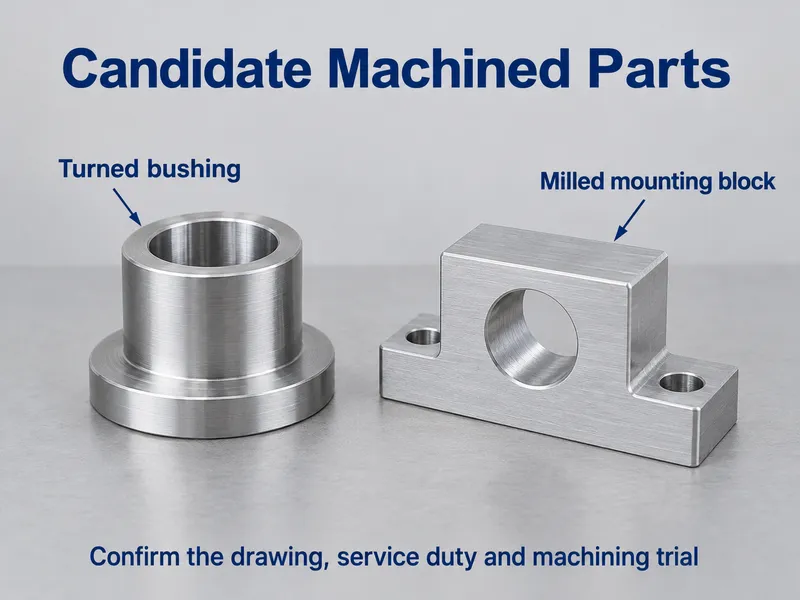
Bismuth does not strengthen aluminium. In the melt it forms discrete, low-melting particles, and those particles break the chip as the tool passes so that swarf comes off short instead of stringing around the tool and the workpiece.
On a simple part that difference barely registers. On a long-running job, a deep pocket, or a tight surface-finish call-out, it shows up as tool life, scrap rate, and the operator time spent clearing chips. That is the whole business case for moving a part from 6061 to 6065.
Against 6262, the deciding row is lead. 6262 uses 0.4–0.7% lead alongside its bismuth; 6065 holds lead at 0.05% maximum. Where an end product or a customer specification restricts lead content, that single row settles which of the two grades is usable.
The machining gain belongs to the aged tempers. In O the alloy is soft and ductile, which is the wrong condition for chip control — O is the forming temper, and machining normally happens after aging.
Welding, Forming and Finishing
6065 is a machining grade, not a welding grade. The same bismuth particles that break chips also enter the weld pool, and free-machining 6xxx grades weld poorly. A procedure qualified on 6061 does not transfer across, and a 6065 joint should not be assumed to reach parent-metal properties.
Where a design needs both machined detail and welded structure, the usual split is 6061 or 5083 for the welded members. If a 6065 part must be welded, qualify the procedure on the alloy and temper actually being supplied rather than extending an existing one.
Forming is straightforward in O, which makes annealed stock the normal input for parts that are bent before aging. Anodizing and polishing are both supported on 6065; confirm the finish class and any colour-match requirement against a sample before releasing the part.
How 6065 Compares with 6061
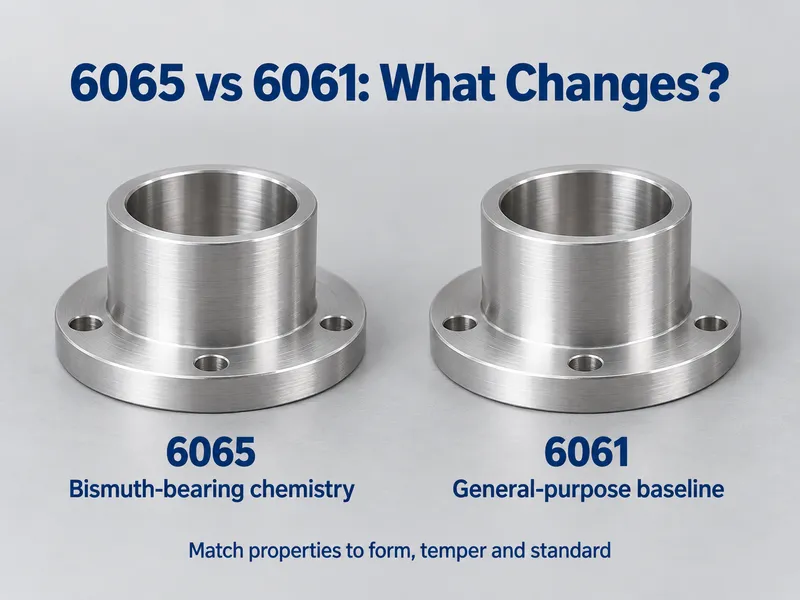
| Property | EN AW-6065 | EN AW-6061 |
| Registered name | AlMg1Bi1Si | AlMg1SiCu |
| Bismuth | 0.50 – 1.50% | not present |
| Zirconium | 0.15% max | not present |
| Chromium | 0.15% max | 0.04 – 0.35% |
| T6 minimum, extruded (EN 755-2) | Rm ≥ 260 MPa, Rp0.2 ≥ 240 MPa | Rm ≥ 260 MPa, Rp0.2 ≥ 240 MPa |
| Machining behaviour | Free-cutting; bismuth breaks the chip | General machining |
| Welding | Not a welding grade | Readily welded |
| What decides the choice | Chip control and as-machined finish | Availability, weldability, price |
Choose 6065 only when chip control or surface finish is the bottleneck.
If welding appears anywhere in the routing, stay on 6061. If the part is a machined detail inside a welded assembly, split the two: 6061 for the welded members, 6065 for the parts cut from solid.
Neither grade is a marine alloy in the sense that 5083 or 5052 are. For permanent immersion or heavy chloride exposure, the 5xxx grades remain the safer starting point.
Where 6065 Is Used
- Machined components and fittings cut from bar, tube and extruded stock
- Transport structures — truck bodies and rail car components
- Building framing and support sections
- Aircraft and vehicle components where machining dominates the routing
- Marine hardware and engine-adjacent parts that are not welded assemblies
- General industrial fabrication that needs a clean as-machined finish
Go / No-Go: Should You Specify 6065?
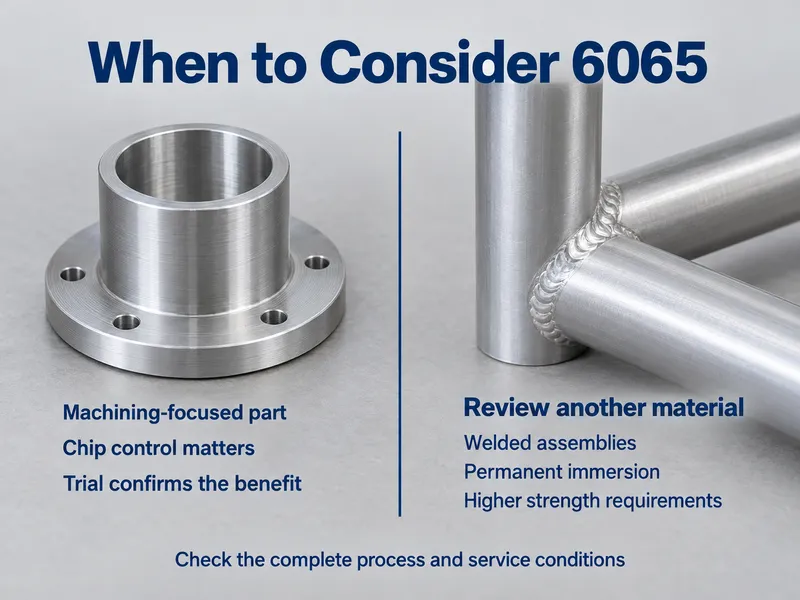
These are the conditions to check before the grade goes on a drawing. They answer whether the alloy fits, not where it is used.
Specify 6065 when:
- Parts are scrapped or reworked because chips wrap the tool or the finish will not hold
- The routing is all machining, with no welding step anywhere in it
- The drawing already names 6065, or a customer specification calls for a low-lead free-machining 6xxx grade
- A 6061 part machines acceptably but not repeatably, and the volume justifies a grade change
Choose another grade when:
- The component is a welded assembly — 6061 is the direct swap and costs less
- Service is permanent immersion or heavy chloride exposure — move to 5083 or 5052
- More strength than 6061 delivers is required — 6065 sits on the same minimums, and 6082 is the next 6xxx step up
- Unit price is the deciding factor — 6065 is a narrower grade than 6061 and rarely wins on cost
Sourcing 6065: Standards, Stock and Documents
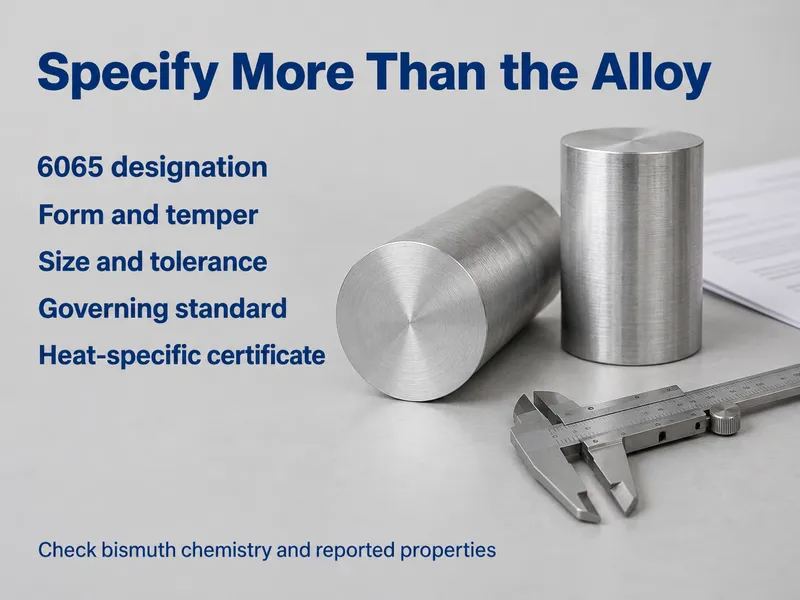
Stock depth comes first. 6065 is not held at anything like the breadth of 6061, and some distributors list it without carrying it. We confirm form, temper and size against actual stock rather than a catalogue line.
Then fix the standard on the order. Quote EN AW-6065 (AlMg1Bi1Si) or AA/UNS 6065 (A96065), name the form and temper, and state the governing standard — EN 755-2 for extruded product, EN 754-2 for cold-drawn. An order that names only “6065” leaves the bismuth range and the property minimums open.
Documentation is what closes the loop. The MTC reports the actual chemistry and mechanical results for the heat, which is how the bismuth row and the proof strength get checked against the standard you specified.
The 6065 aluminium alloy page lists the forms and tempers held, so the size can be checked before you write the enquiry.
Conclusion
6065 is a narrow, purpose-built grade, and the trade it makes is worth stating plainly. Bismuth buys chip control and surface finish on parts that are machined, and it costs the alloy its weldability and its place in the general-purpose supply chain. Nothing in the chemistry makes it stronger than 6061 — both sit on the same T6 minimum line.
We supply EN AW-6065 (AlMg1Bi1Si) in O and T6 across sheet, bar, tube and wire, including low-MOQ custom sizes for a grade most distributors list but do not hold. Every order ships with an MTC.
Send us the drawing or part specification and we will confirm the form, temper and tolerance before you commit.
Frequently Asked Questions
Is 6065 lead-free?
Not strictly. Lead is capped at 0.05% under EN 573-3, which keeps it a trace limit rather than a deliberate addition. That makes 6065 the low-lead option next to 6262, where lead runs 0.4–0.7%. If a specification bans lead outright, have the certificate checked before the order is placed.
What is the minimum order quantity and lead time?
Standard forms ship from stock; non-stock items go to low-MOQ custom production, typically 10–60 days depending on alloy, size and processing. Confirm both against your specific size before planning a build around them.
What documents come with a 6065 order?
An MTC carrying the actual chemistry and mechanical results for the heat. That is how the bismuth content and the proof strength get checked against the standard you named. Where the project needs independent evidence, SGS reports can be arranged at additional testing cost.