¿Qué es el aluminio 5454?
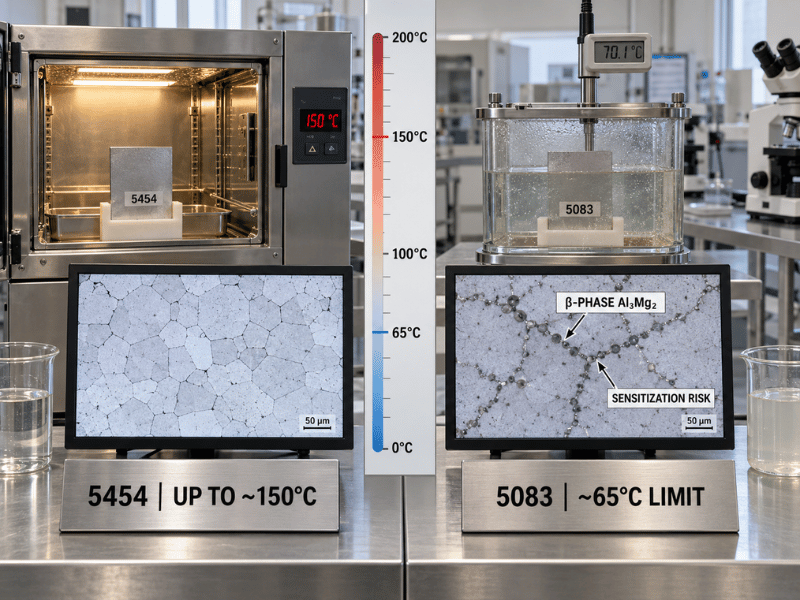
5454 is the 5xxx alloy built for a specific problem: aluminium-magnesium grades that are strong and corrosion-resistant at room temperature, but that become unreliable when they get warm. Its magnesium content is capped at 3.0%, keeping it just under the threshold where high-magnesium grades such as 5083 (4.0–4.9% Mg) and 5456 (4.7–5.5% Mg) start to sensitise and become vulnerable to stress-corrosion cracking above roughly 65 °C. Manganese and chromium are added in small controlled amounts to refine grain structure and suppress the grain-boundary precipitation that drives that failure mode.
The result is a non-heat-treatable alloy that holds useful strength and corrosion resistance in continuous service to about 150 °C — the reason 5454 is one of the few 5xxx grades recognised in ASME pressure-vessel codes for elevated-temperature aluminium construction. It is supplied almost entirely as plate and sheet, and it is specified for welded chemical tanks, warm-process vessels, tanker shells, and marine components that see heat.
What 5454 is not is the strongest option. Where peak tensile strength at room temperature is the deciding factor, 5083 wins and 6061-T6 wins by more. The selection question 5454 answers is different: can the alloy stay intact at the service temperature, not just at the test bench.
5454 Chemical Composition
Composition limits per ASTM B209 / EN 573-3, in weight percent.
| Elemento | Contenido (%) | Papel |
|---|---|---|
| Magnesio (Mg) | 2.4 – 3.0 | Solid-solution strengthening; capped to limit sensitisation |
| Manganeso (Mn) | 0.50 – 1.00 | Raises strength; refines grain structure |
| Cromo (Cr) | 0.05 - 0.20 | Suppresses grain-boundary precipitation |
| Silicio (Si) | 0,25 máx. | Impureza |
| Hierro (Fe) | 0.40 máx. | Impureza |
| Cobre (Cu) | 0,10 máx. | Kept low for corrosion resistance |
| Zinc (Zn) | 0,25 máx. | Traza |
| Titanio (Ti) | 0,20 como máximo | Refinador de grano |
| Otros (cada uno) | 0,05 máx. | Trazas de impurezas |
| Otros (total) | 0,15 máx. | Suma de impurezas traza |
| Aluminio (Al) | Resto | Base |
The manganese and chromium additions are what separate 5454 from plain Al-Mg sheet. Manganese adds roughly 10–15% to tensile and yield strength compared with a comparable Mg level, and together with chromium it inhibits the intergranular precipitation that would otherwise open a stress-corrosion path in welded joints under sustained load. That combination is why 5454 appears in tank and vessel specifications where 5052 or 5754 are not accepted.
5454 Mechanical Properties by Temper

Typical values for plate and sheet. ASTM B209 mínimos values are lower and vary with thickness — the guaranteed figures for a specific lot come from the mill test certificate.
| Temple | Resistencia a la tracción (MPa) | Límite elástico (MPa) | Alargamiento (%) | Dureza (HB) |
|---|---|---|---|---|
| O | 250 | 117 | 22 | 62 |
| H32 | 275 | 207 | 10 | 73 |
| H34 | 305 | 241 | 10 | 81 |
| H36 | 340 | 276 | 8 | — |
| H38 | 370 | 310 | 8 | 100 |
| H111 | 260 | 179 | 14 | 70 |
| H112 | 250 | 124 | 18 | 62 |
Two things drive most temper decisions here. First, H32 and H34 are the only two tempers most 5454 specifications actually use — H32 for formed and welded vessels, H34 for load-bearing shells with less forming. Second, the H3x series matters in a way it does not for other alloys: H1x tempers are strain hardened only, while H3x tempers are strain hardened and then stabilised with a low-temperature treatment. In a welded pressure vessel that stabilisation buys measurably better post-weld resistance to intergranular corrosion. For welded construction, prefer H32 or H34 over the unstabilised equivalents.
H111 and H112 are worth knowing because they are not interchangeable with O. H112 is the as-hot-rolled condition used for thick plate and welded structural work, carrying moderate strength without a separate cold-work step. H111 is lightly strain hardened after annealing, giving a little more strength than O while retaining most of its ductility.
Why 5454 Resists Stress Corrosion Cracking
This is the section that justifies the alloy, so it is worth being precise about the mechanism.
In aluminium-magnesium alloys containing more than about 3% magnesium, sustained exposure above roughly 65 °C causes the magnesium to precipitate as β-phase (Al₃Mg₂) along grain boundaries. Those boundaries become anodic and susceptible to intergranular attack; under sustained tensile stress in a corrosive environment, that becomes stress-corrosion cracking. The damage is cumulative and cannot be reversed by heat treatment, which is why 5083 and 5456 plate carries a service-temperature caveat rather than a repair procedure.
By capping magnesium at 3.0% and adding chromium, 5454 minimises that precipitation. The practical consequence is a service window that opens where 5083’s closes:
| Service condition | 5454 | 5083 |
|---|---|---|
| Continuous service, ambient | Excelente | Excelente |
| Continuous service above ~65 °C | Accepted — rated to about 150 °C | Not recommended; SCC risk |
| Post-weld integrity in warm service | Strong — stabilised H3x tempers preferred | Requires H116/H321 condition and temperature control |
| ASME pressure-vessel recognition, elevated temperature | Sí | Limited by the temperature ceiling |
Strength also falls with temperature, as it does for every aluminium alloy. 5454-H32 at 150 °C retains roughly 200 MPa tensile against its 275 MPa room-temperature figure — about 70% retained, which is a working load, not a residual one. Above roughly 200 °C the decline steepens regardless of alloy and stainless or nickel alloys become the standard material choice.
Design stresses for pressure service must be taken from the applicable code allowable-stress tables for the actual design temperature, not from the room-temperature values in the table above. The ~150 °C figure is a widely accepted continuous-service guideline, and ASME coverage extends into the 150–200 °C band for qualified pressure service.
5454 Physical Properties
| Propiedad | Valor |
|---|---|
| Densidad | 2,69 g/cm³ |
| Rango de fusión | 602 – 646 °C |
| Conductividad térmica | ~134 W/m·K |
| Conductividad eléctrica | ~34% IACS |
| Coeficiente de expansión térmica | 23.6 × 10⁻⁶ /°C (20–100 °C) |
| Capacidad calorífica específica | ~900 J/kg-K |
| Módulo de elasticidad | ~70 GPa |
| Coeficiente de Poisson | 0.33 |
The conductivity figures are lower than 5052’s (~138 W/m·K, ~35% IACS) because 5454 carries more magnesium and manganese in solid solution. That is the expected trade-off: alloying for strength and thermal stability costs some conductivity. Where the application is thermally driven rather than structurally driven, 5052 or 3005 will usually be the better and cheaper choice.
5454 Aluminum Plate and Sheet: Forms, Sizes, and Tempers
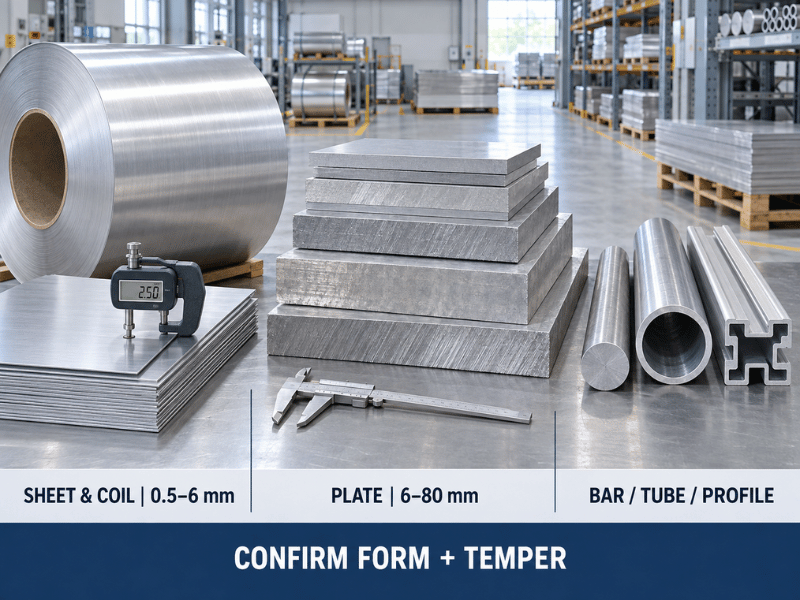
5454 is overwhelmingly a flat-rolled alloy, and the plate-versus-sheet distinction is the first thing to settle when specifying it. The dividing line is nominal thickness: sheet runs from about 0.5 mm up to 6 mm, and plate starts at 6 mm. Plate is used for welded shells, baffles, and structural members where thickness carries the load; 5454 aluminum sheet is used for formed tank liners, compartment partitions, and cladding where the panel is shaped rather than load-bearing.
| Formulario | Thickness / size range | Temple comunes |
|---|---|---|
| Chapa y bobina | 0.5 – 6 mm | O, H32, H34, H38 |
| Placa | 6 – 80 mm | H32, H34, H111, H112 |
| Bar (round, flat, square) | 6 – 300 mm | O, H111, H112 |
| Tube and pipe (seamless / welded) | OD 6 – 400 mm, wall 0.5 – 40 mm | O, H32, H34, H111, H112 |
| Extruded profile | On request | H111, H112 |
A few practical notes on specifying 5454 aluminum plate and sheet:
- Thicker plate is almost always H112 or H32. Cold-worked tempers become difficult to produce and less useful above roughly 25 mm, so heavy sections arrive in the as-hot-rolled or stabilised condition.
- H38 is a sheet and thin-plate temper. It reaches 370 MPa but elongation drops to 8%, so it suits wear-resistant decking and non-formed parts rather than anything with a radius.
- Standard 5454 aluminum sheet bends tighter than plate. In H32, thin sheet takes bend radii approaching the material thickness; plate in H34 generally needs a radius of one to two times thickness, and thicker sections need more.
- Bar and tube arrive in different tempers than sheet. The H32/H34 range is a flat-rolled designation; bar, tube, and extruded profile come in O, H111, or H112. Do not carry a sheet temper across to a bar or profile specification without confirming it.
Corrosion Resistance and Service Limits
5454 resists seawater, marine atmosphere, industrial waste, and a range of chemical exposures. The moderate magnesium level keeps general corrosion resistance high while the capped chemistry removes the sensitisation pathway that limits higher-magnesium grades. This combination — corrosion resistance, weldability, and thermal stability in one alloy — is what makes 5454 a standard material for ammonium nitrate and certain petrochemical storage, and for road tanker bodies and process vessels where the contents arrive warm.
Two limits to keep in view. 5454 is not the choice for continuous seawater immersion on a heavily loaded structure: 5083 and 5086 are stronger and are the recognised hull-plate grades, and where their temperature ceiling is not a constraint they are the better specification. And like any aluminium alloy, 5454 corrodes quickly when electrically coupled to a more noble metal in a wet environment, so direct contact with steel or copper alloys needs an insulating barrier.
Working With 5454

Soldadura. GTAW (TIG), GMAW (MIG), resistance welding, and friction stir welding all work. The filler decision is the one that actually matters:
| Relleno | Chemistry | As-welded strength | Effect on elevated-temperature performance |
|---|---|---|---|
| ER5356 | Al-5% Mg | Más alto | Slightly reduces weld-zone SCC resistance in warm service |
| ER5554 | Al-2.7% Mg | Ligeramente inferior | Matches base metal; preserves the full thermal and corrosion rating |
For structural joints and anything that will run warm, ER5554 is the standard recommendation because it matches the base alloy and keeps the weld zone’s corrosion behaviour consistent with the plate. ER5356 is the right call where as-welded strength dominates and the service temperature stays low. For code work, the filler must be confirmed against the welding procedure specification and the design temperature.
No preheat and no post-weld heat treatment are required. As with every non-heat-treatable alloy, the heat-affected zone reverts toward annealed strength and cannot be recovered by heat treatment — design the joint against the annealed values, not the parent-metal temper.
Conformado. 5454 forms well in O and H32. Deep drawing and tight-radius bending are practical in O; press-brake work on 6–8 mm plate is common in H32 without intermediate annealing. Its work-hardening rate sits between 5052 and 5083 — enough to build strength quickly, but not so much that forming becomes a multi-step operation.
Mecanizado. Fair to moderate, and noticeably better in H34 than in softer tempers. Expect gummy chips and built-up edge, so use sharp tooling, high cutting speeds, and generous lubrication. Where a part is machining-dominated rather than vessel-dominated, 6061-T6 is the better starting point.
Recocido. Stress relief is typically carried out around 343 °C (650 °F) with air cooling. Sustained exposure above roughly 220 °C should be avoided, since it softens the cold-worked structure rather than restoring it.
Anodizado. Worth knowing before it becomes a problem: 5xxx alloys anodise to a muted grey, not the bright, uniform finish that 6xxx extrusion grades produce. If the drawing calls for a decorative anodised appearance, 5454 is the wrong alloy and that requirement should be raised at specification time, not after anodising.
5454 vs 5052 vs 5083 vs 6061
| Aleación y temple | Tracción (MPa) | Límite elástico (MPa) | Alargamiento (%) | Dureza (HB) | Warm service | Lo mejor para |
|---|---|---|---|---|---|---|
| 5454-H32 | 275 | 207 | 10 | 73 | ~150 °C | Welded pressure vessels, warm chemical and marine service |
| 5454-H34 | 305 | 241 | 10 | 81 | ~150 °C | Load-bearing tank shells, tanker bodies |
| 5052-H32 | 228 | 193 | 12 | 60 | Lower hot strength | General sheet metal, fuel tanks, enclosures |
| 5083-H116 | 317 | 228 | 16 | — | ~65 °C limit | Marine hull plate, cryogenic containment |
| 6061-T6 | 310 | 276 | 12 | 95 | Strength declines with heat | Structural frames, machined components |
5454 vs 5052. 5052 is the cheaper, more widely stocked general-purpose Al-Mg sheet alloy. 5454 adds manganese and chromium, which lifts tensile strength by roughly 20% at a comparable magnesium level and — more importantly — improves strength retention and post-weld corrosion behaviour at elevated temperature. Choose 5052 for cost-driven general fabrication with no thermal requirement; choose 5454 when the vessel or tank runs warm or carries a code qualification.
5454 vs 5083. 5083 is about 10–12% stronger at room temperature and is the standard marine hull-plate grade. It also carries the ~65 °C sensitisation limit. If the design temperature crosses that line, 5454 is the specified alloy — chemical transport tanks, asphalt and warm-process vessels, and marine exhaust components are the classic cases. If it does not, 5083’s extra strength and marine certification usually win.
5454 vs 6061. Different categories. 6061-T6 is heat-treatable, roughly comparable in tensile strength, far more machinable, and the standard choice for structural and machined parts. But it is not the default pressure-vessel or chemical-service grade, and bare 6061 corrodes in saltwater and many chemicals. Where corrosion integrity and weldability matter more than machinability, 5454 is the answer.
Go/No-Go: When to Specify 5454
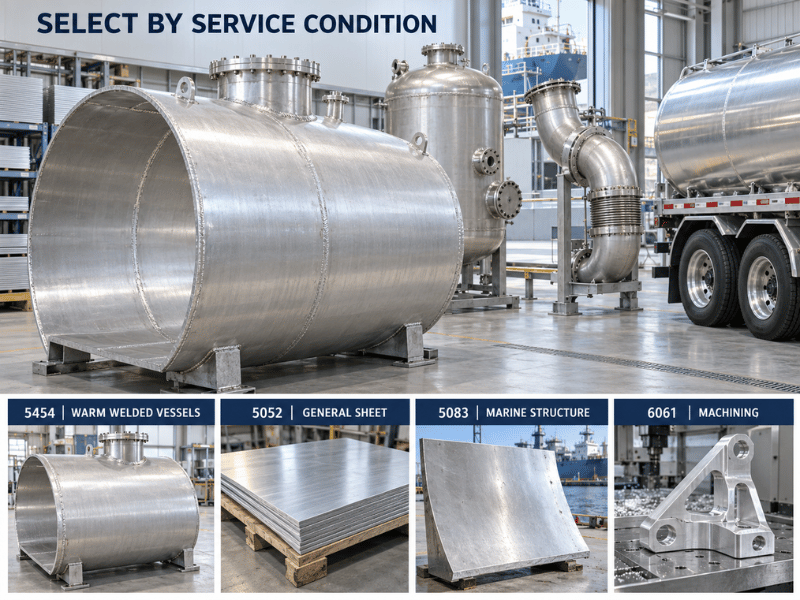
Specify 5454 when:
- Sustained service temperature falls between roughly 65 °C and 150 °C, and the environment involves saltwater, chemicals, or industrial waste — this is 5454’s defining window
- The application is a welded pressure vessel or storage tank requiring code qualification
- Corrosion resistance, weldability, and thermal stability are all required in one material
- The part is flat-rolled plate or sheet that will be formed and welded
- You need moderate strength with a documented mill test certificate
Busque otra opción cuando:
- Room-temperature tensile strength above roughly 330 MPa is the primary requirement — 5083-H116 is stronger, and 6061-T6 or 7075-T6 are stronger still if a heat-treatable alloy is acceptable
- Continuous service temperature exceeds about 150 °C, or peaks beyond roughly 200 °C — aluminium loses strength rapidly in that range and stainless or nickel alloys become the standard choice
- A bright, uniform anodised finish is specified — 5xxx alloys anodise to a muted grey
- Continuous seawater immersion on a loaded structure — 5083 or 5086 in H116/H321 condition
- High-volume CNC machining is the primary production method — 6061-T6 or 7075-T6 machine far better
- Cost is the dominant constraint and there is no thermal requirement — 5052 or 5754 will do the same job for less
Where 5454 Is Used
| Sector | Piezas típicas | Why 5454 |
|---|---|---|
| Chemical processing | Storage tanks, transport vessels, piping for nitrates and petrochemicals | Elevated-temperature corrosion resistance plus weldability |
| Recipientes a presión | ASME-code welded vessels for moderate-temperature service | Code recognition and retained strength to ~150 °C |
| Transporte | Road tanker bodies, rail tank cars, fuel and chemical tank shells | Strength-to-weight with warm-cargo tolerance |
| Marine and offshore | Exhaust components, cooling-water piping, warm-process tanks, deck fittings | Marine corrosion resistance where 5083’s temperature limit applies |
| Industrial equipment | Heat-exchanger shells, process piping, scrubber components | Thermal stability under sustained load |
Ventajas y limitaciones de un vistazo
| Dimensión | Ventaja | Advertencia |
|---|---|---|
| Elevated temperature | Rated to ~150 °C continuous, where 5083 stops at ~65 °C | Strength still declines; above ~200 °C look to other materials |
| Corrosión | Excellent marine, chemical, and industrial-waste resistance | Not for loaded continuous seawater immersion |
| Soldabilidad | Clean TIG/MIG/FSW; no preheat or post-weld heat treatment | HAZ reverts toward annealed strength — design to it |
| Resistencia al SCC | Strong, including in welded joints | Filler choice matters — ER5554 for warm service |
| Fuerza | Higher than 5052 at comparable Mg | Below 5083 and well below 6061-T6 |
| Formabilidad | Good in O and H32; H3x stabilisation aids welded work | H38 is a sheet temper with 8% elongation |
| Mecanizado | Workable | Gummy chips; behind 6061 by a clear margin |
| Acabado superficial | Takes paint, powder coat, and mill finish well | Anodises to muted grey — not a decorative alloy |
| Cost and availability | Standard plate and sheet product | Priced above 5052; a specialty grade |
Conclusión
5454 exists because aluminium-magnesium alloys lose reliability when they get hot — and some applications can’t tolerate that. By capping magnesium at 3.0% and adding manganese and chromium, it holds useful strength and corrosion resistance to about 150°C, past the point where 5083 and 5456 begin to sensitise, earning ASME recognition for elevated-temperature pressure service. The price is moderate strength against 5083 at room temperature, a muted anodised finish, and a premium over 5052 — fair trade-offs when the vessel runs warm and the joint is welded, the wrong ones for a room-temperature enclosure or a machined bracket. So set the design temperature first, the temper second, and the rest of the decision makes itself.
Linsy Aluminum suministra 5454 in plate, sheet, coil, bar, tube, and extruded profile across the common tempers, with in-house machining, welding, laser cutting, anodizing, and polishing — send your drawing with the design temperature and weld details, and we’ll check the service limit and filler before you commit.
Preguntas frecuentes
What makes 5454 aluminum suitable for elevated-temperature service?
Its magnesium content is capped at 3.0%. Above about 3% Mg, 5xxx alloys become susceptible to stress-corrosion cracking above roughly 65 °C, as magnesium precipitates as β-phase (Al₃Mg₂) along grain boundaries. Capping the magnesium, and adding chromium to inhibit that precipitation, keeps 5454 usable in continuous service to about 150 °C with its corrosion resistance intact. Design stresses for pressure service should still be taken from the applicable code tables for the actual design temperature.
How hard is 5454 aluminum?
Typical Brinell hardness runs 62 HB in the annealed O condition, 73 HB in H32, 81 HB in H34, and 100 HB in H38. The H111 and H112 conditions sit around 70 HB and 62 HB respectively. Published figures vary somewhat by source and thickness, so treat these as typical and confirm guaranteed values against the mill test certificate. Hardness is useful for receiving inspection; sizing calculations should use tensile and yield strength.
What is the difference between 5454-H32 and H34?
Both are strain hardened and stabilised, so both hold their properties rather than age-softening. H32 is quarter-hard — about 275 MPa tensile and 207 MPa yield — and is the standard choice for formed and welded vessels. H34 is half-hard at roughly 305 MPa tensile and 241 MPa yield, used for load-bearing shells where less forming is required. Moving from H32 to H34 buys about 11% more strength and costs some formability, so H32 remains the safer default for anything that gets bent.
¿Qué metal de relleno se debe utilizar para soldar 5454?
ER5554 is the standard recommendation for structural joints and anything running warm, because its ~2.7% magnesium matches the base alloy and preserves the weld zone’s corrosion resistance and thermal rating. ER5356 gives higher as-welded strength but slightly reduces weld-zone SCC resistance at elevated temperature, so it suits low-temperature service where strength dominates. For code-qualified pressure work, confirm the filler against the welding procedure specification and design temperature.
Is 5454 the same as 5754?
No — they are related but not interchangeable. 5754 is an Al-Mg alloy with 2.6–3.6% magnesium and no chromium addition; it is widely used for automotive and general sheet work where deep formability matters most. 5454 adds manganese for roughly 10–15% more strength plus chromium for grain-boundary control, which is what improves its stress-corrosion performance and elevated-temperature rating. If a specification calls for pressure-vessel or warm-chemical service, 5454 is the correct grade and 5754 is not a substitute.