O que é o Alumínio 5182
O 5182 é uma liga de alumínio–magnésio reforçada por magnésio em solução sólida e por trabalho a frio. Não pode ser endurecida por precipitação — não existe rota de tratamento de solubilização e envelhecimento, portanto toda a resistência acima da condição recozida vem da deformação, expressa nos temperamentos H.
Duas consequências decorrem disso, e ambas se manifestam na forma como a liga é comprada:
- O temperamento é a especificação. Encomendar “5182” sem temperamento é sem sentido. A diferença entre o 5182-O (cerca de 145 MPa de limite de escoamento, 21% de alongamento) e o 5182-H19 (cerca de 395 MPa de limite de escoamento, 4% de alongamento) é maior do que a diferença entre muitas ligas diferentes.
- A soldagem amolece a zona afetada pelo calor. O trabalho a frio é recozido localmente pelo ciclo de soldagem, e não há tratamento térmico para restaurá-lo. As juntas soldadas são mais fracas que o metal base em temperamento H, e a junta deve ser projetada levando isso em consideração.
As especificações aplicáveis para produtos laminados planos são ASTM B209 (chapa e placa), EN 485-2 (propriedades mecânicas) e EN 573-3 (composição) na Europa, GB/T 3880 na China, e JIS H4000 no Japão. Chapas automotivas são frequentemente especificadas conforme GMW15192 ou uma norma de material equivalente de OEM, e não apenas conforme a B209. Designações equivalentes são UNS A95182, EN AW-5182e ISO AlMg5 em algumas referências.
Composição Química do 5182
| Elemento | Peso % | Função na liga |
|---|---|---|
| Magnésio (Mg) | 4.0 – 5.0 | Principal elemento de reforço; determina a resistência à corrosão |
| Manganês (Mn) | 0.20 – 0.50 | Controle da estrutura de grãos, tenacidade |
| Ferro (Fe) | 0,35 máx. | Impureza — controlada para proteger a conformabilidade |
| Silício (Si) | 0,20 máx | Impureza — mantida baixa para limitar trincas na conformação |
| Cobre (Cu) | 0,15 máximo | Impureza — mantida baixa para proteger a resistência à corrosão |
| Zinco (Zn) | 0,25 máximo | Impureza |
| Cromo (Cr) | 0,10 máximo | Controle menor da estrutura de grãos |
| Titânio (Ti) | 0,10 máximo | Refinador de grãos durante a fundição |
| Outros (cada / total) | 0,05 / 0,15 máx. | — |
| Alumínio (Al) | Remanescente (93,2 – 95,8) | Metal base |
A faixa de magnésio é o número a memorizar. Com 4,0–5,0%, o 5182 contém mais magnésio que o 5083 (4,0–4,9%) e muito mais que o 5052 (2,2–2,8%). É daí que vêm tanto sua resistência quanto sua resistência à corrosão — e é também o que o coloca firmemente dentro do limite de temperatura discutido mais adiante neste guia.
Propriedades físicas
| Propriedade | Valor |
|---|---|
| Densidade | 2,65 – 2,66 g/cm³ |
| Faixa de fusão | 577 – 638 °C (1.070 – 1.180 °F) |
| Condutividade térmica | ~126 W/m·K a 25 °C |
| Condutividade elétrica | ~28 – 32% IACS a 20 °C |
| Coeficiente de expansão térmica | 23,9 × 10⁻⁶ /°C (20–100 °C) |
| Capacidade térmica específica | ~900 J/kg-K |
| Módulo de elasticidade (tração) | ~70 GPa (10.100 ksi) |
| Coeficiente de Poisson | 0.33 |
Dois destes são regularmente citados incorretamente. A faixa de fusão é 577–638 °C, e não o valor de 607–649 °C frequentemente copiado de fichas técnicas do 5052 — as propriedades físicas da série 5xxx são constantemente transpostas entre graus, e o 5182 e o 5052 são adjacentes na maioria das tabelas de propriedades. E a condutividade térmica de ~126 W/m·K é bem inferior à do 5052, de ~138, o que importa se a peça precisa dissipar calor e não apenas manter a forma.
Propriedades Mecânicas por Têmpera
Os valores abaixo são valores típicos dos dados de referência da Aluminum Association. São representativos, não garantidos — o projeto e a aceitação devem usar os mínimos da norma aplicável para o temperamento e a espessura especificados, juntamente com os valores do certificado de ensaio da usina.
| Temperamento | Resistência à tração (MPa) | Limite de escoamento (MPa) | Alongamento (%) | Uso típico |
|---|---|---|---|---|
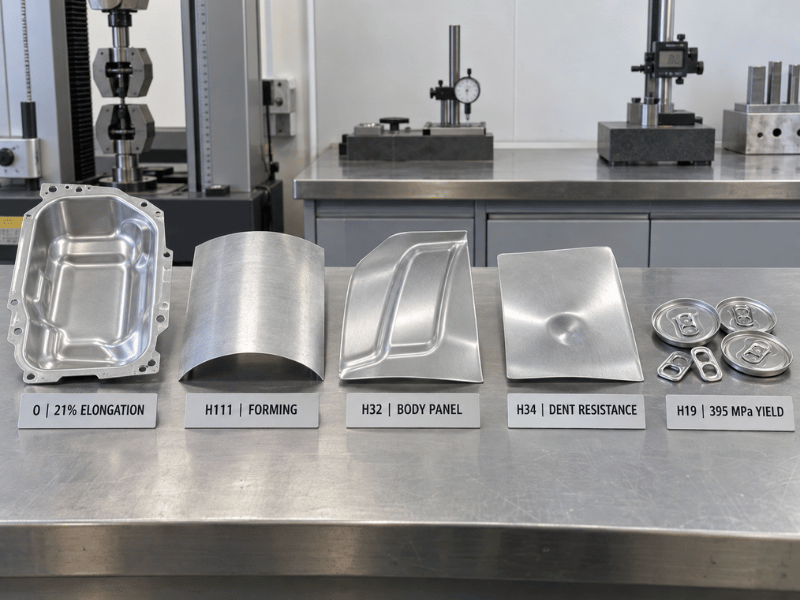
| O | ~276 | ~145 | ~21 | Estampagem profunda, conformação complexa, painéis internos automotivos |
| H111 | ~260 | ~125 | ~18 | Chapas para caminhões-tanque, tanques de combustível, peças conformadas e soldadas |
| H32 | 290 – 315 | 210 – 230 | 10 – 12 | Painéis de carroceria automotiva, chapas estruturais planas |
| H34 | ~331 | ~255 | ~11 | Painéis de carroceria e chapas estruturais que necessitam de mais resistência |
| H38 | ~372 | ~324 | ~6 | Peças planas de alta resistência |
| H19 / H39 | ~420 | ~395 | ~4 | Extremidades de latas, anéis de abertura, estoque para latas |
| H116 / H321 | Fornecimento com orientação marítima | Estrutura marítima não primária — confirmar mínimos conforme a norma |
A variação de O a H19 é de aproximadamente 145 a 395 MPa de limite de escoamento. Isso não é um pequeno detalhe de pedido; é a diferença entre um material que se estampa em um painel interno de porta e um material que se estampa em uma aba de lata.
Qual Temperamento para Qual Aplicação
- O é recozido e totalmente macio, com o alongamento necessário para estampagens profundas, formas torneadas e estampagens complexas. Painéis internos automotivos e tampos de tanque conformados começam aqui.
- H111 é levemente endurecido por deformação — mais resistência que o O, ainda conformável, e a escolha comum para carrocerias de caminhões-tanque soldadas e tanques de combustível.
- H32 e H34 são os temperamentos de endurecimento por deformação e estabilizados para painéis de carroçaria automóvel. Acrescentam a resistência e a resistência a amolgadelas de que os painéis exteriores necessitam, mantendo conformabilidade suficiente para a estampagem. O H34 tende a ser mais resistente, o H32 mais conformável.
- H19 e H39 são os temperamentos para embalagens. Resistência muito elevada obtida por laminagem a frio intensa, com alongamento deliberadamente baixo — a produção de fundos de lata e de linguetas é uma operação de puncionamento e vinco, não de estampagem profunda, e o material tem de manter a forma em espessuras finas. Se está a comprar 5182 para stock de latas, este é o temperamento, e as propriedades que importam dizem tanto respeito à consistência ao longo da bobina como aos valores absolutos.
Conformabilidade e Estampagem Profunda
A conformabilidade é onde o 5182 conquista o seu lugar na chapa automóvel, e é mais matizada do que uma única classificação de “excelente” ou “boa”.
Nos temperamentos recozidos e levemente trabalhados (O, H111), o 5182 conforma-se bem — um alongamento de cerca de 18–21% suporta estampagens profundas, estampagens complexas e formas obtidas por repuxamento. Em comparação com o 5052, o 5182 troca um pouco de conformabilidade máxima por uma resistência visivelmente superior: o 5052 geralmente vai mais longe nas estampagens mais profundas, enquanto o 5182 mantém melhor a forma e resiste melhor às amolgadelas depois de conformado. Em comparação com o 5083, o 5182 é o mais conformável dos dois por uma margem clara, o que explica em grande parte por que o 5083 domina o chapeamento de cascos e o 5182 domina os painéis de carroçaria.
Para painéis exteriores automóveis, os valores que efetivamente determinam a seleção são o rácio de deformação plástica (valor r) e o expoente de endurecimento por deformação (valor n), e não apenas o alongamento. O valor r controla a resistência ao adelgaçamento durante a estampagem; o valor n controla a forma como a deformação se distribui antes do estrangulamento local. Os laminadores que fornecem 5182 para painéis automóveis expostos certificam segundo estes parâmetros, e normas de OEM como a GMW15192 especificam-nos. Se está a comprar para painéis de carroçaria visíveis, peça os valores r e n juntamente com os de tração e cedência — um 5182 que cumpre o intervalo de tração pode ainda assim falhar numa estampagem.
Duas precauções práticas. Um teor mais elevado de magnésio significa que o 5182 endurece por deformação mais rapidamente do que o 5052, pelo que necessita de mais força, de raios de curvatura maiores nos temperamentos mais duros e de mais atenção ao retorno elástico. E pode ser necessário recozimento entre etapas em estampagens de vários passos onde o 5052 passaria numa só operação.
Resistência à Corrosão e o Limite de 65 °C
O elevado teor de magnésio confere ao 5182 uma boa resistência a ambientes atmosféricos, à água do mar e a muitos ambientes de produtos alimentares, e é a razão pela qual a liga é utilizada sem revestimento em acessórios marítimos e em embalagens de contacto alimentar com um sistema de verniz qualificado. Situa-se confortavelmente acima do 5052 e do 5754 em ambientes com cloretos.
A limitação é térmica, e no 5182 impõe-se com mais rigor do que na maioria dos graus 5xxx.
Com teores de magnésio acima de aproximadamente 3%, a exposição prolongada a temperaturas mornas permite que o magnésio precipite ao longo dos contornos de grão como fase beta (Al₃Mg₂). Essa rede é anódica em relação à matriz circundante, o que expõe a liga à corrosão intergranular, à esfoliação e à fissuração por corrosão sob tensão. O limite de engenharia habitual é 65 °C (150 °F) para serviço contínuo em ambientes corrosivos. O teor de magnésio de 4,0–5,0% do 5182 coloca-o no topo do intervalo comercial, pelo que o limite se aplica com menos margem do que no 5052.
Na prática:
- Mantenha o 5182 fora de serviço prolongado acima de 65 °C — linhas de processo quentes, zonas de escape sem isolamento e equipamento que permanece morno.
- Quando o serviço a temperaturas mornas for inevitável, considere o 5052 ou o 5454 em vez de tentar contornar a sensitização por via de engenharia. A precipitação não é reversível.
- Para aplicações marítimas, está disponível fornecimento em H116 ou H321, mas confirme o temperamento e os seus mínimos garantidos face à norma aplicável e ao certificado do laminador.
A corrosão galvânica é a segunda precaução, e aplica-se a mesma regra que para qualquer liga 5xxx: o 5182 é anódico em relação ao aço, ao inox e às ligas de cobre. Numa montagem com metais mistos na presença de um eletrólito, isole a junta ou adicione proteção sacrificial.
Soldadura do 5182
O 5182 solda-se por GMAW (MIG) e GTAW (TIG), e é soldado rotineiramente em carroçarias de camiões-cisterna, depósitos de combustível e acessórios marítimos. O material de adição é normalmente um fio 5xxx — ER5356 para trabalho geral e para corresponder ao teor de magnésio, com ER5183 uma opção quando se pretende maior resistência no estado soldado ou melhor comportamento face à corrosão marinha.
O que a soldadura não faz é preservar as propriedades de trabalho a frio. A zona afetada pelo calor é recozida pelo ciclo de soldadura; o endurecimento por deformação é removido localmente e não pode ser restaurado, porque a liga não é tratável termicamente. Uma junta em H32 ou H34 soldada é mais fraca do que o metal base, e é a faixa amolecida — não o metal de solda — que geralmente determina o dimensionamento da junta.
A regra de projeto decorre diretamente: dimensione as juntas soldadas de 5182 com base nas propriedades da ZAC recozida, e não nos valores do temperamento do metal base. Uma montagem em H34 calculada para uma tensão de cedência de 255 MPa estará a transmitir carga através de uma zona que cede perto de 145 MPa. A AWS D1.2 publica tensões admissíveis para estruturas soldadas de alumínio e é a referência a utilizar.
Maquinagem e Acabamento Superficial
Usinagem é razoável e não boa. O 5182 endurece por deformação rapidamente e produz aparas fibrosas nos temperamentos mais macios; os temperamentos mais duros cortam-se de forma mais limpa e com melhor quebra de aparas. Ferramentas de metal duro afiadas, geometria de ângulo de ataque positivo e fluido de corte abundante são as recomendações habituais. Não é uma liga de corte fácil, e as oficinas que orçamentam em comparação com o 6061 ou o 2011 notarão a diferença na vida da ferramenta e no tempo de ciclo.
Acabamento de superfície é um ponto forte em contextos de embalagem e de painéis de carroçaria — a liga lamina-se para uma superfície limpa e uniforme que recebe bem revestimento, verniz e impressão, o que contribui para que detenha o mercado dos fundos de lata. Pode ser anodizada para proteção, mas, tal como outros graus com alto teor de magnésio, não é uma liga de anodização decorativa; o acabamento é menos brilhante e uniforme do que o do 5005 ou do 6063, e a consistência de cor entre lotes é mais difícil de manter. Especifique anodização para proteção, não para aparência.
Onde o 5182 É Utilizado
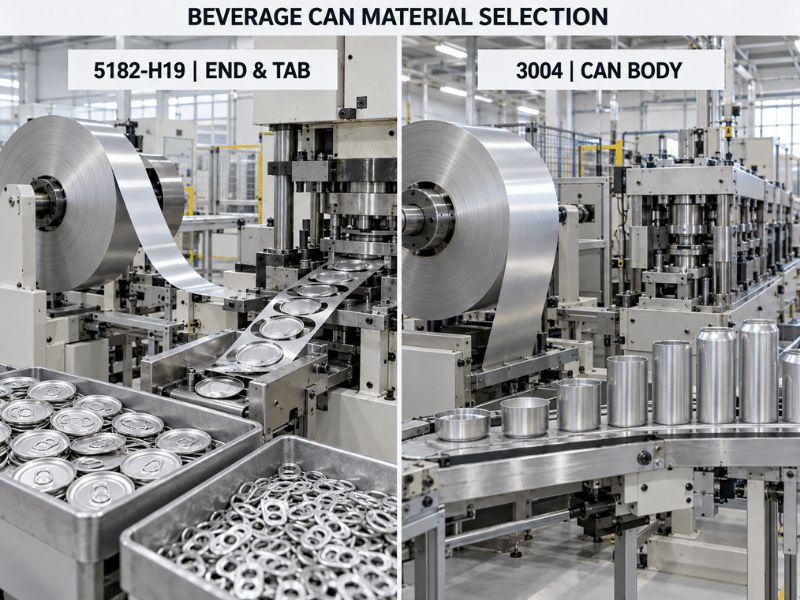
Fundos de lata e linguetas de abertura fácil são o uso global dominante, produzidos em H19. A distinção é importante na especificação: os corpos de lata são tipicamente uma liga 3xxx, como o 3004, enquanto os fundos, os fundos de abertura fácil e as linguetas são em 5182. Se um pedido de informação mencionar “lata de bebida” sem indicar qual o componente, a liga pode ser qualquer uma delas — pergunte antes de orçamentar.
Painéis de carroçaria automóvel são o segundo grande mercado — capôs, portas, guarda-lamas, painéis interiores e reforços estruturais, em O a H34 consoante a quantidade de conformação que a peça necessita. O fator determinante é a redução de peso com resistência a amolgadelas aceitável, e é por isso que o valor r e o valor n aparecem nestas especificações.
Carroçarias de camiões-cisterna e depósitos de combustível utilizam H111 e H32, onde a soldabilidade e a resistência à corrosão face a combustíveis e produtos químicos suaves importam mais do que a resistência máxima.
Outras utilizações incluem acessórios marítimos e estrutura marítima não primária (H116/H321 quando especificado), recipientes e fechos para alimentos e bebidas, vasos de pressão e peças industriais gerais que necessitam de resistência à corrosão com resistência moderada e boa soldabilidade.
5182 vs 5052, 5754, 5083 e 6061
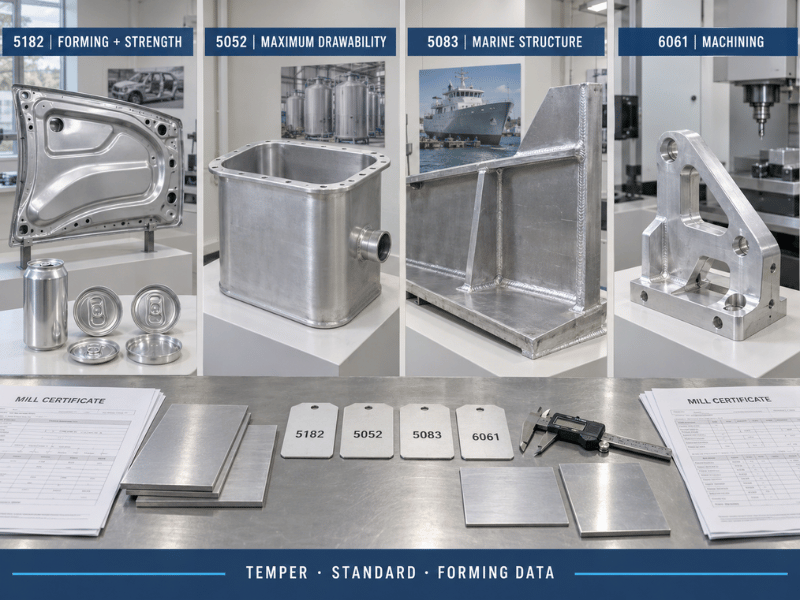
Dentro da família 5xxx, 5052 → 5754 → 5182 → 5083 é aproximadamente uma escada ascendente de resistência com conformabilidade decrescente.
| Propriedade | 5182 | 5052 | 5754 | 5083 | 6061-T6 |
|---|---|---|---|---|---|
| Magnésio (%) | 4.0 – 5.0 | 2.2 - 2.8 | 2.6 – 3.6 | 4.0 - 4.9 | 0.8 - 1.2 |
| Manganês (%) | 0.20 – 0.50 | — | ≤ 0,50 | 0.40 – 1.0 | — |
| Tração (MPa, típico) | 276 – 420 | 210 – 260 | 220 – 290 | 300 – 350 | ~310 |
| Limite de escoamento (MPa, típico) | 145 – 395 | 160 – 195 | 130 – 190 | 215 – 260 | ~275 |
| Alongamento (%) | 4 – 21 | 12 – 20 | 12 – 18 | 10 – 14 | 8 – 12 |
| Tratável termicamente | Não | Não | Não | Não | Sim |
| Estampagem profunda | Boa (O/H111) | Excelente | Bom | Justo | Justo |
| Corrosão marinha | Muito boa | Bom | Muito boa | Excelente | Moderado |
| Soldabilidade | Bom | Excelente | Excelente | Excelente | Bom |
| Usinabilidade | Justo | Justo | Justo | Justo | Muito boa |
| Utilizações típicas | Fundos de lata, painéis de carroçaria | Chapa geral, depósitos | Chapa marítima, piso antiderrapante | Chapa de casco, criogênica | Peças usinadas, quadros |
Em comparação com 5052, o 5182 é mais resistente e mais resistente a amassados, mas abre mão de alguma estampabilidade final; o 5052 também é tipicamente mais barato e mais fácil de soldar. Se a peça é um estampo profundo e a resistência não é limitante, o 5052 geralmente vence. Se é um painel de carroceria que precisa resistir a amassados, o 5182 vence. Dados completos estão em nosso guia de alumínio 5052.
Em comparação com 5754, o 5182 é o mais resistente dos dois, com comportamento de corrosão comparável; o 5754 é a liga europeia mais estabelecida e aparece com mais frequência em chapas marítimas e chapas antiderrapantes.
Em comparação com 5083, o 5182 é mais conformável e mais fácil de estampar, enquanto o 5083 é mais resistente e é a classificação de liga que as sociedades classificadoras esperam para estrutura marítima primária. Nosso guia do alumínio 5083 cobre esse lado da comparação, e a de grau marítimo visão geral mostra como as ligas marítimas da série 5xxx dividem as aplicações entre si.
Em comparação com 6061, a comparação se inverte no processo: o 6061 é tratável termicamente, usina bem e atinge resistência mais alta, mas suas juntas soldadas perdem resistência e sua resistência à corrosão em água do mar é pior. O 6061 é a escolha certa para peças usinadas e quadros; o 5182 é a escolha certa para chapas conformadas e soldadas. Veja o guia de alumínio 6061.
Quando o 5182 É a Escolha Errada
Declarado como condições em vez de nomes de peças, já que as condições são o que realmente decide.
Especifique 5182 quando:
- A peça é um fundo de lata, tampa de fácil abertura ou anel de puxar — H19 é o padrão da indústria por um motivo.
- Você precisa de resistência de painel de carroceria automotiva com estampabilidade real, e a resistência a amassados importa.
- A peça é conformada e soldada em vez de usinada, em ambiente corrosivo ou de contato com alimentos.
- A temperatura de serviço permanece abaixo de 65 °C, ou zonas quentes são isoladas.
- Você precisa de mais resistência do que o 5052 ou 5754 podem oferecer sem recorrer à menor conformabilidade do 5083.
Procure outra opção quando:
- O serviço contínuo excede ~65 °C em ambiente corrosivo. A sensitização por fase beta não é reversível — use 5052 ou 5454.
- A peça é um estampo profundo no limite do que o 5052 consegue fazer. O 5052 estampa mais e custa menos.
- Estrutura marítima primária está envolvida. As regras de classificação esperam 5083 ou 5086, não 5182.
- A peça é usinada a partir de sólido em volume. O 6061 ou 2011 é mais rápido e mais barato.
- Anodização decorativa é o acabamento. Use 5005 ou 6063.
- Resistência máxima tratável termicamente é necessária e a soldagem é mínima. 6061-T6 ou 7075-T651 supera qualquer liga 5xxx.
Normas, Equivalentes e Documentação
| Padrão | Escopo |
|---|---|
| ASTM B209 | Chapas e placas de alumínio e ligas de alumínio |
| EN 573-3 | Composição química (Europa) |
| EN 485-2 | Propriedades mecânicas de chapa e tira (Europa) |
| GB/T 3880 | Chapa, tira e placa (China) |
| JIS H4000 | Chapa, tira e placa (Japão) |
| GMW15192 | Chapa de alumínio automotiva — requisitos de nível OEM |
| AWS A5.10 / D1.2 | Classificação de metal de adição e projeto de solda estrutural |
| ASTM B928 | Placa marítima de alto magnésio (onde H116/H321 é especificado) |
Designações equivalentes: UNS A95182, EN AW-5182, AlMg5 (algumas referências).
Na ordem de compra, quatro coisas carregam o peso. Declare o tempera explicitamente — O, H111, H32, H34 e H19 não são intercambiáveis. Nomeie a norma aplicável, já que os mínimos da B209 e da EN 485-2 não são os mesmos números. Solicite um certificado de ensaio do fabricante (MTC) conforme EN 10204 3.1 listando tração real, escoamento e alongamento para o lote. E se o material é para painéis automotivos ou estoque de latas, especifique a janela de propriedades que realmente importa — valor-r e valor-n para estampagem, ou consistência bobina a bobina para linhas de latas de alta velocidade — em vez de confiar apenas na faixa de tração.
A maioria dos problemas com o 5182 são problemas de especificação: uma tempera deixada em aberto, uma norma não nomeada, ou uma propriedade crítica para conformação nunca solicitada.
Trabalhando com a Linsy Aluminum
A Linsy Aluminum fornece 5182 alumínio como chapa e bobina em O, H111, H32, H34 e H19, com H116 e H321 disponíveis para fornecimento orientado ao marítimo — como acontece com outras ligas de alto magnésio, as temperas marítimas são especificações de laminados planos e não são produzidas em barra. A capacidade interna cobre usinagem CNC, soldagem, corte a laser e acabamento superficial; a forjaria é coordenada através de instalações de processo parceiras em vez de ser executada internamente, então considere isso no planejamento se sua peça precisar disso.
Cada remessa acompanha um certificado de teste de usina (MTC), e testes SGS podem ser organizados sob solicitação. Para trabalho com painéis automotivos ou estoque de latas, diga-nos quais propriedades governam — valor-r, valor-n ou consistência de bobina — para que a consulta vá à usina com a janela correta anexada. Para dimensões fora de estoque, o prazo típico é de 10–60 dias, e apoiamos quantidades mínimas baixas de pedido em construções de teste e protótipo.
Envie seu desenho ou especificação e confirmaremos temperas disponíveis, espessuras, tolerâncias e documentação, e sinalizaremos qualquer coisa nas condições de serviço que aponte para uma liga diferente.
Conclusão
O 5182 é o mais resistente das ligas 5xxx conformáveis comumente fornecidas, e ele sustenta dois mercados que o puxam em direções opostas: estoque de latas H19 em resistência muito alta e baixo alongamento, e chapa automotiva em O até H34 escolhida pela distância que estampa. Escolha a tempera primeiro, porque a variação entre temperas é maior do que a diferença entre muitas ligas. Respeite o teto de 65 °C, já que 4,0–5,01% de magnésio deixa menos margem do que a maioria das ligas. E projete juntas soldadas com base nas propriedades da ZTA annealed em vez dos valores da tempera base. Acerte esses três pontos e o 5182 é uma liga capaz, bem documentada e com fornecimento profundo por trás. Erre esses pontos — H19 especificado para um estampo profundo, serviço contínuo a quente, ou uma solda dimensionada com base na resistência do H34 — e a falha parecerá um problema de material quando era um problema de especificação.
Perguntas frequentes
Para que o alumínio 5182 é principalmente usado?
Duas aplicações dominantes. A maior globalmente é estoque para fundos de latas — fundos de latas de bebida, tampas de fácil abertura e anéis de puxar — fornecidos na tempera H19. A segunda é painéis de carroçaria automóvel tais como capôs, portas, para-lamas e painéis internos, em O até H34. Note que podem carroçarias são geralmente uma liga 3xxx como a 3004; a 5182 é o extremidade e aba material.
Quão resistente é o alumínio 5182?
Depende inteiramente do temperamento, e a variação é ampla: aproximadamente 276 MPa de resistência à tração / 145 MPa de limite de escoamento / 21% de alongamento em O, versus cerca de 420 MPa de resistência à tração / 395 MPa de limite de escoamento / 4% de alongamento em H19. Os temperamentos para painéis de carroçaria automóvel situam-se entre estes — H32 em torno de 290–315 MPa de resistência à tração e 210–230 MPa de limite de escoamento, H34 em torno de 331 MPa e 255 MPa.
O 5182 é mais resistente que o 5052?
Sim, significativamente. O 5182-H34 atinge cerca de 331 MPa de resistência à tração contra aproximadamente 210–260 MPa para o 5052-H32, com limite de escoamento correspondentemente superior. O compromisso é a conformabilidade e o custo: o 5052 estira-se mais em trabalhos de estampagem profunda, solda-se um pouco mais facilmente e é geralmente mais barato. Escolha o 5182 quando a resistência ou a resistência a amolgadelas for determinante; escolha o 5052 quando a máxima estampabilidade ou o custo for determinante.
O alumínio 5182 pode ser soldado?
Sim, por MIG e TIG, tipicamente com material de adição ER5356, ou ER5183 onde seja necessária maior resistência no estado soldado. A ressalva importante é que o 5182 não é tratável termicamente, pelo que a zona afetada pelo calor é recozida pela soldadura e não pode ser restaurada — as juntas soldadas são mais fracas que o metal base em temperamento H, e as juntas devem ser dimensionadas com base nas propriedades da ZAC recozida conforme a AWS D1.2.
Qual é a temperatura máxima de serviço para o 5182?
Cerca de 65 °C (150 °F) para serviço contínuo em ambientes corrosivos. Acima disso, o teor de magnésio de 4,0–5,0% pode precipitar nos contornos de grão como fase beta, levando à corrosão intergranular e à fissuração por corrosão sob tensão. A alteração não é reversível por tratamento térmico, pelo que para serviço contínuo a temperaturas elevadas deve especificar-se 5052 ou 5454 em alternativa.
O 5182 é adequado para estampagem profunda?
Nos temperamentos macios, sim. O 5182-O e o H111 oferecem cerca de 18–21% de alongamento e estampam-se bem para painéis internos automóveis, fundos de depósitos e cascas estampadas. Não estira tanto como o 5052 e endurece por deformação mais rapidamente, pelo que deve esperar maior força, raios de curvatura maiores e possivelmente recozimento entre etapas em estampagens de várias fases. Para painéis automóveis expostos, especifique o valor r e o valor n, não apenas o alongamento.
Qual é a diferença entre o 5182-H19 e o 5182-H32?
Estão em extremos opostos do intervalo de temperamentos e não são intercambiáveis. H19 é fortemente laminado a frio até à resistência máxima — cerca de 420 MPa de resistência à tração, 395 MPa de limite de escoamento, apenas 4% de alongamento — e é utilizado para fundos de latas e anéis de abertura, onde a operação é de puncionamento e ranhuração em vez de estampagem. H32 é endurecido por deformação e estabilizado até cerca de 290–315 MPa de resistência à tração e 210–230 MPa de limite de escoamento com 10–12% de alongamento, e é utilizado para painéis de carroçaria automóvel e chapa estrutural.