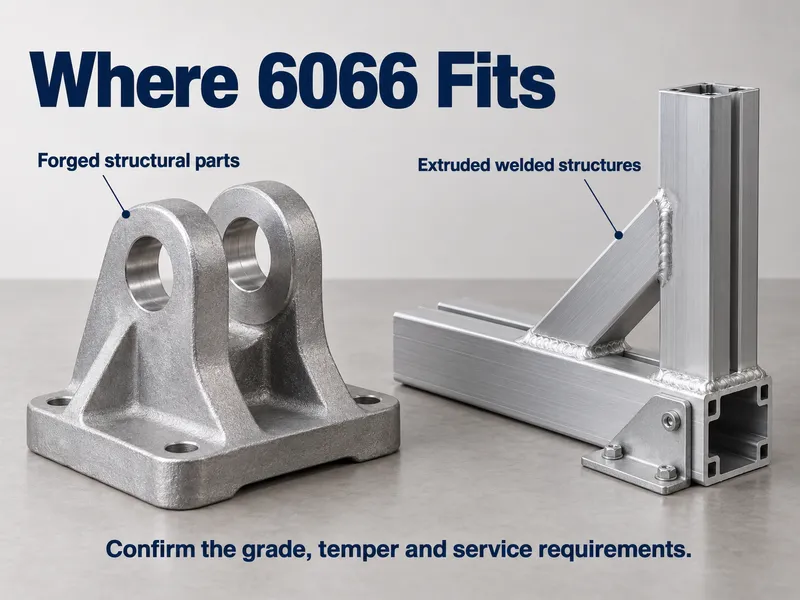
6066 is a weldable 6xxx alloy carrying roughly three times the copper of 6061 and reaching a higher T6 strength — which is why the Aluminum Association describes it as an alloy for welded structural forgings and extrusions rather than as a general-purpose grade.
Copper decides the trade-off: it raises the aged strength above 6061 and lowers the corrosion margin, and the two move together. That is why 6066 is specified for welded structural work rather than for anything exposed to salt water unpainted.
If 6066 is already named on your drawing, the decisions that matter are the temper and the documentation.
¿Qué es el aluminio 6066?
6066 is a heat-treatable Al-Mg-Si-Cu wrought alloy of the 6xxx series, registered by the Aluminum Association as UNS A96066. It hardens through precipitation of magnesium silicide (Mg₂Si) during artificial aging, the same mechanism that hardens 6061 and 6082, with copper-bearing phases adding to the response.
The practical differences from 6061 are three, and they all trace back to chemistry:
- Copper at 0.7–1.2%, against 0.15–0.40% in 6061, which is the source of the higher aged strength.
- Silicon at 0.9–1.8%, at the top of the 6xxx range, which raises strength and lowers the melting point for extrusion.
- Manganese at 0.6–1.1%, higher than 6061, which adds toughness and fatigue resistance.
6066 is an extrusion and forging alloy, not a structural sheet or architectural grade. Standard bar, rod and profile cover most orders, and other forms are cut to drawing at low minimum quantities.
Chemical Composition of 6066
The limits below are the registered composition, and they agree between the Aluminum Association registration for UNS A96066 and GB/T 3190-2020.
| Elemento | Peso % |
| Silicio (Si) | 0.90 – 1.80 |
| Hierro (Fe) | 0,50 máx. |
| Cobre (Cu) | 0.70 – 1.20 |
| Manganeso (Mn) | 0.60 – 1.10 |
| Magnesio (Mg) | 0.80 – 1.40 |
| Cromo (Cr) | 0.40 máx. |
| Zinc (Zn) | 0,25 máx. |
| Titanio (Ti) | 0,20 como máximo |
| Otros, cada uno / total | 0.05 max / 0.15 max |
| Aluminio (Al) | Saldo |
Two rows are worth checking first on any mill certificate:
- Titanium is 0.20% max. Confirm it on the mill certificate; a 0.15% limit is a tighter customer requirement, not the registered value.
- Zinc is 0.25% max.
The aluminum row is a remainder, not a fixed range: adding the maximums above leaves an aluminum floor near 93%, so the entry is “balance”. If a certificate shows a fixed aluminum range that does not match its own element limits, ask which standard the sheet was drawn against.
Propiedades mecánicas según el estado de templado
6066 is specified by product form, and the form decides which standard applies. The table gives specification minimums for extruded product alongside typical commercial values.
| Condición | Tensile strength, min | Yield strength (0.2%), min | Elongation, min | Typical tensile / yield |
| T4 / T4510 / T4511 | 275 MPa | 170 MPa | 14% | 360 / 207 MPa |
| T42 | 275 MPa | 165 MPa | 14% | — |
| T6 / T6510 / T6511 | 345 MPa | 310 MPa | 8% | 393 / 359 MPa |
| T62 | 345 MPa | 290 MPa | 8% | — |
Die forgings are covered separately, and 6066-T6 forgings carry the same 345 MPa tensile and 310 MPa yield minimums as extrusions.
Read the minimum column, not the typical column. The gap is real — 345 MPa against a 393 MPa typical means designing from the typical value overshoots the specification by roughly 14%, and a mill test certificate only has to meet the minimum.
Under ASTM B221, a quotation offering 6066-T6 at 310 MPa tensile is quoting 6061-T6 minimums, not 6066.
Propiedades físicas
| Propiedad | Valor |
| Densidad | 2,72 g/cm³ |
| Rango de fusión | ≈563 – 646 °C (solidus – liquidus) |
| Thermal conductivity (T6) | ≈150 W/m·K |
| Electrical conductivity (T6) | ≈37 – 40% IACS |
| Coeficiente de expansión térmica | 23.2 × 10⁻⁶ /°C (20–100 °C) |
| Módulo de elasticidad | ≈70 GPa |
| Hardness (T6) | ≈120 HB |
| Resistencia al corte (T6) | ≈234 MPa |
| Fatigue strength (T6, rotating beam, 5 × 10⁸ cycles) | ≈110 MPa |
Both conductivity figures are lower than a typical 6xxx, and the reason is the copper. Copper in solid solution scatters both heat and charge carriers, so 6066 conducts roughly 10% below 6061-T6 at approximately 167 W/m·K.
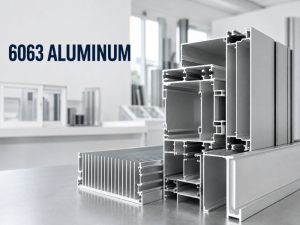
That rules 6066 out of heat-sink and busbar work, where extrusiones de aluminio 6063 at around 201 W/m·K are the sensible 6xxx choice. The fatigue figure of about 110 MPa is the more useful number here: it is a genuine 6xxx strength, and it is the reason 6066 turns up in forged and extruded parts that see cyclic load.
6066 vs 6061 vs 6082 vs 2024 vs 7075
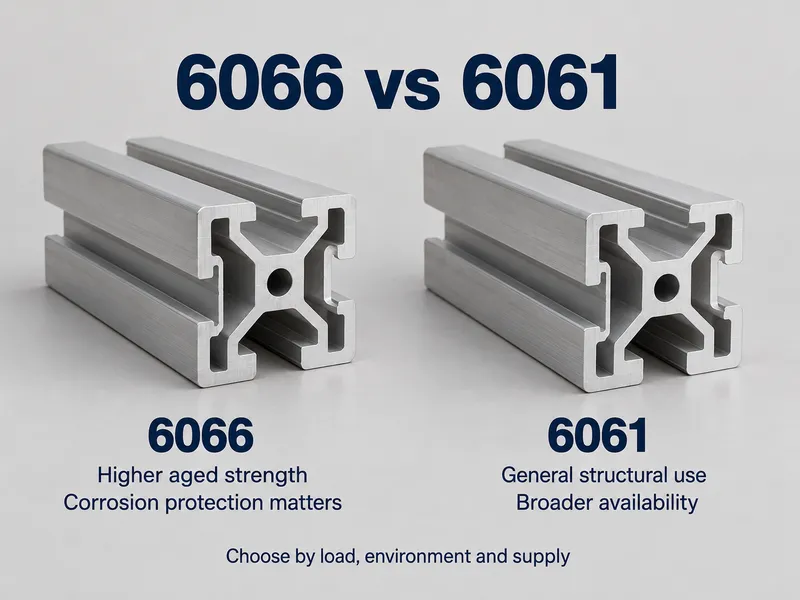
Comparison is at T6 or the closest common commercial condition, against the registered chemistry for each alloy.
| Aleación | Copper (wt%) | Tensile strength, T6 | Resistencia a la corrosión | Fusion weldability | Uso típico |
| 6066 | 0.70 – 1.20 | 345 MPa min / ~393 MPa typical | Fair — below 6061 | Bien | Welded structural forgings and extrusions, forged vehicle and bicycle parts |
| 6061 | 0.15 – 0.40 | 310 MPa min / ~310 MPa typical | Muy buena | Excelente | Trabajo estructural general, marcos marinos, piezas mecanizadas |
| 6082 | 0,10 máx. | 310 – 340 MPa | Muy buena | Muy buena | European structural extrusions, transport frames |
| 2024 | 3.8 - 4.9 | ~470 MPa (T3) | Poor — cladding or paint required | Not welded in practice | Aircraft skins, tension-critical structure |
| 7075 | 1.2 - 2.0 | 500 – 570 MPa | Pobre | Not welded in practice | High-strength airframe and defence parts |
Pick 6066 over 6061 when the extra 35 MPa on the T6 tensile minimum is doing real work in a welded or forged part, and accept that you are trading away corrosion margin to get it. On the copper column, at 0.70–1.20%, 6066 sits closer to 7075 than to 6061, which is why its corrosion performance has to be read alongside its strength.
When the enquiry is European and the corrosion margin matters more than the last 35 MPa, 6082-T6 is the practical answer; 2024 and 7075 are a different strength class and neither is a fusion-welded substitute.
T4, T6, T6510 and T6511: Which Temper to Specify
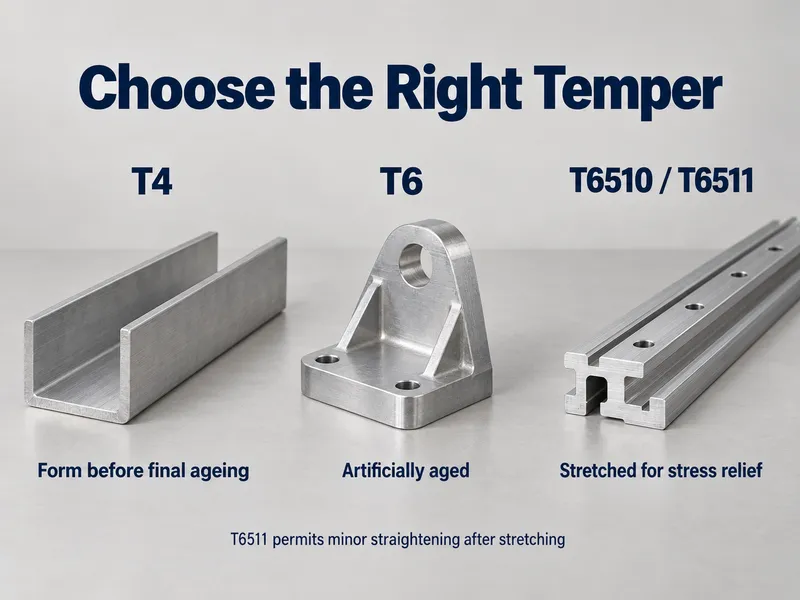
The suffix on a 6066 temper designation carries real information, and it decides which minimums apply.
| Denominación | What it means | Specify it when |
| T4 | Solution heat treated, quenched, naturally aged | The part is formed after delivery and aged later |
| T6 | Solution heat treated, quenched, artificially aged | The part is finished as delivered and needs maximum strength |
| T6510 / T6511 | T6 with stress relief by controlled stretching | The part is machined from bar or profile and dimensional stability matters |
| T42 / T62 | Re-solution treated and aged by the fabricator | You are heat treating in-house after forming or welding |
The distinction that catches people is T6 against T6510/T6511. Both deliver the same strength minimums, and the difference is residual stress, not chemistry — the T651x route stretches the product about 1–3% after quenching so it does not move during machining. On a long, thin, tightly toleranced part, that is the difference between holding a tolerance and scrapping the part.
Specifying a bare “T651” on an extrusion is imprecise. Extruded product carries T6510 (not stretched after cutting) or T6511 (stretched, then cut to length), and we will default to one unless you say which.
Working With 6066
Soldadura. 6066 is a weldable structural alloy, and TIG and MIG both apply with the standard Al-Mg-Si filler logic — ER4043 where crack resistance and puddle control dominate, ER5356 where higher weld strength or a closer anodizing color match matters.
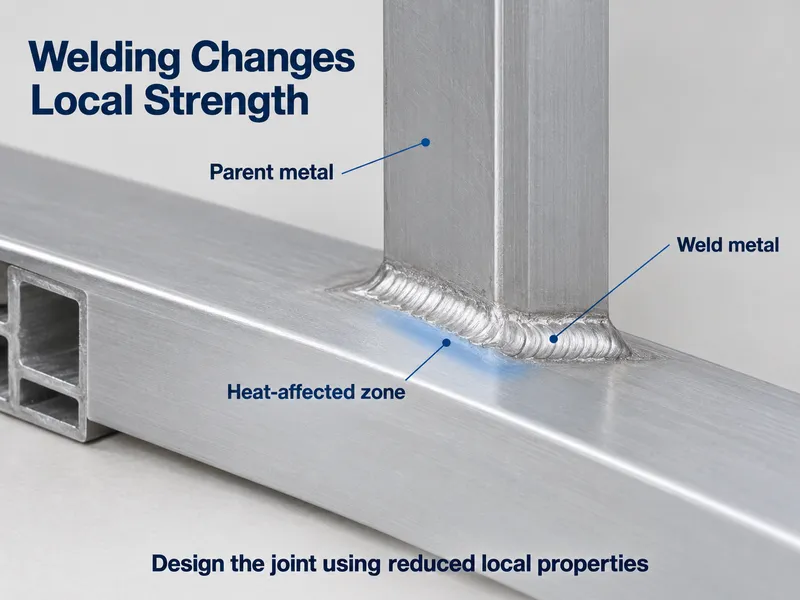
The heat-affected zone of any heat-treatable alloy softens through overaging, and that loss cannot be recovered by aging the joint alone. Size welded joints on reduced heat-affected-zone values rather than parent T6 properties, and see this guide to aluminum welding filler selection before fixing the wire. A procedure qualified on 6061 should be re-qualified here rather than reused, because the two copper ranges barely overlap.
Conformado. T4 is the forming condition; expect good formability there and a sharp drop in T6. Ask for bend radii against your thickness rather than assuming 6061 numbers carry over.
Mecanizado. The aged tempers machine well and produce shorter chips than T4, which tends to be gummier. T6510 or T6511 is the better starting condition for a part with tight dimensional requirements.
Anodizado y acabado. 6066 anodizes, but the copper content works against you: copper-bearing 6xxx alloys finish slightly darker and less uniform than low-copper grades. Where color consistency is a specification line, run a sample through the actual finishing line before production. The same copper limits suitability for bright decorative work.
Standards and Documentation
This is where 6066 differs most from a mainstream grade, because the standards that used to govern it have moved.
| Formulario | Norma aplicable |
| Extruded bar, rod, wire, profile, tube | ASTM B221 |
| Seamless extruded tube | ASTM B241 |
| Die forgings and hand forgings | ASTM B247 |
| Composition (China) | GB/T 3190-2020 |
Two older specifications still appear on drawings, and both are cancelled:
- QQ-A-200/10E — the US federal specification for 6066 extruded bar, rod, shapes, tube and wire, cancelled in December 2002.
- AMS-QQ-A-200/10A — the aerospace version, designated cancelled and superseded in June 2007, with the technical requirements folded into ASTM B221 and ASTM B241.
Neither is wrong to see on an old drawing, but neither is a current specification. When a drawing still calls up QQ-A-200/10, quote ASTM B221 and ask for the certificate to cite it.
On the European side, be cautious with cross-references: 6066 sometimes appears with a European-style or ISO-style designation. Quote the chemistry limits and confirm them on the mill certificate rather than relying on a cross-reference designation.
Where 6066 Is Actually Used
| Sector | Aplicación |
| Estructuras soldadas | Structural forgings and extrusions that are joined after heat treatment |
| Automoción y transporte | Structural members, truck and rail components, forged brackets and fittings |
| Intercambiadores de calor | Radiator and engine-adjacent parts specified for strength, not for conductivity |
| Bicycles | Forged and extruded frame components on higher-tier aluminum frames |
| Machinery | Cyclically loaded forged parts, fittings and studs |
| Marine (protected) | Secondary structures where anodizing or painting is part of the finish schedule |
6066 has an aerospace lineage — the AMS-QQ-A-200/10 specification existed because aerospace buyers used it — but that specification is cancelled and 6066 is not a primary airframe material.
Go/No-Go: When to Specify 6066
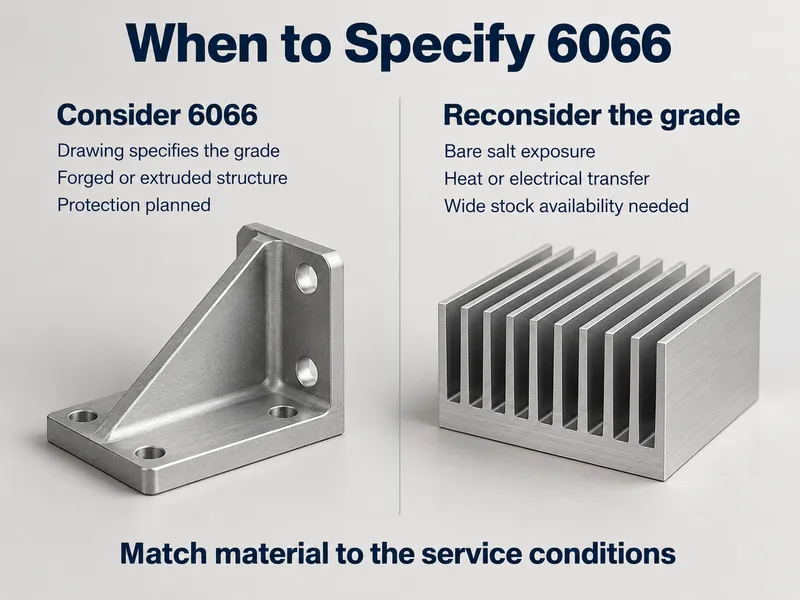
Go — specify 6066 when:
- A customer drawing or an existing qualified assembly already names it and substitution is not available.
- You need 6xxx weldability and a T6 yield minimum above what 6061 delivers.
- The part is forged, or extruded and machined, rather than rolled.
- The service environment is protected — coated, anodized or painted — so the copper-driven corrosion penalty is contained.
- You can verify chemistry and mechanical results on a mill test certificate for the heat and form ordered.
No-go — elija otra cosa cuando:
- The part sees marine, de-icing salt or chemical exposure unpainted — 6061 o 5083 en su lugar.
- You are designing for heat transfer or electrical conductivity — 6063 at about 201 W/m·K instead.
- You need a sheet, plate or architectural extrusion — 6061 or 6082, which are rolled and stocked in far greater breadth.
- The application is primary airframe structure — 2024, 7075 or 7050, not 6066.
- You need a wide supply base and published property data across many tempers — 6061 or 6082.
Sourcing 6066: What to Verify
6066 is a specialty grade, and form and temper availability decide more of the sourcing work than the alloy data does.
Confirm three things at enquiry stage:
- Chemistry against the registration, not against a product page. The titanium and zinc limits are the ones to read.
- Temper and form together. T6 extrusion, T6511 bar and T6 die forging are three different lines with three different minimums.
- The governing standard, so the certificate cites something current rather than QQ-A-200/10.
We list the forms and tempers we quote on the Aleación de aluminio 6066 page; fix the temper and size at enquiry, because they decide which minimums apply.
For documentation, a mill test certificate reporting actual chemical analysis and mechanical results for the heat is the baseline for any engineered application. Where the project calls for third-party verification, arrange it before the order rather than after — composition disputes are far cheaper to settle at quotation.
Conclusión
6066 is the copper-bearing option inside the weldable 6xxx family: about 345 MPa minimum tensile strength in T6 extrusions against 310 MPa for 6061, at the cost of corrosion resistance that sits below 6061 and a form range built around extrusion and forging rather than rolled product. Specify it because the drawing names it, or because the extra strength is genuinely load-bearing — and plan for the sourcing work either way.
We cover the harder-to-find grades across the 1000–8000 series and produce non-stock items to order at low minimum quantities, with an MTC reporting actual chemistry and mechanical results on every shipment. Custom lead time runs 10–60 days depending on alloy, size and processing.
Envíenos el plano, temper and quantity for a grade-fit and availability check.
Preguntas frecuentes
What should a 6066 purchase order or quote request specify?
Four lines cover most of the risk on a 6066 order.
- Estándar — ASTM B221 for extruded forms, ASTM B247 for forgings.
- Form, temper, size — a T6 extrusion and a T6511 bar carry different minimums.
- Química — check titanium 0.20% max and zinc 0.25% max.
- Documents — MTC with actual results; third-party testing agreed up front.
How available is 6066, and what lead time should I plan?
Extruded bar, rod, and profile are standard; other forms are made to order.
- Bar, rod, and profile cover most 6066 demand.
- Plate, sheet, and custom sections run as low-MOQ production, 10–60 days.
- Die forgings follow tooling, so allow time for that route.
- If the drawing allows, 6061 or 6082 quote faster.
What documents come with a 6066 order?
An MTC with the actual chemistry and mechanical results for the heat, issued for every order. If the project needs an independent countersignature, specify EN 10204 3.2 at enquiry stage — settling a composition question before shipment costs far less than settling it after.
Can 6066 replace 6061 in an existing welded assembly?
Only if the assembly was designed with margin. 6066 delivers a higher T6 minimum but carries roughly three times the copper, so the corrosion margin narrows and welded joints still have to be sized on reduced values. Re-check the corrosion protection before substituting.