3004 is the 3000-series alloy you reach for when 3003 is not strong enough and 5052 is more than the job needs. It is 3003’s manganese base with 0.8–1.3% magnesium added, which lifts specified strength at every temper without giving up the drawability that makes the family useful.
The decision usually comes down to three things — how much strength the part needs, how deep the draw is, and whether the service environment is wet or corrosive. Watch the second and third: the extra magnesium is what makes 3004 pit in chloride service and anodise unevenly across a large visible panel.
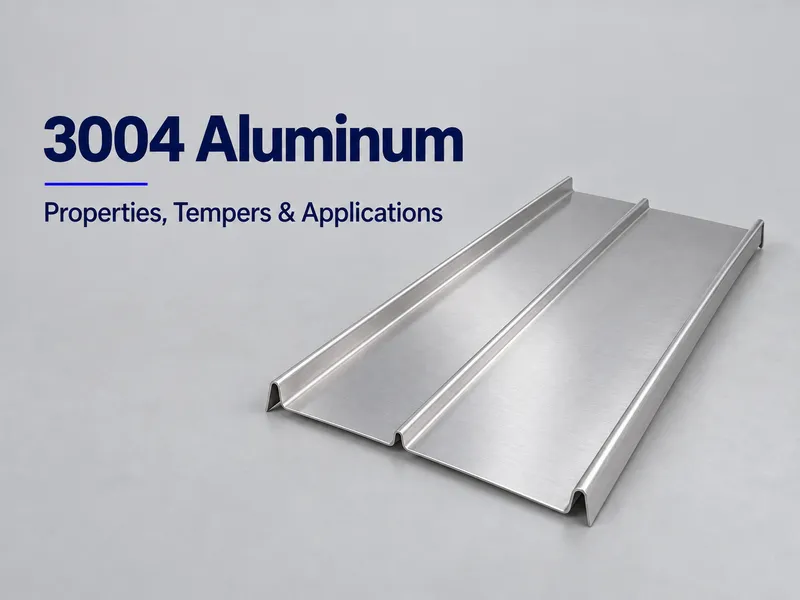
¿Qué es la Aleación de Aluminio 3004?
3004 is a wrought alloy in the 3000 series. It is non-heat-treatable: final strength comes from composition and cold work, not from a solution-treat-and-age cycle. Manganese provides the base strength and recrystallisation control, and magnesium is the addition that lifts strength above 3003 without a large formability penalty.
| Elemento | Range (% by weight) | Papel |
| Manganeso (Mn) | 1.0–1.5 | Primary strengthening element; recrystallisation control |
| Magnesio (Mg) | 0.8–1.3 | Secondary strengthener; the addition 3003 does not carry |
| Silicio (Si) | ≤0,30 | Límite de impurezas |
| Hierro (Fe) | ≤0.70 | Límite de impurezas |
| Cobre (Cu) | ≤0,25 | Mantenido bajo para resistencia a la corrosión |
| Zinc (Zn) | ≤0,25 | Trace limit |
| Otros (cada uno / total) | ≤0.05 / ≤0.15 | Límites de trazas |
| Aluminio (Al) | Saldo | Metal común |
Ranges follow EN 573-3 and the AA registration — EN AW-3004, chemical designation AlMn1Mg1, UNS A93004. Density is about 2.72 g/cm³ and the melting range starts near 630 °C.
Form matters before anything else. Sheet and coil are the standard rolled range, governed by ASTM B209 and EN 485-2. Bar and wire are also produced, and anything outside the standard range — an unusual thickness, a cut-to-size blank, a non-standard temper, or a custom profile — is produced to drawing. Name the form and its governing standard on the enquiry so the quote matches the drawing.
Tempers and Typical Mechanical Properties
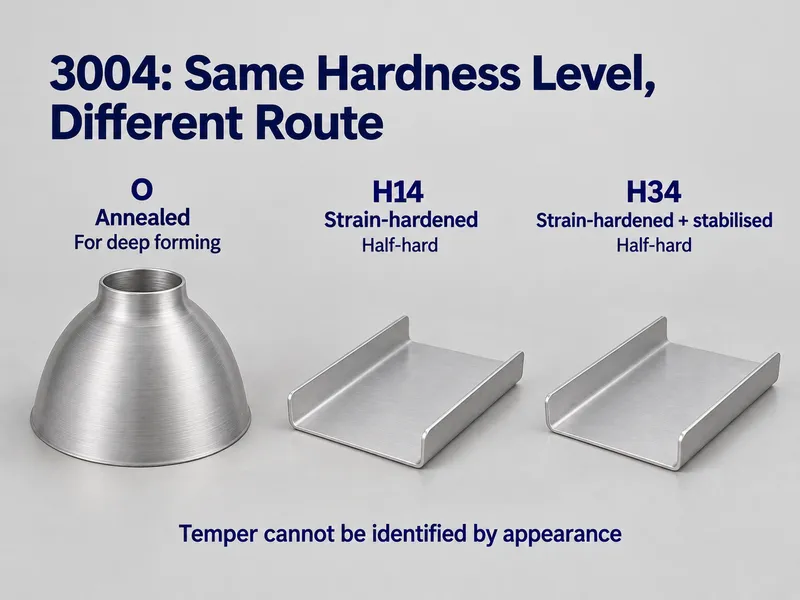
3004 is delivered either annealed or strain-hardened. Three conditions cover most orders:
- O (recocido) — softest and most formable, used for the deepest draws and spun parts.
- H14 (quarter-hard) — strain hardened to a quarter-hard level; the balance point between strength and formability for panels and general parts.
- H34 (quarter-hard, stabilised) — the same quarter-hard level as H14, with a low-temperature stabilisation step that locks the properties in place.
H3x tempers exist because a magnesium-bearing 3xxx alloy slowly softens at room temperature after rolling. Stabilising turns that drift into a fixed, reproducible condition, which is why can stock and other high-volume parts are specified in the H3x series and in the extra-hard H19 rather than H14.
| Temple | Tensile, Rm (MPa) | Yield, Rp0.2 (MPa) | Alargamiento (%) |
| O | 155–200 | 60 min | 14 mín. |
| H14 | 220–265 | 180 mín. | 2 min |
| H34 | 220–265 | 170 mín. | 4 min |
These are specified ranges and minima from EN 485-2 for EN AW-3004 sheet and strip, tabulated by thickness class, not marketing averages. H14 and H34 sit at the same strength level because both are quarter-hard: stabilisation relaxes the proof stress slightly and buys back elongation, which is why H34 is the safer call where properties must hold over a long shelf life or warm service. Harder conditions extend the range, with H16 and H18 on the EN side and H36 and H38 on the ASTM side reaching 240–285 MPa and above.
Treat the table as design floors. Minimum values change with gauge and test direction, and the numbers that matter for a given order are the ones on its mill certificate.
3004 vs 3003, 5052, and 6061
| Alloy / temper | Tensile, Rm (MPa) | Yield, Rp0.2 (MPa) | Soldabilidad | Corrosión | Mejor ajuste |
| 3003-H14 | 140–180 | 115 mín. | Excelente | Bien | Cheapest route for light forming |
| 3004-H14 / H34 | 220–265 | 170–180 min | Excellent; HAZ anneals | Good atmospheric; not for bare saltwater | Can ends, roofing, fuel tanks, spun parts |
| 5052-H32 | 215–265 | 160 mín. | Excelente | Very good, including marine | Marine service and welded tanks |
| 6061-T6 | ~310 | ~276 | Bien | Bien | Structural and welded parts that need post-weld strength |
3004, 3003, and 5052 figures are specified values from EN 485-2 and ASTM B209 for common sheet gauges; 6061-T6 is typical mill data. Minimums move with thickness.
3004 vs 3003
Same manganese base, same corrosion behaviour, same welding approach; the difference is the 0.8–1.3% magnesium that 3003 does not carry. That addition raises specified strength at every temper — 3004-H14 runs 220–265 MPa against roughly 140–180 MPa for 3003-H14. Formability stays close, so 3004 substitutes for 3003 wherever the part needs more strength without moving up to a 5xxx or a heat-treatable grade. For the wider 3000-series view, see the 3104 vs 3003 vs 3004 sheet comparison.
3004 vs 5052
5052 carries more magnesium (2.2–2.8%) and runs a little stronger, with markedly better performance in saltwater and marine atmospheres. The trade is cost and drawability: 3004 forms and draws more easily and is the usual pick for can ends, closures, and building products, while 5052 is preferred for hulls, decks, and welded tanks. Compare stock forms on the 5052 product page.
3004 vs 6061
6061 is heat-treatable, so in T6 it reaches roughly 310 MPa tensile — well above anything 3004 delivers — but it is harder to deep-draw and work-hardens differently. 3004 wins on formability and is the better pick for spun or drawn sheet; 6061 wins when the part is structural or welded and needs post-weld strength. See the 6061 product page para formatos de stock.
Working With 3004
Conformado
Cold formability is good, with less springback than a 5xxx or 6xxx sheet. Use O for the deepest draws and H14 or H34 where the formed part also needs strength. Minimum bend radii grow with temper and gauge: the O condition bends at roughly its own thickness or less, H3x conditions need more, and the standard bend-radius tables are tabulated per temper and thickness.
Soldadura
3004 welds readily by TIG or MIG. Use 4043 filler for the best crack resistance and fluidity, or 5356 where higher joint strength and a closer anodised colour match matter.
Because 3004 is non-heat-treatable and strain-hardened, the weld heat anneals the heat-affected zone back toward the O condition, and no heat treatment restores it. Design the joint on annealed values rather than on the H14 or H34 parent numbers — a heavily worked parent can give up a large share of its specified strength in the HAZ.
Hot-cracking sensitivity is low, and 3004 sits well under the 3% magnesium threshold that brings in the 65 °C service-temperature limit on alloys such as 5083 and 5086. That makes it a straightforward choice for welded parts that also run warm.
Mecanizado
Fair, not a machining grade. The soft O condition is gummy and produces long chips; the harder tempers cut more cleanly. Where a part is machined and never formed, 6000-series stock carries the same jobs with less fuss.
Acabado
3004 anodises, but the manganese–iron intermetallic particles in the alloy affect coating clarity and tone across large visible surfaces. Small parts and functional coatings are fine. For architectural panels and anything colour-critical, painting or coil coating — polyester for general use, PVDF where weather resistance matters — is the more predictable route.
Aplicaciones
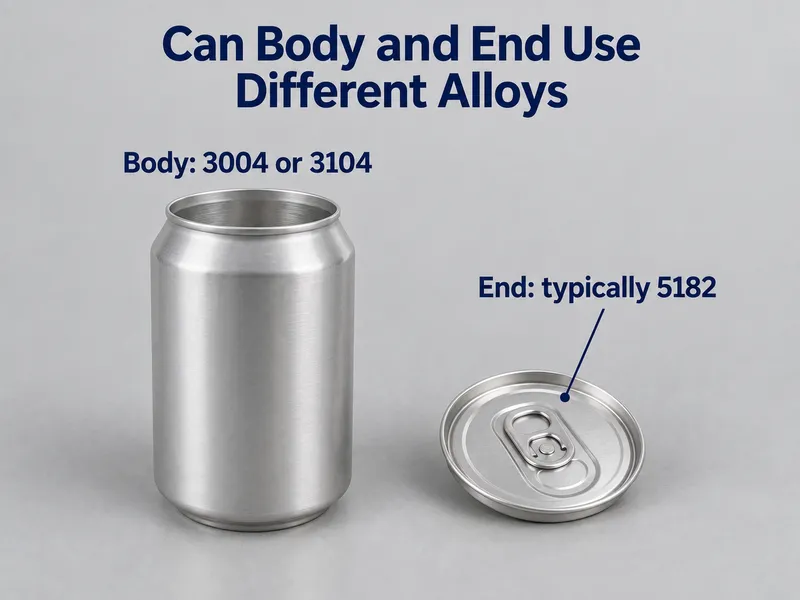
- Beverage can bodies, ends, and tabs
- Building products: roofing, siding, gutters, fascia, and painted wall panels
- Containers: fuel tanks, paint cans, and general sheet containers
- Lighting and spun parts: lamp housings, reflectors, and decorative spinnings
- Heat-exchanger and air-conditioning fin stock
- Trailer panels and other transport sheet
Límites de idoneidad (Go/No-Go)
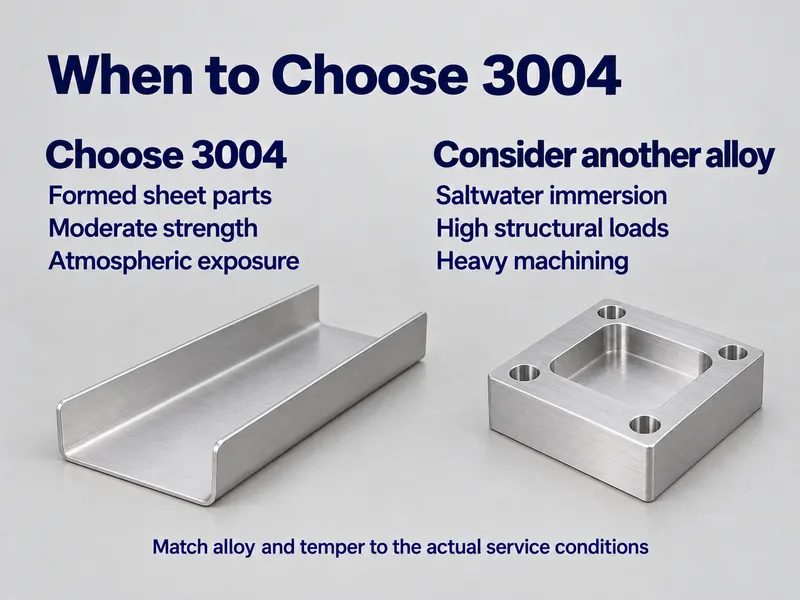
Go — specify 3004 when:
- The part needs moderate strength with good cold formability and is drawn, spun, or bent — can ends, cosmetic closures, lamp housings, and reflectors.
- Atmospheric or industrial corrosion is the worst exposure and nothing is immersed in saltwater — roofing, siding, gutters, and architectural trim.
- A non-heat-treatable sheet is preferred for predictable forming behaviour — painted building panels and fuel tanks.
No-Go — look elsewhere when:
- The part sits in direct saltwater immersion or marine submersion without coating. Pitting is the risk; 5052, 5083, or 5086 are the better answers.
- The design carries high structural strength or welded load paths. 6061-T6 or 5052-H32 provide more, and 3004 cannot be heat-treated to recover what welding takes away.
- Visible, colour-critical anodising over large areas is the priority. 6063 or 6061 anodise more predictably.
- Heavy CNC machining is the main operation. Reserve that for 6000-series stock.
Sourcing Notes: What to Confirm Before You Order
Standard tempers and coil gauges are the stocked range; an unusual thickness, width, or temper runs as low-MOQ production rather than as a limit on the job. Sheet and coil cover most orders, and other forms and sizes are produced to your drawing.
Four lines on the enquiry do most of the work:
- Norma aplicable — ASTM B209 or EN 485-2, plus the temper as that standard names it, since H14 and H32 are not the same designation.
- Temper and gauge — specified minima are tabulated by thickness class, so the gauge is part of the specification.
- Formulario — sheet, coil, or something outside the rolled range, so it is quoted against the right standard.
- Documentation level — MTC as standard; EN 10204 3.1 or 3.2 where the project needs independent verification.
On documents, the MTC that ships with every order carries the chemistry and mechanical results for that lot. EN 10204 3.1 is signed by the manufacturer’s own authorised inspection representative, while 3.2 adds an independent third party such as TÜV, BV, SGS, or DNV.
Conclusión
3004 is the stronger, still-formable member of the 3003 family, and it covers most of what can stock, roofing, and fuel tanks need. It stops being the right grade once the job needs marine-grade corrosion resistance, welded structural strength, or heat-treatable performance.
We supply 3004 as sheet and coil, and produce custom thicknesses, widths, and tempers to your drawing through low-MOQ production with lead times of 10–60 days. Every order ships with an MTC.
Send the drawing or requirement sheet for a temper and gauge fit check and a quote.
Preguntas frecuentes
Can I use 3004 where the part is welded and carries load?
Not for the primary load path. Welding anneals the heat-affected zone back toward O, and no heat treatment restores it because the alloy is not heat-treatable. Size welded joints on annealed values, or move the load path to 6061-T6 or 5052-H32.
What is your minimum order for 3004, and what lead time should I plan?
Standard tempers and coil gauges ship from stock; anything else runs as low-MOQ production, typically 10–60 days. Sheet and coil cover most orders, and heavier plate or a non-standard temper is produced to your drawing.
What documentation ships with a 3004 order?
A mill test certificate reporting the actual chemistry and mechanical results for your lot, issued by us once the order is produced. Where a project needs independent verification, EN 10204 3.2 adds a third-party countersignature from a body such as TÜV, BV, SGS or DNV.