Qu'est-ce que l'aluminium 1350 ?
Le 1350 est un alliage de la série 1xxx avec une teneur minimale en aluminium de 99,50 %, et c'est l'alliage que l'Aluminum Association désigne comme qualité EC (Electrical Conductor). Il n'est pas traitable thermiquement — il acquiert le peu de résistance qu'il possède par écrouissage à froid, et non par traitement de mise en solution et vieillissement comme les alliages 6xxx ou 2xxx.
Cette pureté est l'essentiel : le fer et le silicium sont maintenus à des limites basses spécifiquement pour protéger la conductivité électrique, ce qui fait du 1350 le choix standard pour les fils, les barres omnibus et les enroulements de transformateurs plutôt que pour les pièces structurelles. Le compromis déterminant est une conductivité maximale au détriment d'une faible résistance — et ce compromis est exactement pourquoi le temp que vous choisissez (O pour le formage, H19 pour la résistance) importe plus que toute autre spécification.
Composition chimique de l'aluminium 1350
Le 1350 est contrôlé presque entièrement par des plafonds d'impuretés, car le métal de base est déjà constitué de 99,5 % d'aluminium. Le fer et le silicium sont les deux éléments les plus dommageables pour la conductivité, c'est pourquoi leurs limites sont strictes.
| Élément | Teneur (max sauf indication contraire) |
|---|---|
| Aluminium (Al) | 99,50 % minimum (balance) |
| Silicium (Si) | 0.10% |
| Fer (Fe) | 0.40% |
| Cuivre (Cu) | 0.05% |
| Manganèse (Mn) | 0.01% |
| Magnésium (Mg) | 0.01% |
| Chrome (Cr) | 0.01% |
| Zinc (Zn) | 0.05% |
| Titane (Ti) | 0.02% |
| Autres (chaque / total) | 0.03% / 0.10% |
Le rapport fer-silicium importe également en pratique : le fil conducteur de qualité EC est généralement spécifié avec Fe + Si contrôlés de sorte que la somme reste suffisamment basse pour protéger la conductivité. Pour un usage électrique, le tableau de composition ci-dessus constitue la base d'acceptation (ASTM B230 / B233, EN AW-1350, GB 1A35).
Propriétés physiques et mécaniques de l'aluminium 1350
Le chiffre unique qui définit le 1350 est sa conductivité électrique — un minimum garanti de 61,2 % IACS (International Annealed Copper Standard), couramment spécifié à 61,8 % IACS. C'est la conductivité la plus élevée de tout alliage d'aluminium corroyé courant et la raison pour laquelle le cuivre est remplacé par le 1350 dans les conducteurs sensibles au poids.
| Propriété | Valeur |
|---|---|
| Densité | 2,70 g/cm³ |
| Intervalle de fusion | 646–657 °C |
| Conductivité électrique | ≥ 61,2 % IACS (couramment 61,8 % IACS) |
| Conductivité thermique | ~234 W/(m·K) |
| Module d'élasticité | ~68,9 GPa |
| Résistance à la traction, état O | 60–100 MPa |
| Résistance à la traction, temp H19 | 150–200 MPa |
| Limite d'élasticité, temp O | 20–50 MPa |
| Limite d'élasticité, temp H19 | 145–185 MPa |
| Allongement, O / H19 | ≥ 20 % / ≥ 1,5 % |
La conductivité reste essentiellement constante selon les temps — environ 61,8 % IACS aussi bien en O qu'en H19 — de sorte que choisir le H19 pour la résistance ne coûte pas de capacité de transport de courant. Les valeurs mécaniques ci-dessus concernent le fil selon ASTM B230 ; les tôles et autres formes évoluent selon la même logique d'écrouissage à froid mais utilisent des valeurs spécifiques à la forme.
Températures courantes de l'aluminium 1350
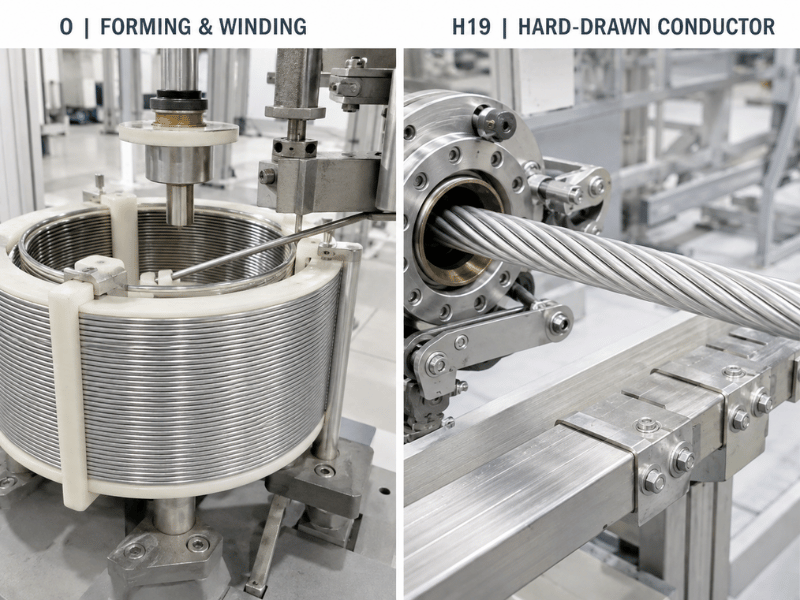
Le 1350 n'est renforcé que par écrouissage à froid (durcissement par déformation), jamais par traitement thermique. En partant de l'état O entièrement recuit, chaque étape H1x applique une réduction supplémentaire et un recuit partiel pour augmenter la résistance au détriment de l'allongement.
| Tempérer | Niveau d'écrouissage | UTS typique (MPa) | Meilleur pour |
|---|---|---|---|
| O | Entièrement recuit, mou | 60–100 | Tréfilage, bobinage, cintrages serrés |
| H12–H18 | Écrouissage progressif entre O et H19 | Augmente d'environ ~90 vers ~170 sur l'échelle | Conducteurs formés nécessitant plus de rigidité que le O |
| H19 | Écroui à fond (fil EC standard) | 150–200 | Conducteurs aériens, barres omnibus, âmes de câbles |
Le H19 est le cheval de trait commercial : c'est le temp spécifié pour le fil EC étiré à froid dans l'ASTM B230 et pour les conducteurs câblés en couches concentriques (AAC/ACSR) dans l'ASTM B231. Si l'application est un fil tréfilé, un câble câblé ou une barre omnibus, le H19 est presque toujours le choix. Le O est réservé au fil de bobinage, au tréfilage fin et aux conducteurs flexibles où la formabilité domine.
Limites Go/No-Go
Utilisez cette liste pour déterminer si le 1350 convient avant de le spécifier.
Go — utilisez le 1350 lorsque :
- La conductivité électrique maximale à poids minimal est la priorité — lignes aériennes, barres omnibus et enroulements de transformateurs ou de moteurs où 61,2 % IACS importe plus que la résistance.
- La pièce est non structurelle et formée ou tréfilée — le fil de bobinage, l'enroulement de bobines et les conducteurs flexibles tirent parti de la formabilité du temp O.
- La résistance à la corrosion en service atmosphérique ordinaire ou légèrement chimique suffit — le film d'oxyde d'aluminium pur protège les conducteurs extérieurs exposés sans revêtement.
- Un remplacement du cuivre est souhaité pour le poids ou le coût, et la conception peut accepter le rapport conductivité-cuivre inférieur de l'aluminium (~61 % vs 100 % IACS).
No-Go — n'utilisez pas le 1350 lorsque :
- Le composant supporte une charge mécanique — le 1350-H19 n'atteint qu'environ 150–200 MPa en traction, bien en dessous des nuances structurelles comme le 6061-T6 (310 MPa) ou le 6082-T6.
- La dureté ou la résistance à l'usure est requise — l'alliage est mou même à l'état H19 et grippera ou se rayera sous contact glissant.
- La température de service est élevée et la résistance doit être maintenue — comme tout aluminium, le 1350 perd une résistance notable au-dessus d'environ 150 °C, ce n'est donc pas un matériau structurel haute température.
- La pièce nécessite un filetage, une flexion répétée sous charge ou des chemins de charge usinés — sa faible limite d'élasticité et sa dureté en font un mauvais choix structurel.
Où l'aluminium 1350 est utilisé
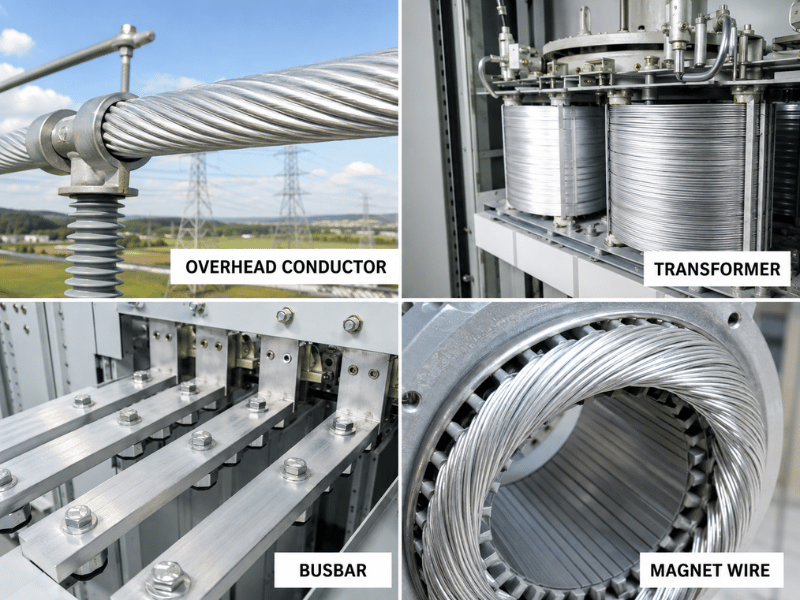
Les critères Go/No-Go ci-dessus séparent “ dois-je ? ” de “ où ? ”. La liste ci-dessous cartographie les systèmes où le 1350 est une pratique standard.
Transport et distribution d'énergie
Les conducteurs aériens constituent l'utilisation la plus importante : les lignes en aluminium pur (AAC) et en aluminium avec âme en acier renforcé (ACSR) sont construites à partir de fils 1350-H19 étirés à froid car ils transportent le plus de courant par kilogramme de toute famille de conducteurs aériens courants. Les âmes de câbles souterrains, les travaux de barres omnibus en sous-station et les enroulements de transformateurs utilisent la même conductivité de qualité EC, avec du fil en temp O là où la flexibilité lors de l'installation importe.
Fil de bobinage, enroulement de bobines et barres omnibus
Les moteurs, générateurs et transformateurs utilisent le 1350-O pour le fil de magnéto et le bobinage fin, où une formabilité extrême et la conductivité la plus élevée priment. Les barres omnibus — massives et câblées — utilisent le H19 pour la distribution rigide à courant élevé dans les appareillages de commutation et l'électronique de puissance. Pour les formes de fil de qualité EC, voir les fils en aluminium 1350-O/H19 de Linsy.
1350 vs 6061 vs 8000 — Comment choisir
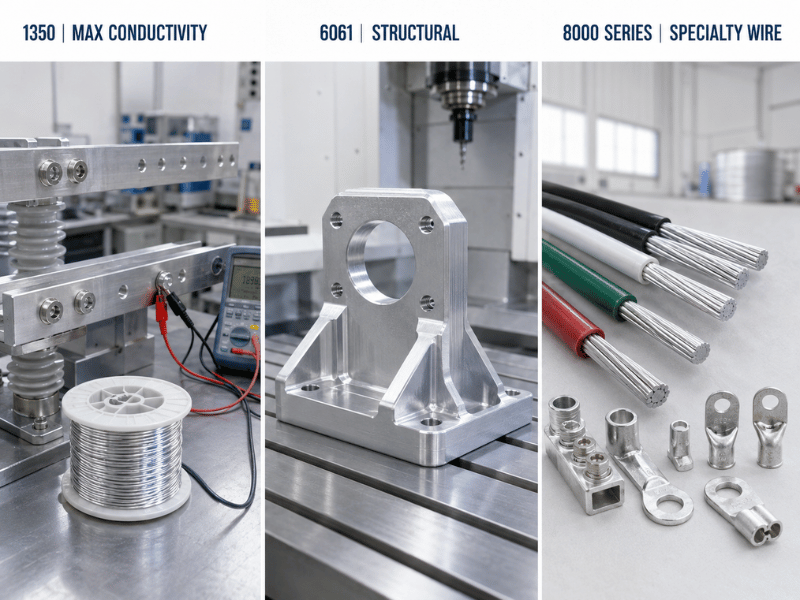
Ces trois alliages ne sont pas concurrents ; ils répondent à des questions différentes. Le 1350 est la nuance de conductivité, le 6061 est la nuance structurelle, et la série 8000 remplit des rôles de conducteurs de niche.
| Propriété | 1350 (qualité EC) | 6061-T6 | Nuances de conducteurs de la série 8000 |
|---|---|---|---|
| Rôle principal | Conductivité électrique | Résistance structurelle | Conducteurs spéciaux (certains fils de bâtiment) |
| Conductivité électrique | 61,2% IACS (min) | ~40 % IACS | Généralement inférieur à 61,2% IACS |
| Résistance à la traction | 60–200 MPa (selon l'écrouissage) | 310 MPa | ~100–200 MPa |
| Traitement thermique | Non (écrouissage à froid uniquement) | Oui (T6) | Varie selon la nuance |
| Résistance à la corrosion | Élevée (pureté) | Élevée (moins que le 1350) | Bonne, dépend de l'alliage |
| Utilisation typique | Fil, barre omnibus, bobinages | Châssis, pièces usinées | Spécifications spécifiques des conducteurs 8000 |
Choisissez le 1350 lorsque la conductivité par unité de poids est la contrainte. Choisissez le 6061-T6 lorsque la pièce doit supporter une charge et implique un soudage ou un usinage. Envisagez une nuance de la série 8000 (par exemple 8176 ou 8130 pour fil de bâtiment) uniquement lorsqu'une norme spécifique ou un avantage d'alliage — et non une conductivité plus élevée — dicte la spécification ; le 1350 reste en tête pour la performance IACS pure. Pour l'alternative structurelle, voir la page de l'alliage d'aluminium 6061.
Travailler avec l'aluminium 1350
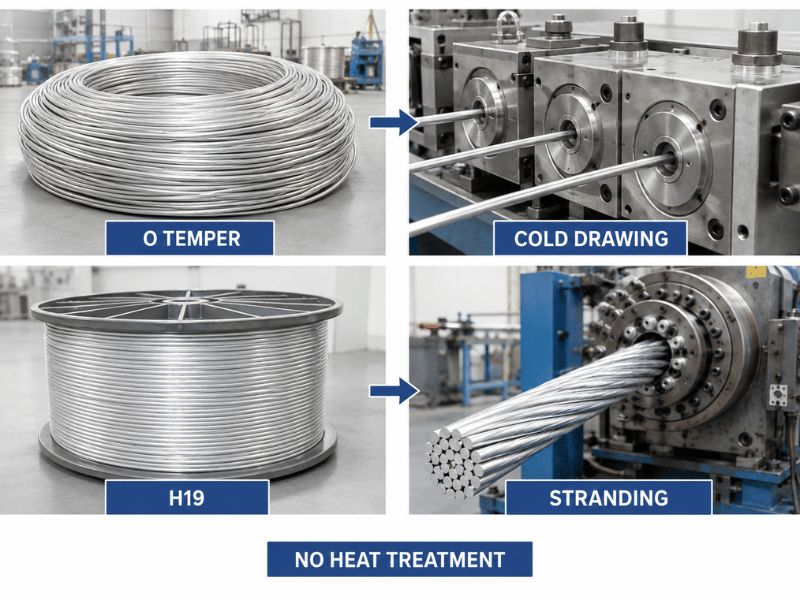
Formage et étirage : À l'état O, le 1350 est extrêmement formable — il s'étire, se plie et s'enroule sans difficulté, ce qui en fait le choix par défaut pour le fil de magnéto et les conducteurs fins. Le H19 perd la majeure partie de cette ductilité (l'allongement chute à environ 1,5%), donc formez-le avant le durcissement final ou utilisez-le tel qu'étiré.
Soudage et assemblage : Le 1350 se soude bien par les méthodes par résistance (utilisées pour l'épissage des conducteurs) et peut être assemblé par MIG/TIG avec un métal d'apport approprié, bien que le soudage soit peu courant dans la fabrication standard de conducteurs. Notez que le soudage ne traite pas thermiquement l'alliage — il n'y a pas de trempe T à restaurer.
Protection contre la corrosion : La haute pureté confère au 1350 une excellente résistance à la corrosion atmosphérique grâce à son film d'oxyde naturel, de sorte que la plupart des conducteurs extérieurs ne nécessitent aucun revêtement. Dans les environnements chlorurés ou industriels, les mêmes procédés d'anodisation, de peinture ou de gainage utilisés sur les autres nuances d'aluminium s'appliquent.
Pas de traitement thermique : Parce que le 1350 n'est pas trempable, la résistance provient uniquement de l'écrouissage à froid. Toute étape de recuit le ramène vers l'état O ; restaurer le H19 nécessite un réétirage, pas un traitement en four. Planifiez la route de fabrication en fonction de la trempe finale.
Avantages et limites en un coup d'œil
| Dimension | La force | Limitation |
|---|---|---|
| Conductivité électrique | La plus élevée de tous les alliages d'aluminium courants (≥61,2% IACS) | Encore ~61% de celle du cuivre — pas un remplacement du cuivre lorsque l'espace est fixe |
| Poids | ~1/3 du poids du cuivre pour un courant égal | La faible résistance limite l'utilisation structurelle |
| Formabilité (O) | Excellente pour l'étirage et le bobinage | Le H19 est fragile dans les pliages serrés |
| Résistance à la corrosion | Élevée grâce à la pureté, aucun revêtement nécessaire en extérieur | La surface tendre grippe sous usure par glissement |
| Coût | Moins cher et plus léger que les conducteurs en cuivre | Les faibles propriétés mécaniques restreignent les applications |
| Disponibilité | Nuance EC standard, large approvisionnement en usine | Pas une nuance de section structurelle en stock |
Conclusion
L'aluminium 1350 offre la conductivité la plus élevée de tout alliage d'aluminium corroyé courant — un minimum garanti de 61,2% IACS — mais son compromis est une faible résistance et une dureté qui l'excluent pour les pièces porteuses. Cela en fait le bon choix pour les conducteurs, les barres omnibus et les bobinages, et le mauvais choix pour tout usage structurel.
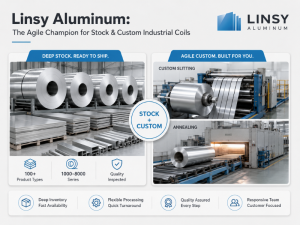
Linsy Aluminum, une usine basée à Shenzhen avec plus de 20 ans d'expérience, fournit le 1350 en fil, barre omnibus, tôle et bobine dans les séries 1000–8000, y compris le fil EC 1350-O et 1350-H19, avec documentation MTC complète par commande et rapports d'essai SGS disponibles sur demande ; le délai de livraison personnalisé typique est de 10 à 60 jours avec un support de faible MOQ pour les tailles non stock. Lorsque la spécification exige du 1350 de qualité EC, envoyez le dessin ou la spécification du conducteur pour une revue de nuance et de trempe.
Questions fréquemment posées
Quelle est la différence entre le 1350-O et le 1350-H19 ?
Le 1350-O est entièrement recuit et mou, avec un allongement de 20% ou plus — idéal pour l'étirage, le bobinage et les pliages serrés. Le 1350-H19 est écroui à froid à pleine dureté jusqu'à 150–200 MPa de résistance à la traction, la trempe standard pour les conducteurs aériens et les barres omnibus où la résistance importe plus que la formabilité. La conductivité est la même (~61,8% IACS) dans les deux cas.
L'aluminium 1350 est-il adapté aux applications structurelles ?
Non. Même à l'état H19, le 1350 n'atteint qu'environ 150–200 MPa de résistance à la traction, bien en dessous des nuances structurelles telles que le 6061-T6 (310 MPa). C'est une nuance de conducteur, pas une nuance structurelle, et elle doit être limitée aux usages électriques non porteurs.
Quelle est la différence entre l'aluminium 1350 et le 1370 ?
Les deux sont des alliages purs de qualité EC, mais le 1370 a une pureté minimale plus élevée de 99,70% d'aluminium contre 99,50% pour le 1350, offrant une conductivité légèrement meilleure. Les deux servent de conducteurs électriques ; le 1370 est spécifié lorsque l'application exige la nuance de pureté supérieure.
L'aluminium 1350 peut-il être traité thermiquement pour augmenter sa résistance ?
Non. Le 1350 n'est pas un alliage à traitement thermique — il gagne en résistance uniquement par écrouissage à froid (les tempers H1x). Le recuit le ramène vers l'état O, et la restauration de l'état H19 nécessite un réétirage, et non un cycle de four.
Quelle est la différence entre l'aluminium 1350 et l'aluminium 1050 ?
Les deux sont des alliages purs à teneur minimale de 99,5%, mais le 1350 est optimisé pour les applications électriques avec le fer et le silicium maintenus à un faible niveau pour préserver la conductivité, tandis que le 1050 est une nuance pure à usage général. Choisissez le 1350 lorsque la performance électrique est la priorité et le 1050 pour le formage et la fabrication généraux.